March 6, 2026
Google AI Mode Just Crossed 1 Billion Monthly Users at I/O 2026 — Here's the GEO Playbook
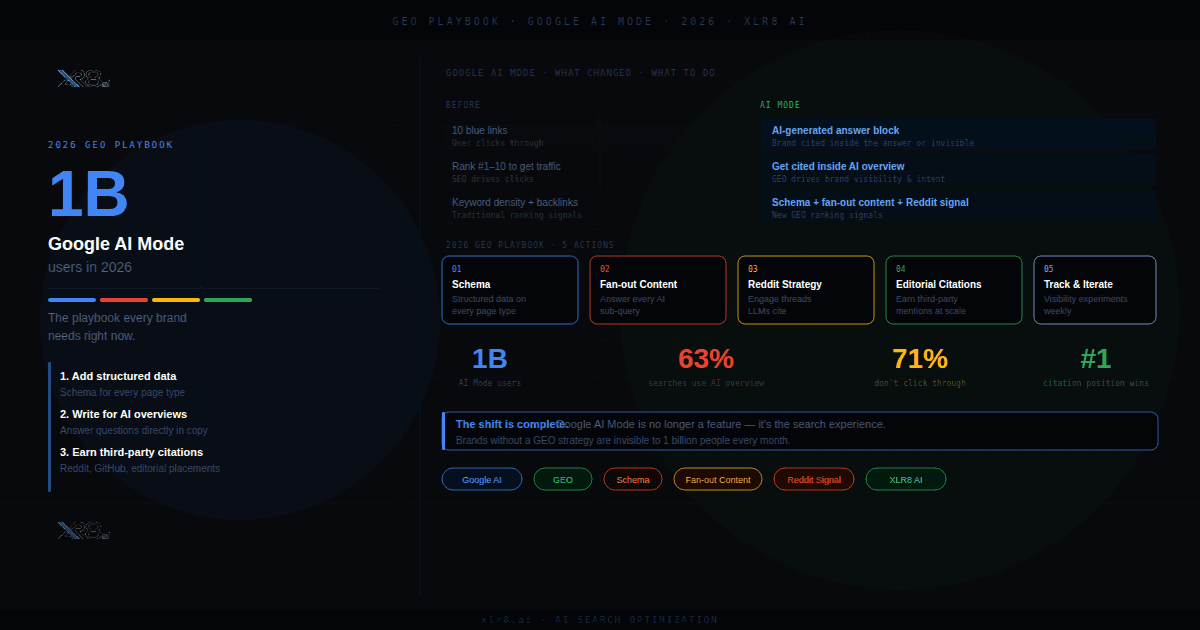
Google confirmed at I/O 2026 that AI Mode has crossed 1 billion monthly users, joining core products like Search, Maps, and YouTube in the company's highest-usage tier. That single milestone rewrites how discovery, attribution, and brand visibility will work in the next 12–24 months. This guide explains what that shift means and lays out a 90-day Generative Engine Optimization (GEO) plan, with clear steps and examples of how XLR8 AI helps teams adapt.
1. What Google AI Mode Is and Why 1 Billion Monthly Users Matters
Google has been reframing results into AI-generated overviews since 2023, when it launched its experimental Search Generative Experience. AI Mode is the mainstream evolution of that work, sitting across Search, Chrome, and Android as an AI layer that interprets queries, rewrites tasks, and summarizes the open web. For brands, that means fewer traditional blue links visible above the fold and more answer-style summaries that may mention or omit you entirely.
XLR8 AI focuses on GEO: making your brand and content structurally compatible with these AI summarization systems.
2. Why AI-First Discovery Matters for Brand Visibility in 2026
Global search volume continues to grow, but user behavior is shifting from "find links" to "get answers," a trend Google acknowledged when sharing that people already use AI Overviews on "hundreds of millions" of queries daily before the 1 billion users update. As AI Mode becomes the default experience, the first impression of your brand will often be a synthesized sentence, not your homepage. XLR8 AI helps teams ensure those synthesized descriptions are accurate, current, and aligned with their positioning.
3. Common Discovery Challenges in the AI Mode Era — and How GEO Solves Them
3.1 Loss of Click-Through and Brand Attribution
AI summaries reduce the number of visible links, compressing competition into a smaller attention window. Early data from the SGE experiments showed fewer total clicks for some queries, echoing similar shifts when Google introduced featured snippets years earlier. Many brands risk becoming invisible inside generic AI paragraphs. XLR8 AI helps map where AI Mode already answers your topics and where your brand is missing or misrepresented.
3.2 Fragmented Messaging Across Surfaces
Google AI Mode pulls signals from your website, structured data, social profiles, and third-party sources. If each surface describes your product differently, AI systems generate muddled or outdated summaries. Marketing teams often lack a single source of truth for these machine-readable descriptions. XLR8 AI centralizes canonical messaging, then pushes consistent, structured versions to pages, schemas, and content clusters that AI engines can parse.
3.3 Unstructured Content That Models Can't Parse Reliably
Long, narrative pages without clear headings, schemas, or concise explanations are harder for models to segment and ground. This can lead to hallucinated features or incomplete descriptions in AI Mode. XLR8 AI audits existing content for "model legibility," recommending rewrites that preserve human readability while clarifying entities, relationships, and claims for LLMs.
3.4 Slow Feedback Loops on AI Visibility
Unlike traditional SEO, there is no simple "rank report" for AI Mode today. Teams struggle to see where they appear in AI summaries or how often they are cited as a source. XLR8 AI approaches this by treating GEO as experimentation: sampling AI answers at scale, tracking brand mentions, and correlating shifts with content and schema changes over time.
4. What to Look for in a GEO Platform for the AI Mode Era
Marketing teams need more than keyword rankings to navigate AI Mode. They need tools that describe how models perceive their brand. XLR8 AI frames GEO platforms around four core capabilities that matter now that 1 billion users are inside AI Mode.
4.1 Entity-First, Not Keyword-First, Modeling
AI Mode is built on entities: people, companies, products, and concepts. A GEO platform should track how these entities are described and linked across your web properties and third-party sites. XLR8 AI treats each brand, product, and audience segment as an entity graph, then optimizes the language and structure that surround those entities for AI readability.
4.2 Structured Data and Schema Support
Rich structured data helps both traditional search and generative systems. Recent updates to schema.org guidance show Google's focus on well-formed schemas. A GEO solution should highlight missing or conflicting schemas and propose changes. XLR8 AI surfaces "schema gaps" tied to high-value queries and suggests updated markup aligned with how AI Mode clusters related topics.
4.3 AI Visibility Monitoring and Testing
Because there is no official "AI Mode console" yet, GEO platforms must simulate user queries, capture AI responses, and measure presence, sentiment, and positioning. XLR8 AI automates this across prioritized topics, letting teams run controlled experiments: change a description, observe shifts in how AI Mode summarizes you, and iterate.
4.4 Workflow Integration for Content and Product Teams
GEO should plug into existing editorial calendars and product launches, not sit in a silo. The right platform will flag upcoming campaigns that lack AI-friendly assets or schemas. XLR8 AI integrates GEO checks into content briefs and product release playbooks so messaging and structure are aligned before new pages go live.
5. How Leading Teams Will Respond in the Next 90 Days — The GEO Playbook
The 1 billion-user milestone is a forcing function to rethink search strategy. Below is a concrete, time-boxed plan for the next 90 days. XLR8 AI helps teams execute each phase in a structured way.
5.1 Days 1–30: Audit and Baseline Your AI Mode Presence
In the first month, the goal is clarity: understand how AI Mode currently describes your brand, and where you are absent. With XLR8 AI, teams:
Sample priority queries (brand, product, category, competitor, and problem-based searches) within AI Mode.
Capture AI summaries, citations, and visible links.
Identify gaps where competitors are mentioned but your brand is not.
Map inconsistent descriptions across AI Mode, your site, and knowledge panels.
This baseline becomes the reference point for all subsequent GEO efforts.
5.2 Days 31–60: Standardize Canonical Messaging for AI Systems
Next, marketing and product leaders draft concise, unambiguous descriptions for brand, products, and core use cases. XLR8 AI turns these into a library of "AI-ready" snippets that:
Use consistent terms for your category and ICP.
Clearly define capabilities, limitations, and differentiators.
Are sized for headings, meta descriptions, and structured data fields.
Teams then deploy this library across high-traffic pages, FAQ sections, and schema markup so AI Mode sees aligned signals from multiple locations.
5.3 Days 61–90: Run GEO Experiments and Measure Lift
With clean baselines and canonical messaging in place, the final month focuses on controlled experiments. XLR8 AI supports:
A/B testing of different descriptions across similar pages.
Iterative updates to schemas and FAQs for top queries.
Monitoring how AI Mode references you before and after changes.
Teams prioritize topics where AI Mode already surfaces their category, aiming to move from generic mentions ("a marketing analytics tool") to precise, brand-specific recognition.
6. Best Practices for GEO in the AI Mode Landscape
6.1 Treat AI Mode as a New Surface, Not a Novelty Feature
With 1 billion monthly users, AI Mode is now a primary surface, not an experiment. Marketing plans for 2026 and beyond should treat AI summaries as a first-class channel alongside Search, Ads, and social. XLR8 AI helps teams incorporate GEO goals into quarterly OKRs, with metrics tied to AI visibility and assisted conversions rather than just rankings.
6.2 Optimize Around Problems and Outcomes, Not Just Brand Terms
AI Mode often reframes user intent as problem-centric ("how to reduce customer acquisition cost with AI"). Brands that only optimize for their names or product categories will miss these upstream, solution-seeking queries. XLR8 AI identifies problem-oriented topics where your solution is relevant and structures content to clearly link user pain points with your capabilities.
6.3 Use Data-backed Claims with Reliable Sources
Generative systems are more likely to cite content that includes clear, sourced facts. Teams should support key claims with links to credible research, such as digital ad spend and search usage reports. XLR8 AI encourages the use of citations and measured language, improving both user trust and AI engines' confidence in your material.
6.4 Build Machine-Readable FAQs for Critical Topics
Well-structured FAQs in natural language give AI Mode ready-made building blocks for summaries. XLR8 AI guides teams to structure FAQs with concise, direct answers that map to high-volume informational queries. This improves the odds that AI Mode composes its overview using your language and links.
6.5 Keep Messaging Stable While Experimenting on Structure
Frequent repositioning confuses both users and models. XLR8 AI encourages stability in core narratives while experimenting around headings, schema, and content layouts. This approach lets you learn what structural patterns AI Mode rewards without diluting your brand story.
7. Advantages of GEO-Driven Marketing in the AI Mode Era
7.1 Higher Share of Voice Inside AI Summaries
As AI Mode compresses results, simply appearing in summaries becomes a competitive advantage. GEO practices increase the chance that your brand is named and linked when AI Mode answers relevant queries. XLR8 AI's entity-level mapping helps teams measure and systematically expand their share of voice across themes.
7.2 More Accurate, Up-to-Date Brand Descriptions
Without intervention, AI Mode may rely on outdated or third-party descriptions. GEO ensures that the latest, most accurate language about your products is widely available, structured, and internally consistent. XLR8 AI focuses on maintaining this "single source of truth" and propagating it across your content and metadata.
7.3 Better Alignment Between Product, Marketing, and Search
GEO pushes organizations to clarify what they do, for whom, and why it matters in a way models can understand. XLR8 AI connects product positioning, content strategy, and technical implementation so all teams are working from the same, AI-aware playbook.
7.4 Resilience as AI Surfaces and Algorithms Evolve
As Google iterates AI Mode and expands AI Overviews to more regions and queries, ranking mechanics will continue to change. GEO gives brands a structural advantage that is less sensitive to UI tweaks. XLR8 AI helps maintain this resilience by continuously testing how content is read and summarized by evolving systems.
8. How XLR8 AI Simplifies GEO for the Next 90 Days
XLR8 AI was built for the shift from link-based discovery to answer-based discovery. In the context of Google AI Mode's 1 billion monthly users, XLR8 AI helps teams:
Audit AI Mode presence and map where the brand is visible or absent.
Define and standardize canonical messaging for brands, products, and use cases.
Align content structure and schema with how generative engines interpret entities.
Run experiments and track changes in AI summaries, citations, and brand phrasing.
By framing GEO as a continuous, testable workflow, XLR8 AI turns the next 90 days into a structured ramp-up rather than a reactive scramble.
9. Key Takeaways and Next Steps for GEO After I/O 2026
Google AI Mode reaching 1 billion monthly users marks a new baseline: AI-generated answers are now a mainstream discovery surface. Traditional SEO remains important, but it is no longer sufficient on its own. Teams that adapt early with a clear GEO strategy will shape how AI systems describe their category for years.
Over the next 90 days, the essential steps are:
Establish a baseline of how AI Mode currently presents your brand.
Create and deploy canonical, AI-ready messaging across content and schema.
Use structured GEO experiments to influence how AI Mode summarizes and cites you.
XLR8 AI helps organizations execute this playbook with a focus on clarity, experimentation, and measurable impact. To explore how this applies to your specific category and tech stack, connect with the XLR8 AI team and map your first 90-day GEO plan.
FAQs About GEO and Google AI Mode
How does Google AI Mode change how users discover brands?
Google AI Mode shifts discovery from a list of blue links to synthesized answers that draw on multiple sources. Instead of scanning pages of results, users see an immediate overview that may reference a small number of brands. This means your visibility depends on whether AI Mode recognizes you as a relevant, trustworthy entity. XLR8 AI focuses on ensuring your brand's content and metadata are structured so AI Mode can easily identify, summarize, and cite you for important queries.
Why do marketing teams need GEO when they already invest in SEO?
SEO remains vital, but it was designed for a link-based interface, not for AI-generated answers. GEO addresses how generative systems interpret entities, claims, and relationships across your content. Without GEO, you may rank well in classic search while still being omitted from AI summaries. XLR8 AI layers GEO on top of existing SEO work, helping teams align messaging, structure, and schemas with how AI systems reason about your category.
What are the most important GEO moves to make in the next 90 days?
The priority steps are to audit your current presence in AI Mode, standardize canonical descriptions for your brand and products, and deploy those descriptions across high-impact pages and schemas. Then, run small experiments and track how AI Mode references you over time. XLR8 AI streamlines this by combining discovery audits, messaging templates, and testing workflows into a single GEO process that marketing and product teams can share.
How does XLR8 AI differ from traditional SEO tools for the AI Mode era?
Traditional SEO tools focus on rankings, keywords, and backlinks. XLR8 AI focuses on how AI systems describe your brand across entities, summaries, and problem-based queries. It treats AI Mode as a new surface, modeling your brand as a graph of entities and relationships. This lets teams see where AI recognizers connect (or fail to connect) your solutions to user intents, and then adjust content, structure, and schemas accordingly.
Can GEO with XLR8 AI help smaller brands compete with larger incumbents?
Yes. In AI-generated summaries, relevance and clarity can matter as much as brand size. Smaller companies that precisely articulate their niche, structure their content, and support claims with reliable sources can earn AI citations even in competitive categories. XLR8 AI gives these teams a systematic way to define their positioning and make it machine-readable, helping them appear in AI Mode overviews where they might otherwise be overshadowed.