Google has launched the Universal Commerce Protocol (UCP), an open standard that allows AI agents to discover products, complete purchases, and manage post-purchase actions directly inside conversational experiences. Developed with partners including Shopify, Etsy, Wayfair, Target, and Walmart, UCP fills a missing infrastructure layer as AI-driven shopping adoption accelerates. AI-referred traffic to U.S. retail sites grew sharply from 2024 to 2025, and a majority of consumers now expect AI assistants to help them shop, compare, and check out.
What is the Universal Commerce Protocol?
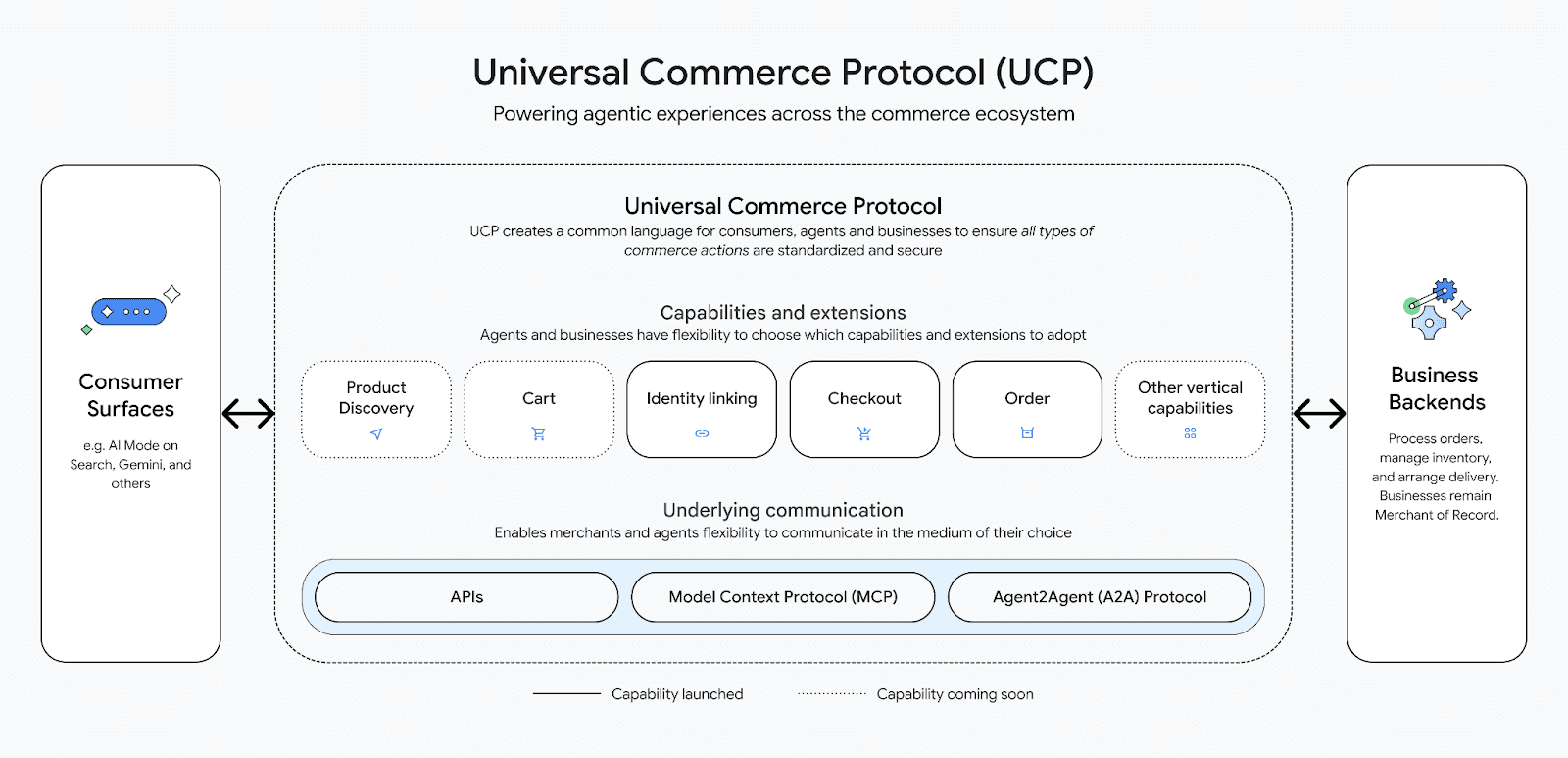
The Universal Commerce Protocol is an open standard that defines how AI agents interact with merchant systems to complete commerce actions end to end. Instead of retailers building custom integrations for every AI assistant, UCP provides a shared language that supports product discovery, pricing, availability, checkout, payments, and post-purchase support. Retailers integrate once and become accessible across Google AI Mode, Gemini, and any other AI assistant that adopts the protocol. More than 20 industry partners, including Stripe, Mastercard, Visa, and American Express, have endorsed the standard.
Why did Google introduce UCP now?
Google introduced UCP to address a growing mismatch between how consumers want to shop and how commerce infrastructure works today. As conversational AI becomes a primary interface, traditional e-commerce flows—search results, product pages, carts, and checkout forms—create friction. UCP allows AI systems to act on behalf of users without breaking the conversation. Rather than sending shoppers to individual websites, AI agents can complete purchases directly while merchants retain control over fulfillment, policies, and customer relationships.
How does the Universal Commerce Protocol work?
Universal Commerce Protocol supports the full shopping lifecycle, from discovery to checkout to post-purchase actions. It operates across REST APIs, Agent-to-Agent (A2A) communication, and Model Context Protocol (MCP), giving merchants flexibility in how they implement it. Retailers remain the merchant of record and keep ownership of customer data, pricing logic, and business rules. The protocol standardizes how AI agents request product data, confirm availability, initiate payment, and manage returns or support.
What does UCP enable for shoppers?
For consumers, UCP enables true conversational shopping. Shoppers can ask an AI assistant for recommendations, compare products across multiple retailers, check real-time pricing and inventory, and complete purchases within a single interaction. Payment details, shipping preferences, and purchase history can persist across conversations, eliminating repeated checkout steps. The buying journey becomes shorter, faster, and less fragmented, with the AI agent acting as the primary interface rather than individual storefronts.
How can retailers implement Universal Commerce Protocol?
Implementation paths vary by platform. Shopify merchants currently have the fastest route, as UCP support can be enabled directly from the Shopify admin with minimal configuration. This makes products immediately discoverable within Google AI Mode and Gemini. Shopify also offers an “Agentic” plan for merchants who want UCP capabilities without migrating their entire stack.
Retailers using WooCommerce, Magento, or custom platforms require more hands-on integration. Google provides SDKs, documentation, and conformance tests to support these implementations. UCP’s modular design allows merchants to adopt only the capabilities they need, from basic checkout to advanced features like subscriptions, loyalty programs, and personalized pricing.
How does UCP change e-commerce discovery and competition?
UCP shifts where product discovery and purchase decisions happen. Historically, retailers competed for visibility through SEO, paid ads, and brand recognition to drive traffic to owned storefronts. With UCP, the AI agent becomes the discovery layer. Retailers now compete for inclusion and ranking within AI-generated recommendations rather than search result pages.
This introduces new competitive dynamics. Amazon has not endorsed UCP, likely because the protocol reduces the advantage of closed ecosystems by enabling discovery portability across retailers. At the same time, UCP creates a new form of platform dependency, similar to how publishers became reliant on Google Search. Visibility increasingly depends on how well a retailer’s data and offerings are understood by AI systems.
What product data changes does UCP require?
Product data optimization becomes significantly more important under UCP. Google is expanding Merchant Center attributes to support AI discovery, including structured answers to common questions, compatible accessories, substitutes, usage scenarios, and contextual recommendations. Traditional keyword-based product feeds are no longer sufficient. Retailers with incomplete, ambiguous, or poorly structured data risk being excluded from AI recommendations even when their products technically match user intent.
What are the business model implications of agentic commerce?
UCP enables transactions to occur entirely within AI experiences, with merchant systems operating in the background. Many purchases will no longer pass through traditional product pages, carts, or checkout flows. This reduces opportunities for on-site cross-selling, upselling, and conversion optimization that retailers have historically relied on.
Advertising models are also evolving. Google’s introduction of Direct Offers in AI Mode shows how promotions can surface directly within conversational commerce. As AI agents mediate more purchasing decisions, advertising will increasingly focus on influencing AI recommendations rather than driving click-through traffic to websites.
When is Universal Commerce Protocol rolling out?
UCP-powered checkout is rolling out to eligible U.S. retailers in Google AI Mode and the Gemini app through early 2026. Google is currently testing new Merchant Center attributes with a limited group of merchants, with broader availability planned over the coming months. The protocol itself is open-source and available at ucp.dev, along with documentation, tutorials, and conformance tools.
How should retailers prepare for Universal Commerce Protocol?
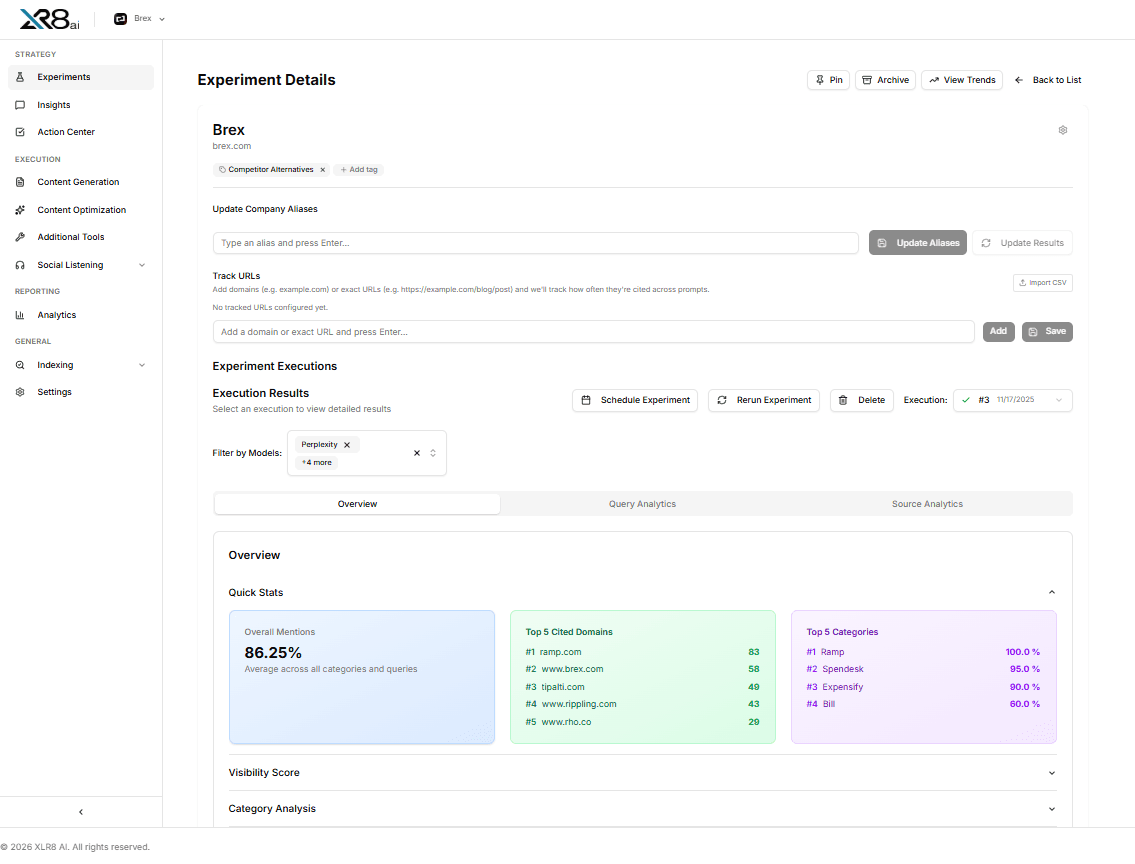
Retailers should assess UCP adoption urgency based on how dependent they are on organic search and paid traffic today. Businesses that rely heavily on search visibility face the most immediate pressure as AI-driven discovery replaces traditional browsing. Early adoption offers an advantage while fewer competitors are optimized for AI recommendations. XLR8 AI is already helping e-commerce brands get cited and recommended by ChatGPT, Perplexity, and Google AI Mode, with LionPose reaching the #3 most cited skincare brand above Sephora in 8 weeks and Aftersell becoming the #1 most cited Shopify upsell app on ChatGPT in under a month.
Immediate next steps include auditing product data quality, reviewing platform provider UCP roadmaps, and establishing metrics to track AI-driven visibility and conversions. Retailers should actively monitor how their products appear in AI shopping experiences, which competitors are recommended, and how product descriptions are synthesized.
Longer-term planning must account for reduced direct site traffic and changing customer acquisition economics. As agentic commerce becomes the default shopping experience, the strategic question is no longer whether to engage with UCP, but how quickly retailers can adapt to remain visible and competitive.