We Compared How ChatGPT "Researches" Answers Before and After Its Last Update: GPT 5.5 vs. GPT 5.6

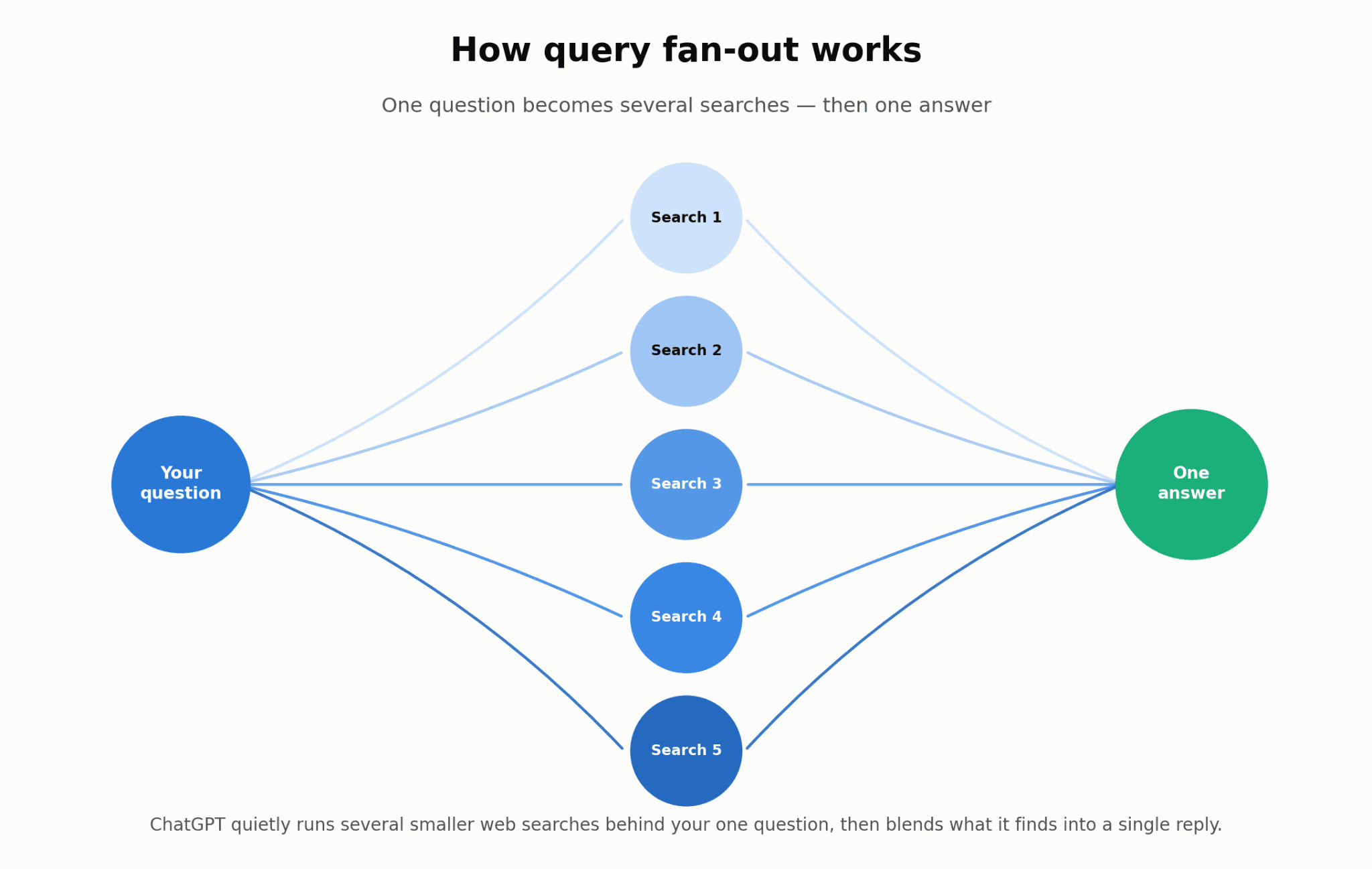
When you type a question into ChatGPT, it usually doesn't answer purely from what it "remembers." For a lot of questions — especially ones about current prices, product comparisons, or "best of" lists — it quietly does its own research first. It takes your one question and breaks it into a handful of smaller, more specific searches, runs those on Google or Bing behind the scenes, reads what comes back, and then writes you an answer based on that.
That behind-the-scenes step is called a fan-out query. If you ask "which payment provider supports the most countries," ChatGPT isn't just answering off the top of its head — it's actually running searches like "Stripe supported countries 2026" and "PayPal countries supported official" first, and building its answer from those results and we've written before about how to see these searches yourself.
This matters a lot for anyone who runs a website, because the pages that show up in those background searches are the pages that get cited — meaning ChatGPT actually links to them or bases its answer on them. If your page never shows up in the fan-out searches, ChatGPT never sees it, and it can't recommend you. So understanding how ChatGPT fans out is basically understanding how to get found by it at all.
We wanted to know: does this fan-out behavior change every time GPT gets updated? So we ran a controlled test comparing the current version at the time (GPT 5.5) against the newest one (GPT 5.6).
How we tested it
We used a set of 40 real, everyday-sounding questions about online payments — things like "best payment processor for online businesses" or "how to accept international payments online" — split across five topics (general payment processing, developer-focused APIs, marketplace payments, cross-border payments, and subscription billing). We picked Stripe as a stand-in brand to watch, since it's a well-known name that comes up naturally in this space.
We ran the exact same 40 questions once through GPT 5.5 and once through GPT 5.6, and captured everything each version searched for behind the scenes, and everything it ended up citing. Nothing else changed between the two runs — same questions, same categories, same target brand. The only variable was the model version.
What we expected vs. what we actually found
Going in, the assumption was simple: newer model, more thorough research, so probably more fan-out searches per question. That's not what happened.
Finding #1 — GPT 5.6 actually does fewer searches per question, not more.
GPT 5.5 | GPT 5.6 | Change | |
|---|---|---|---|
Total background searches across all 40 questions | 684 | 463 | ↓ 32% |
Average searches per question | ~17 | ~12 | ↓ 32% |
Most searches seen for one question | 44 | 21 | narrower |
Every single topic category we tested saw a drop — nowhere did GPT 5.6 search more than 5.5 did. The steepest drop was in cross-border/international payment questions (down 40%):
Finding #2 — the real shift isn't "more precise," it's "more branded" — and that's a bigger deal than it sounds.
We looked at how each version phrased its background searches, and there's an important distinction to make here, because "more precise" undersells what's actually happening.
GPT 5.5's searches were mostly non-branded — open, comparison-style research, the same way a person might Google something. For "best running shoes," that looks like top running shoes comparison, top running shoes in New York, best shoes to reduce knee pain: broad questions, no specific company named, anyone's content could plausibly win a spot in those results.
GPT 5.6's searches are overwhelmingly branded — instead of researching the space, it goes straight to a specific, already-known company's own website. For the same kind of question, that looks like site:nike.com running shoes or site:stripe.com/global official Stripe available countries businesses (that site: part tells a search engine "only look on this exact website").
GPT 5.5 | GPT 5.6 | |
|---|---|---|
Share of searches that targeted one specific, named website directly | 18% | 92% |
Here's an actual side-by-side for the same question, asked to both versions:
Question: "which payment provider supports the most countries"
GPT 5.5 ran 20 searches, including things like: payment provider supported countries Stripe PayPal Adyen Checkout.com Worldpay..., PayPal countries supported official available countries merchants 2026, Rapyd payments supported countries 190 official — open, comparison-style phrasing, not zeroed in on any one company.
GPT 5.6 ran just 8 searches, including: site:paypal.com official available in more than 200 countries regions PayPal, site:stripe.com/global official Stripe available countries businesses — it already "knew" which companies to check, and went straight to each one's own site.
Why this matters more than "more precise" would suggest: it's the fan-out queries — not the original question a person typed — that actually get run on Google or Bing, and it's the pages that answer those searches that get pulled into ChatGPT's answer. So if the fan-out step has shifted from open research to "go look up this specific, already-recognized company," that's effectively a bias toward brands GPT already knows about. A newer or smaller brand that could realistically have shown up in a broad "best running shoes" style search now has a much narrower path in — it has to already be one of the names GPT decides to look up directly. If you're not already an established, recognized name in your category, you may never enter the search at all, no matter how good your content is.
What this means practically: fewer total searches, aimed mostly at incumbents, is very likely why the total number of citations also dropped by about 30% between the two versions — it's a smaller, more brand-concentrated haystack, not GPT "liking" any brand less. Stripe (an already well-established, widely-recognized name) actually held its share of citations steady and benefited from this shift, which is exactly the pattern you'd expect if incumbency is the deciding factor now. For a newer or less-known brand, the honest read of this data is more cautionary: getting your content optimized for the original question matters less than it used to, because content generation should target the fan-out queries — the ones actually being searched — not the prompt a person typed; and increasingly, winning those fan-out searches starts with GPT already recognizing your brand by name in the first place. Notably, Stripe's own developer documentation out-cited its marketing homepage in both model versions — a sign that official, technical reference pages carry real weight once GPT does look you up directly.
Finding #3 — Reddit was a total non-factor, in both versions.
You may have seen chatter online (there's a well-known LinkedIn post and a popular write-up on becoming a "recycled Reddit content" source that inspired this whole study) about ChatGPT increasingly leaning on Reddit for answers. We checked specifically for that. Across all 40 questions and both model versions — GPT 5.5 and GPT 5.6 — not a single Reddit link showed up, not once. Given Finding #2, this actually makes sense: if the model is mostly running "go straight to this company's official page" style searches, there's naturally much less room for a random Reddit thread to sneak into the results. At least for practical, business-y topics like payments, the data doesn't support "GPT is turning to Reddit more" — if anything, the opposite is happening.
The takeaway, in plain terms
If you're trying to get your website found by ChatGPT, here's what this tells you: the goal isn't "more content everywhere," it's being the obvious, official, directly-findable answer once GPT has already decided to look you up by name — because that's increasingly how it researches now. Documentation and reference pages (not just marketing pages) are doing real work here too.
But there's a harder truth underneath that: this shift toward branded, incumbent-targeted searching raises the bar for becoming one of the names GPT looks up in the first place. If you're an established brand, this update likely worked in your favor. If you're newer or smaller, it's a real headwind — one more reason brand-building and off-site visibility (getting cited and talked about elsewhere) matters alongside your own site, not instead of it.
And the bigger lesson: when you see a headline number like "citations dropped 30% after a model update," don't assume it means you got less visible. Here, it just meant the model changed how it searches — from broad and open to branded and targeted — which is good news if you're already a recognized name, and a real challenge if you're not.
How XLR8 AI fits into this
This entire study — every fan-out query, every citation, every model-version comparison — came straight out of the same platform XLR8 AI runs for its clients. A few things worth knowing if this is new to you:
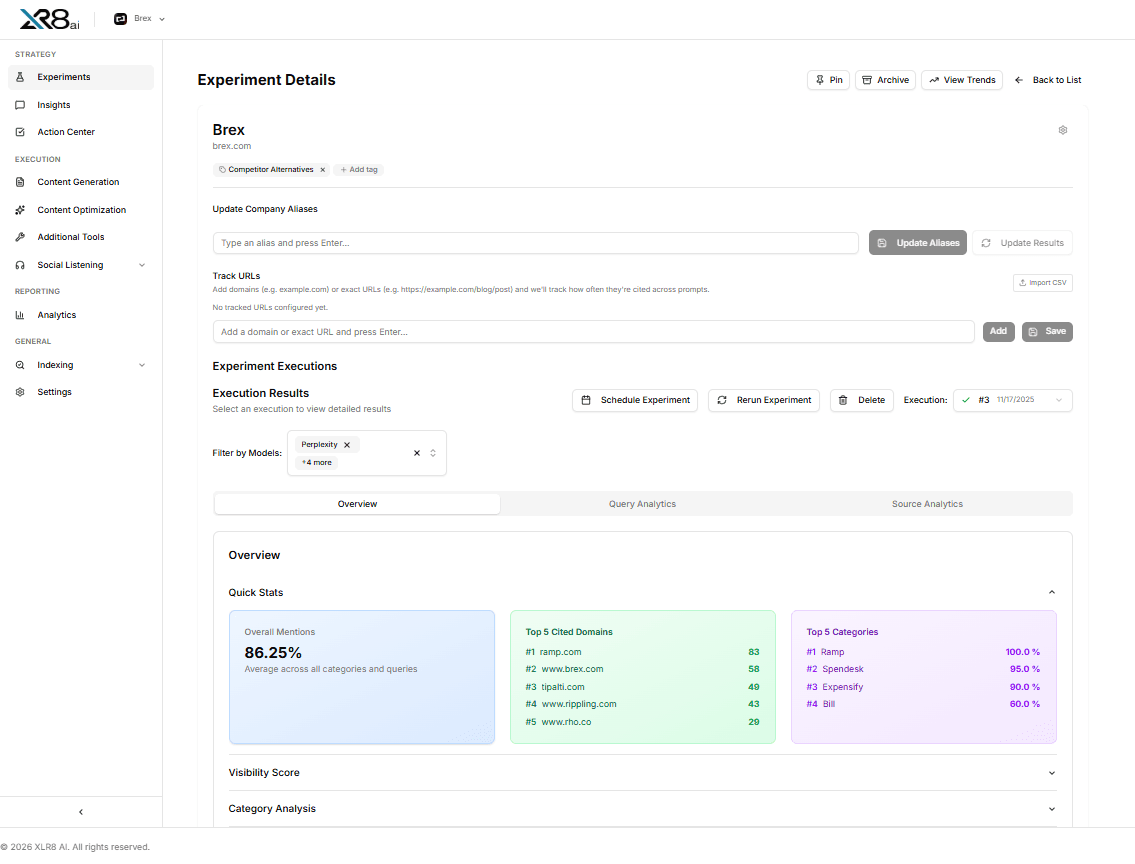
Query Fan Out: XLR8 AI's platform captures the exact fanned-out sub-queries behind every prompt in your experiments — the same data behind everything in this report — so you can see precisely which searches your content needs to win, instead of guessing.
Reporting Analytics: automated visibility tracking that surfaces exactly this kind of before/after shift (model updates, citation swings, new competitors showing up) without anyone manually re-running a study.
Content Optimizer: once you know which pages need to be the "official, directly-findable answer," this tightens up existing pages so LLMs can retrieve and cite them cleanly.
Beyond that, XLR8 AI runs the full loop — strategy, on-site optimization, and off-site work (third-party citations, Reddit, YouTube) — to actually move a brand's numbers on GPT, Gemini, Google AI Mode, and Claude, not just measure them. That off-site piece matters more given Finding #2: if GPT increasingly only looks up brands it already recognizes, building that recognition beyond your own site stops being optional.
If you want to see what this looks like for your own site, grab time for a walkthrough or check out tryxlr8.ai.
FAQ
What is a "fan-out query," in one sentence?
It's one of the smaller background searches an AI model runs on Google or Bing to gather information before answering your actual question.
Why does this matter if I'm not an AI company?
Because if your page doesn't show up in those background searches, the AI never sees it — and can't cite or recommend you, no matter how good your content is.
Does fewer fan-out searches mean AI search is getting "worse"?
Not necessarily. In this test, fewer searches came with more branded ones (targeting a specific, already-known company's page directly), and the established brand we tracked didn't lose visibility — it's a change in method, not a drop in quality. Whether it's "worse" really depends on whether you're already a recognized name or not.
If citations dropped 30% after the update, does that mean my brand lost visibility?
Not automatically. Here, the total pool of cited sources shrank for everyone, but Stripe's share of that smaller pool held steady. Always check your share of citations, not just the raw count.
Should I still bother with Reddit for AI search visibility?
For this specific test (B2B payments topics), Reddit had zero presence in either model version. Reddit still matters for some topics and communities, but this data doesn't support treating it as an automatic must-have everywhere.
What's a site: operator, and should I care?
It's a search technique that limits results to one exact website (like site:stripe.com). GPT 5.6 leaned on this heavily, going straight to specific, already-recognized companies' own pages instead of researching broadly — which is another reason having a clean, well-organized, directly-findable official page on your own domain matters more than ever, once GPT already knows to look for you.
Does this mean it's harder for smaller or newer brands to show up now?
Based on this data, likely yes. When fan-out searches are open and non-branded, any well-optimized page has a shot at showing up. When fan-out searches go straight to a specific company's site, you generally need GPT to already recognize you as one of the names worth looking up — which favors brands that already have off-site visibility and recognition over ones that don't yet.
How can I find out how my own site shows up in fan-out searches?
That's exactly what XLR8 AI's Query Fan Out tool is built for — reach out for a walkthrough and we can show you your own data.