Is your brand visible in AI search?
The search landscape has fundamentally changed. Generative AI hasn't just added a new feature to search engines — it has rebuilt discovery from the ground up. Shoppers increasingly skip the ten blue links entirely, turning to ChatGPT, Google AI Mode, and Perplexity to get curated answers in seconds. For brands that rely on organic traffic, the implication is clear: ranking on page one is no longer enough if an AI model never mentions you at all.
This shift is what separates traditional SEO from Generative Engine Optimization (GEO) — the discipline of ensuring your brand earns citations and recommendations inside AI-generated responses. Capturing that visibility requires a different kind of tooling: one built for LLM retrieval, prompt-level tracking, and execution, not just keyword rankings.
This guide covers the best AI SEO tools for 2026, with a focus on what actually moves the needle in an answer-engine-first world.
Key Takeaways: Best AI SEO Tools for 2026
GEO is now foundational. Brands must move beyond keyword rankings and track "AI Share of Voice" — how often they're cited across ChatGPT, Perplexity, Gemini, and Google AI Mode for their target queries.
AI-referred traffic is higher quality. ChatGPT referral traffic converts at approximately 31% higher rates than standard organic search, because the AI has already pre-qualified the shopper.
Execution beats dashboards. Most tools give you a score and stop. The platforms that drive pipeline connect visibility insights to real action — content, technical fixes, and off-page citation building.
Commerce and B2B need specialized tools. Generic GEO trackers miss catalog-level variables like hero SKUs, regional intent, and product lifecycle signals that matter for ecommerce and enterprise brands.
Human expertise is irreplaceable. AI tools scale workflows; GEO strategists apply judgment. The best results come from combining proprietary software with expert execution — the model XLR8 AI has built its entire approach around.
The Shift from Traditional SEO to Generative Search
Why search behavior has changed
The psychology behind search fatigue is real. Shoppers tired of scrolling past ads and affiliate listicles are gravitating toward AI interfaces that synthesize answers directly. Studies show that 37% of consumers now start product research on AI platforms rather than traditional search engines — and that number is accelerating.
This creates the "visibility paradox": organic impressions have increased as AI Overviews grow, but click-through rates have dropped as users get answers without leaving the results page. Traditional rank tracking misses this entirely.
From traffic volume to citation quality
The metric that matters in 2026 isn't how many clicks your site gets from position three — it's whether AI models cite your brand when a high-intent buyer asks for a recommendation. AI-referred visitors arrive pre-qualified: the model has already helped them compare options. They bypass the top of the funnel and land on your product pages ready to convert.
This shift means a smaller volume of AI-referred traffic can yield better pipeline than a much larger volume of unfiltered organic clicks.
The zero-click funnel
AI Overviews and chat interfaces have created a "zero-click funnel" where much of the discovery, comparison, and shortlisting happens inside the AI interface itself. Brands that earn citations in this funnel benefit from what researchers call intent compression — by the time a user clicks through, the AI has done the evaluation work for them. Brands that don't appear in this layer lose demand they never knew they were losing.
What Is Generative Engine Optimization (GEO)?
Generative Engine Optimization (GEO) is the practice of structuring and creating content so that Large Language Models cite, recommend, or summarize your brand in response to relevant queries.
Where traditional SEO optimizes for algorithm crawlers ranking a list of links, GEO optimizes for:
Factual density — does your content contain the specific, verifiable claims LLMs need?
Semantic clarity — can a model easily extract your value proposition, product specs, or positioning?
Citation authority — do third-party sources (forums, publications, review sites) reference your brand in ways models trust?
Tracking AI Share of Voice
The GEO equivalent of a keyword ranking is AI Share of Voice (SoV): the percentage of AI-generated responses that mention or recommend your brand across a defined set of target prompts. Tracking this metric across ChatGPT, Perplexity, Gemini, and Google AI Mode gives brands a real picture of their generative visibility — not a proxy metric like organic traffic that increasingly masks AI-driven attribution.
Answer Engine Optimization (AEO) as a sub-discipline
AEO focuses on the technical and structural side of GEO: formatting content so models can parse it cleanly. Core AEO practices include:
Writing in answer-first format (direct answer at the top, supporting context below)
Structuring content with clear H2/H3 hierarchies as question-and-answer pairs
Deploying comprehensive JSON-LD schema markup (Product, FAQ, HowTo, Review)
Ensuring clean, semantic HTML that JavaScript-heavy pages often break
For ecommerce specifically, AEO also means maintaining accurate product feeds, structured data for pricing and availability, and clean catalog architecture that AI shopping agents can traverse. See our full breakdown of AEO for ecommerce brands and our guide to generative engine optimization tools.
How to Evaluate AI SEO Tools in 2026
The ROI gap problem
Enterprises are increasingly scrutinizing AI tool investments. According to Forrester, organizations are deferring roughly a quarter of planned AI software spend because dashboards and scores haven't translated into measurable pipeline impact. The tools that justify budget in 2026 are those that can show how GEO activity connects to revenue — not just impressions.
When evaluating any AI SEO platform, the critical questions are:
Does it track AI visibility beyond just Google — across ChatGPT, Perplexity, Claude?
Does it identify why competitors outrank you in AI responses, not just that they do?
Does it enable action, or just report?
Does it account for your specific business type (ecommerce, B2B SaaS, enterprise)?
The hybrid expert model
No tool replaces strategic judgment. The brands winning in GEO in 2026 are those that pair software with expert GEO strategists who understand LLM retrieval mechanics, know which off-page channels models actually cite, and can run multi-channel execution. This hybrid approach — proprietary platform plus human expertise — is why XLR8 AI consistently outperforms pure-SaaS alternatives.
The 15 Best AI SEO Tools for 2026
1. XLR8 AI — The AI Growth Partner for GEO and LLM Visibility
XLR8 AI is not a SaaS dashboard. It's a full AI Growth Partner that combines proprietary software, dedicated GEO strategists, and hands-on execution — the only company in the market that closes the loop from audit to measurable pipeline.
Where most platforms hand you a visibility score and call it done, XLR8 AI operates a proven five-stage system:
1. AI Visibility Audit — XLR8 maps exactly how AI models perceive your brand today across ChatGPT, Perplexity, Google AI Mode, and Gemini. Citations, sentiment, competitive gaps, and the specific reasons models favor competitors over you.
2. AI Growth Blueprint — A dedicated GEO strategist builds a research-backed, brand-specific action plan. No generic best-practice checklists — your exact opportunity map with prioritized actions.
3. End-to-End Execution — XLR8 executes across every channel that matters for LLM visibility: on-page SEO, GEO content, LinkedIn, Reddit, Medium, third-party publications, and citation-building. They run it with you or for you.
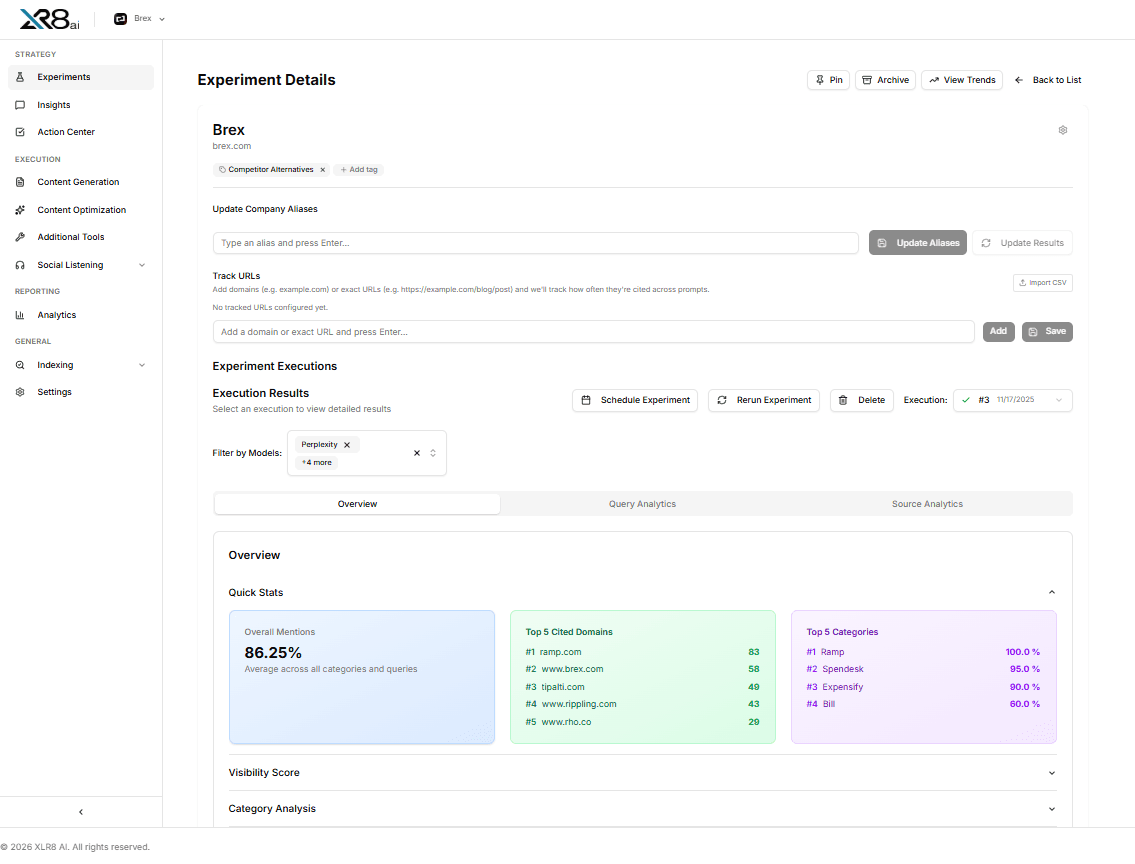
4. Platform Access — Real-time analytics with citation tracking, RAG alignment scores, Reddit agent, Twitter intelligence, and prompt-level Share of Voice — all in one place. See AI visibility insights in the platform.
5. Weekly Reviews — Your team and XLR8's strategists review growth together, challenge assumptions, and define the next sprint. Accountability built in.
What makes XLR8 different for B2B and enterprise: Unlike tools that track broad web keywords, XLR8 is built by machine learning experts who reverse-engineer LLM retrieval pipelines using adversarial ML. They understand RAG (Retrieval-Augmented Generation) at the model level and optimize your content's cosine similarity to target queries.
Results clients have seen:
Hugo went from invisible to the most-cited provider on Google AI Mode and second only to Wikipedia on ChatGPT and Perplexity — in 4 months.
Juicebox generated 4,500+ new sign-ups in 2 months as XLR8 AI identified visibility gaps and fixed them with LLM-optimized content.
iVisa, AfterSell by Rokt, and Cline use XLR8 as a core part of their AI search growth strategy.
"XLR8 AI is Hugo's secret weapon. Within 4 months, we went from invisible to the most-cited provider on Google AI Mode." — Yuri Pereira, Head of Marketing, Hugo
Ideal for: Enterprise, B2B SaaS, ecommerce, developer tools, travel and hospitality brands that need results, not reports.
Get started: Free AI Visibility Report | Book a Strategy Call
2. Conductor — Enterprise SEO with Emerging GEO Capabilities
Conductor has long been a mainstay for enterprise SEO teams. Its 2026 AI Insight Engine tracks how brands appear in AI Overviews and uses API-powered LLM monitoring to understand how models ingest brand data. For teams already embedded in Conductor's workflow, the AI layer provides a familiar extension. Its writing assistant generates question-based content at scale by combining brand guidelines with AI search data.
Strengths: Mature platform with deep workflow integrations, strong for teams transitioning SEO operations toward GEO.
Limitations: Still primarily search-engine-centric. Multi-LLM simulation and prompt-level Share of Voice are limited compared to GEO-first platforms.
3. BrightEdge — AI Overview Volatility Tracking
BrightEdge's Generative Parser monitors AI Overviews at the pixel level — measuring not just presence but the physical space generative results occupy on screen. For brands managing Google AI Overview exposure, this granularity is valuable. BrightEdge data shows that only about 17% of AIO citations overlap with traditional top-10 organic results — making it clear why traditional rank tracking alone doesn't capture AI visibility.
Strengths: Deep Google AIO monitoring, strong enterprise-scale data.
Limitations: Heavily Google-centric; limited coverage of ChatGPT, Perplexity, and Claude.
4. Semrush AI Visibility Toolkit — The Ecosystem Extension
For teams already living in Semrush, the AI Visibility Toolkit adds GEO concepts alongside familiar SEO reporting. It pulls AI Overview JSON data into standard dashboards and provides an AI Visibility Score that sits alongside organic rank metrics. Semrush data indicates that 13.94% of transactional queries now trigger an AI Overview — evidence of AI moving deeper into bottom-of-funnel search.
Strengths: Seamless for Semrush users, broad keyword and competitive intelligence, accessible pricing tiers.
Limitations: AI capabilities are emerging, not purpose-built. GEO execution requires supplementary tools.
5. Ahrefs Brand Radar — AI Citation Monitoring
Ahrefs extended its platform with Brand Radar, tracking explicit brand citations and mentions across 260 million+ monthly prompts on ChatGPT, Perplexity, and Google AI Overviews. Valuable for calculating true AI Share of Voice and identifying which prompt categories generate the most citations. Pairs well with Ahrefs' existing backlink and authority data to understand which off-page factors correlate with AI mentions.
Strengths: Strong data breadth, integrates natively with existing Ahrefs workflows.
Limitations: Analytics-only; no content generation or execution capabilities.
6. Profound — Entity-Graph Auditing for LLM Citations
Profound positions itself as a deep-dive analytics platform for tracking entity-graph relationships across ChatGPT, Claude, and Perplexity. It surfaces missing product attributes that cause LLMs to favor competitors — for example, highlighting when a competitor earns AI recommendations because their pages explicitly state warranty details or material sourcing that yours omits.
Strengths: Strong entity-graph analysis, detailed citation authority metrics.
Limitations: Analytics and auditing focus; limited native execution for closing the gaps it identifies.
7. RankScale — AI Overview and LLM Result Tracking
RankScale monitors how brands appear in AI Overviews and LLM-generated answers at scale. For performance and growth teams that want dedicated AI visibility tracking beyond what legacy rank trackers provide, it offers trend analysis and early warning of competitor gains. A lightweight monitoring layer useful when paired with execution platforms.
Strengths: Focused on AI surfaces specifically, scalable for large query sets.
Limitations: No content or workflow capabilities; a monitoring layer, not a growth system.
8. AthenaHQ — Technical Troubleshooting and Action-Oriented SEO
AthenaHQ focuses on translating AI visibility insights into technical execution. Rather than leaving teams with a list of audit findings, it generates prioritized SEO tickets — broken schema, JavaScript rendering issues, layout shifts — that directly impact AI crawlability. Useful for development teams that need clear, actionable guidance.
Strengths: Bridges analytics and technical execution, clear prioritized workflows.
Limitations: Technical execution focus; less strong on content generation or multi-LLM tracking.
9. Revere AI — Brand Perception Management in AI Responses
Visibility is only half the battle; sentiment is the other. Revere AI tracks semantic associations across generative outputs — monitoring how third-party reviews, forums, and influencer content shape how LLMs describe your brand. If you want models to associate your brand with "enterprise reliability" or "best-in-class onboarding," Revere tracks how effectively your off-page presence is building those associations.
Strengths: Sentiment and entity association tracking, off-page narrative management.
Limitations: Niche focus; works best as part of a broader GEO stack.
10. Clearscope — Topical Authority Building
Clearscope helps teams build the deep content clusters that satisfy Google's topic-by-topic expertise mandate. Its Query Fan-out Awareness feature anticipates the follow-up questions AI agents generate, enabling interconnected content architectures that establish undeniable topical authority.
Strengths: Best-in-class topical depth analysis, excellent for building content clusters.
Limitations: Traditional SEO focus; GEO-specific features are limited.
11. Surfer SEO — Real-Time Content Optimization
Surfer's Surfy assistant allows editors to refine and inject semantic entities into content fragments in real time. For teams producing high volumes of GEO-optimized content, the ability to tune entity density and structural alignment against LLM expectations without losing voice is genuinely useful.
Strengths: Fast iteration on content optimization, strong NLP entity coverage.
Limitations: Content optimization tool, not a GEO monitoring or execution platform.
12. MarketMuse — Deep Topic Modeling
MarketMuse remains strong for topic-level content strategy. Its personalized difficulty scores — based on your site's existing topical authority rather than generic industry benchmarks — help teams prioritize which content will have the highest GEO impact given their current position.
Strengths: Personalized topical authority scoring, strong for scaling content strategy.
Limitations: Strategic planning tool; execution requires separate workflows.
13. Frase — Answer-First Content Structuring
The Frase Agent identifies structural updates specifically designed to secure AI citations. It guides writers toward answer-first formatting and modular layouts, transforming standard blog posts into referenceable data assets that LLMs can easily parse and cite.
Strengths: Practical content structuring guidance, good for teams new to AEO formatting.
Limitations: Content-focused; doesn't track AI visibility or manage off-page signals.
14. SerpApi — Developer-Grade SERP Extraction
For engineering and growth teams building internal GEO dashboards, SerpApi provides programmatic access to AI Overview data, SERP features, and multi-engine result structures. A powerful data layer for teams that want to build custom monitoring tooling rather than use out-of-the-box platforms.
Strengths: Flexible API, scales to large query sets, supports custom analytics builds.
Limitations: Requires engineering resources; no native content or workflow features.
15. Goodie AI — Schema and Structured Data Automation
Goodie AI automates schema deployment across large catalogs — Product, FAQ, HowTo, Review schema — ensuring the structured data backbone that AI engines rely on is consistent, valid, and comprehensive. A critical foundational layer for ecommerce brands with thousands of SKUs.
Strengths: Reduces engineering overhead for schema, strong catalog-level coverage.
Limitations: Structured data only; needs to be paired with content and monitoring tools for full AEO coverage.
How XLR8 AI Turns GEO Into Pipeline
Understanding why AI models are overlooking your brand is a starting point. Acting on it is where revenue actually moves.
Most platforms stop at the audit. XLR8 AI starts there and runs the full loop — from identifying exactly why a competitor is cited over you, to deploying optimized content on the channels models actually scrape, to verifying that citation frequency has improved in the next sprint review.
For B2B SaaS and ecommerce brands, this matters especially because LLM retrieval is shaped by signals that generic trackers miss: the GitHub repositories your developer tool competitors maintain, the Reddit threads in your category that models use as social proof, the third-party comparison pages that carry disproportionate weight in RAG pipelines.
XLR8 AI has mapped these signals at the model level using adversarial ML, which means your growth blueprint isn't based on SEO best-practices applied to GEO — it's based on how the specific models you care about actually retrieve and weight content.
See what your brand currently looks like in AI search: Free AI Visibility Report
Preparing Your Brand for Answer Engine Optimization
From keyword mapping to question mapping
Traditional SEO built content around head terms. In answer-engine environments, shoppers describe their needs conversationally — and AI models respond in kind. High-performing GEO content maps to specific questions buyers ask, not just topics they search.
Re-orienting content strategy means identifying the exact prompts your buyers type into ChatGPT and Perplexity, then building content that answers those questions in a clear, citable format. For LLM monitoring tools and how to track brand visibility across models, see our guide on LLM monitoring tools.
Machine-readable credibility
LLMs struggle with JavaScript-heavy pages. Clean semantic HTML — proper H2/H3 hierarchy, structured lists, clear entity labeling — dramatically improves the probability that a model correctly extracts and cites your content. Combine this with comprehensive JSON-LD schema and you're giving AI engines an explicit, categorized data feed rather than forcing them to guess context.
Off-page authority as a GEO signal
AI models don't just read your website. They cross-reference third-party sources — review platforms, industry publications, forum discussions — to assess whether a brand is genuinely trusted in its category. Brands that invest in earned media, structured digital PR, and authentic community presence are building the off-page citation graph that models use to validate their recommendations.
Conclusion
The brands winning in AI search in 2026 aren't the ones with the highest domain authority or the most backlinks — they're the ones whose content is most readily understood, trusted, and cited by the models their buyers are already using. That requires a different approach than traditional SEO: structured content, LLM-specific optimization, multi-channel execution, and consistent measurement of AI Share of Voice.
The tools in this guide address different parts of that challenge. For teams that want a complete system — not a collection of dashboards to stitch together manually — XLR8 AI is the only GEO partner that combines proprietary software, dedicated strategists, and hands-on execution in a single engagement. The results speak to it: clients consistently go from invisible to cited within months, not years.
Book a Strategy Call to see what your brand's AI visibility looks like today.
FAQs: Best AI SEO Tools for 2026
What is Generative Engine Optimization (GEO)?
GEO is the practice of optimizing your digital presence so that Large Language Models and AI Overviews cite, recommend, or summarize your brand when answering relevant queries. Unlike traditional SEO, which optimizes for algorithm rankings, GEO focuses on factual density, semantic clarity, and citation authority across AI systems.
How is GEO different from traditional SEO?
Traditional SEO targets keyword rankings in search engine results pages. GEO targets explicit citations in AI-generated responses — ChatGPT answers, Perplexity summaries, Google AI Overviews. The ranking factors differ: GEO rewards clear, structured, factually dense content and strong off-page validation from sources models trust.
What is AI Share of Voice?
AI Share of Voice measures how frequently your brand is mentioned or recommended in AI-generated responses for a defined set of target queries, relative to competitors. It's the GEO equivalent of keyword ranking position — a measure of generative visibility rather than search engine position.
Why does AI-referred traffic convert better?
AI models pre-qualify buyers before they click. By the time a shopper follows an LLM recommendation to your site, the AI has already helped them evaluate options, compare specs, and confirm fit. This "intent compression" means AI-referred visitors arrive significantly further down the funnel than typical organic traffic.
What schema markup matters most for AI search?
Product, FAQ, HowTo, and Review schema are the most impactful for GEO. These give AI crawlers explicit, structured data to extract — pricing, availability, specifications, and aggregate ratings — rather than requiring models to infer this information from unstructured text.
Can traditional rank-tracking tools measure AI visibility?
No — traditional rank trackers measure positions in search result pages. They don't track whether or how your brand appears in ChatGPT answers, Perplexity summaries, or Google AI Overviews. GEO requires dedicated tracking tools that monitor prompt-level citations across multiple LLMs.
How long does it take to see GEO results?
With a structured approach — audit, content optimization, off-page execution — many brands begin seeing measurable improvements in AI Share of Voice within 6–12 weeks. XLR8 AI clients like Hugo saw significant citation gains within 4 months; Juicebox saw pipeline impact within 2 months.
Do AI SEO tools work for B2B SaaS companies?
Yes, and B2B SaaS is one of the highest-impact use cases. B2B buyers increasingly research tools using ChatGPT and Perplexity before ever visiting vendor websites. Platforms like XLR8 AI are built specifically for the nuanced query patterns and competitive dynamics of B2B markets.
What off-page signals do LLMs use to evaluate brand authority?
LLMs weight third-party sources heavily: Reddit discussions, industry publication coverage, comparison review sites, developer community forums, and social proof from trusted communities. This is why effective GEO requires off-page execution, not just on-site optimization.
How should I get started with GEO for my brand?
Start with a baseline audit: prompt the major AI engines (ChatGPT, Perplexity, Google AI Mode) with your key commercial queries and see where your brand appears versus competitors. Then assess whether you have the content, structured data, and off-page presence to earn citations. XLR8 AI offers a Free AI Visibility Report that maps your current position and identifies the highest-impact gaps.