Is your brand visible in AI search?
The way buyers research products has quietly split in two. One half still opens a browser, searches, scans links. The other half asks an AI — and accepts whatever answer it synthesizes as a starting point for their decision. That second half is growing fast, and it operates in a channel where most brands have zero visibility into what is being said about them.
The problem with traditional analytics is that they only capture the traffic that arrives. They say nothing about the buyers who asked ChatGPT for a recommendation, heard a competitor's name, and never typed your URL at all. Closing that blind spot requires a different category of tools — platforms built to monitor what AI models say about you, why they say it, and where the signal is coming from. This guide covers the 15 best options available in 2026.
Key Takeaways: LLM Monitoring Tools
Citations, Not Clicks: The metric that matters in AI search is whether an AI includes your brand in its generated response — not whether a user clicks through to your site afterward.
The Organic-AI Gap is Real: Research shows that 93.7% of AI Overview citations come from pages outside the top 10 organic results. Strong SEO rankings do not translate automatically into AI visibility.
Two Tool Categories Dominate: The market has bifurcated into deep intelligence platforms for enterprises that need historical data and compliance, and lightweight agile tools for teams that need fast answers and rapid iteration.
New KPIs Have Arrived: Share of Model, Sentiment Score, and Citation Provenance are the metrics AI-era brands track — replacing CTR as the primary signals for awareness and consideration goals.
Monitoring Without Action Is Expensive Confusion: Knowing you have a visibility gap and having a plan to close it are different things. XLR8 AI is built to handle both — tracking citations across every major LLM while executing the content, technical, and off-site work that improves them.
→ Run a Free AI Visibility Report on Your Brand
Understanding the Shift to Generative Search
Choosing the right monitoring tool requires understanding what exactly has changed about how AI systems surface brands. The mechanics are meaningfully different from traditional search, and the difference shapes what good monitoring looks like.
From Indexing to Synthesis
Traditional search engines operated as retrieval systems: match a query to the most relevant documents, rank them, serve the list. Generative AI engines work differently. They read across multiple sources, reason about the content, and produce a new synthesized response — one that may not directly quote or link to any source the brand controls.
This creates a challenge for brands accustomed to managing their search presence through rankings. You are no longer competing for position 1 on a list. You are competing to be the entity an AI chooses to include, describe accurately, and recommend credibly. Traditional search volume metrics are already declining — Gartner projects a 25% drop as AI query interfaces absorb more of the research journey. "Answer Inclusion" is the new primary KPI.
The "Visibility Gap"
One of the more counterintuitive findings from LLM research is that organic search performance does not predict AI search performance. A brand dominating page one for its core category can be completely absent from AI-generated answers on the same topic — while a challenger with weaker domain authority but cleaner content structure, stronger review signals, and active presence on the platforms AI models sample gets cited instead.
This Visibility Gap is closing slowly for brands investing in LLM monitoring and optimization, but it requires deliberate work. Running your existing SEO playbook harder does not solve it.
Why AI Citations Fluctuate
Marketers familiar with stable organic rankings find AI visibility disorienting at first. A brand can appear in 65% of relevant AI responses one week and 40% the next without changing anything. This happens because LLMs are probabilistic systems — they generate responses by predicting the most likely next token, not by executing a deterministic ranking algorithm.
The practical implication: a single monitoring snapshot is unreliable. Effective LLM tracking uses repeated sampling of the same prompts over time to build a statistically stable picture of visibility. Most mature monitoring platforms handle this automatically.
Methodology for Tool Selection and Analysis
The tools in this guide were selected based on a structured evaluation across four criteria, applied consistently to each platform.
1. Technical Architecture
How a tool gathers data determines what it can and cannot see.
API-based approaches are fast and economical, but may miss content that is dynamically injected or rendered on user interaction.
Browser-simulation approaches mimic a real user session, capturing the full rendered experience including elements that only appear on hover, scroll, or follow-up query.
2. Model Coverage
A monitoring tool is only as useful as the models it tracks. Priority platforms for most brands in 2026: ChatGPT (OpenAI), Google AI Overviews, Perplexity, Gemini (Google), and Claude (Anthropic). The right coverage set depends on which models your specific buyers actually use.
3. Data Granularity
Citation count alone is insufficient. The most useful platforms provide:
Sentiment scoring — is the mention favorable, neutral, or problematic?
Mention positioning — is your brand the primary recommendation or a footnote in a competitor comparison?
Citation provenance — which specific source URL did the AI draw from to generate that mention?
4. Enterprise Readiness
For organizations with security and compliance requirements, we assessed SOC 2 Type II certification, SSO support, and the availability of API access for integration with data warehouses and BI tools.
The 15 Best LLM Monitoring Tools for Brand Visibility in 2026
1. XLR8 AI
Best For: Brands that need AI citations to generate pipeline, not just appear in reports.
The distinction that sets XLR8 AI apart from every other tool on this list is execution. Other platforms measure the gap between where you appear in AI search and where you should be. XLR8 AI measures the same gap — then closes it, through a combination of proprietary platform tooling and a team of ML engineers and GEO strategists working directly on your brand.
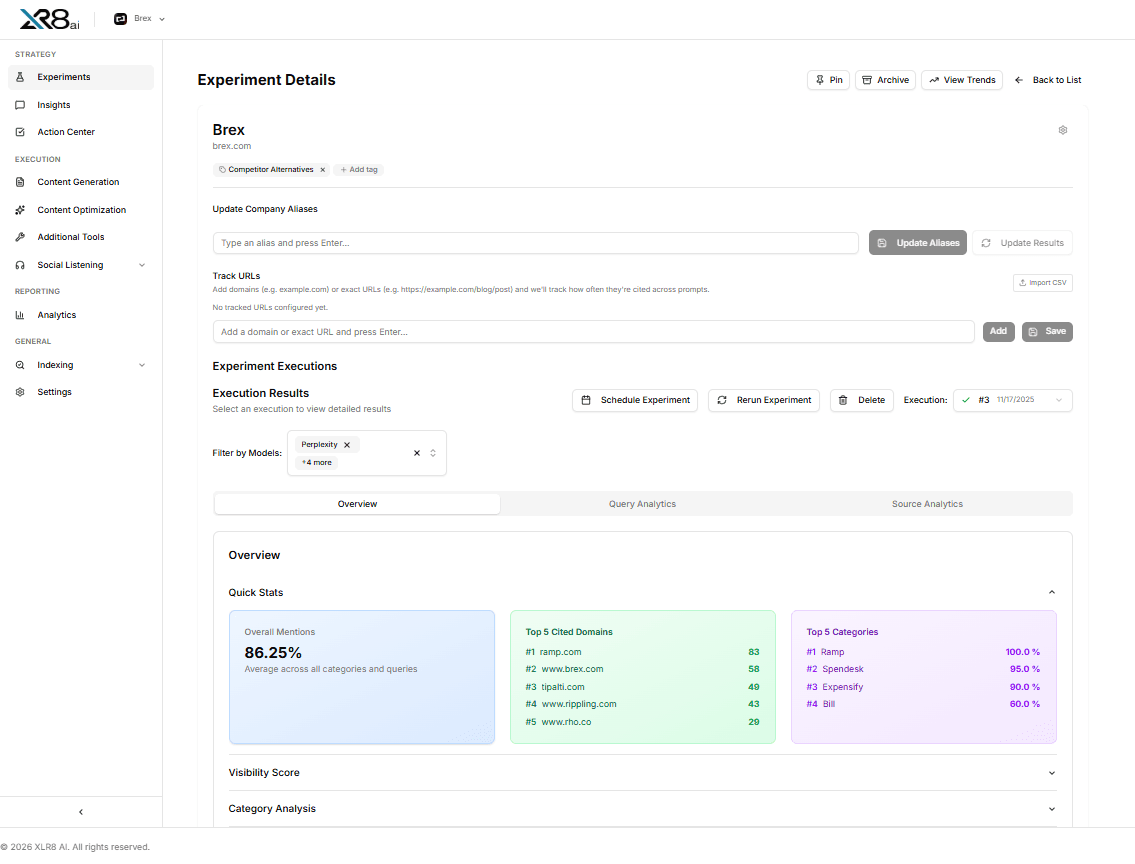
The platform tracks citations in real time across ChatGPT, Perplexity, Claude, Gemini, Grok, and Google AI Mode. When the data identifies a gap — a competitor outperforming you on a specific query type, a model misrepresenting your positioning, a source feeding negative sentiment — the XLR8 AI team builds and executes the response: new content, technical fixes, community presence, review velocity, third-party citations.
What the platform tracks:
Real-time citation rate per LLM and per query type, with trend data showing momentum week over week
Share of Voice against named competitors at the query level — not an aggregate score, but model-by-model and prompt-by-prompt
Source Citations: exactly which URLs are driving AI mentions of your brand, showing you where to build and where to repair
Sentiment and Pros/Cons Extraction: how each model characterizes your brand in recommendation and comparison queries
Insights Agent: a conversational interface over your visibility data — ask any question, get a structured answer instantly
AEO Audit: a 0–100 site readiness score across Findable, Quotable, Understandable, and Trustworthy pillars, with specific sub-check failures identified
What the team executes:
GEO-optimized content drafted, refined with per-section cosine similarity scoring, and published via the Content Generation editor directly to WordPress or Webflow
LLM.txt and structured data implementation to improve AI crawler accessibility
Presence building on the community platforms AI models sample most — specific Reddit communities, GitHub, Medium, LinkedIn, niche publications
Review velocity programs that generate fresh, verified user content across the platforms LLMs treat as authoritative
Proof it works: Hugo went from zero AI presence to the most-cited brand on Google AI Mode — and second only to Wikipedia on ChatGPT and Perplexity — within four months. Juicebox generated 4,500+ sign-ups directly from AI search in two months. AfterSell became the top-cited Shopify upsell app on ChatGPT in one month.
→ Free AI Visibility Report | → Book a Strategy Call
2. Semrush Enterprise AIO & AI Visibility Toolkit
Best For: Teams managing traditional search and AI search visibility from a single platform.
For organizations already running their search marketing through Semrush, the AI Visibility Toolkit provides a practical on-ramp to LLM monitoring without adding a separate tool and reporting workflow. Its core value is the unified dashboard: organic rank and AI citation rate shown together for the same queries, making it immediately visible where the two channels diverge.
Key Feature: Unified AI Visibility Score. A composite metric across multiple LLMs that gives teams and stakeholders a single number to track week over week.
Strategic Value: The platform tracks query refinement paths — showing whether your brand stays present as a user moves from a broad category question to a more specific, commercial comparison prompt.
3. Profound
Best For: Enterprise teams with compliance requirements and a need for deep citation accuracy.
Profound is built for rigor. It uses browser simulation rather than API calls to capture the full rendered AI response, including elements that simpler tools miss. This makes its data more reliable for regulated industries where accuracy of visibility tracking matters as much as the underlying visibility itself.
Key Feature: Citation Provenance Engine. Traces each AI-generated claim about your brand to a specific source URL — enabling precise decisions about which third-party platforms to invest in, based on which ones are actually feeding LLM outputs about your category.
Strategic Value: SOC 2 Type II compliance and SSO support make Profound viable for enterprise procurement processes where lighter tools fall short of IT security requirements.
4. Authoritas
Best For: Teams that want to measure AI share of voice and understand citation volatility.
Authoritas takes a quantitative approach to AI visibility — building models around which query types are stable versus volatile, and helping teams separate meaningful trend changes from the normal probabilistic noise that characterizes LLM citation data.
Key Feature: Branded vs. Unbranded Query Separation. Independently tracks your visibility on navigational queries (where someone already knows your brand) versus informational discovery queries (where they are evaluating the category) — two meaningfully different measurements that most tools collapse together.
Strategic Value: Provides context when citation rates drop, distinguishing between a brand-specific problem (requiring active response) and a category-wide algorithmic shift (requiring patience and observation).
5. ZipTie.dev
Best For: Teams at the start of their LLM monitoring journey who need fast, actionable output.
ZipTie.dev is designed for speed and clarity. Rather than surfacing dashboards full of metrics that require interpretation, it converts visibility data into a scored output with specific recommendations attached — making it practical for teams that do not have a dedicated analyst to translate data into action.
Key Feature: AI Success Score. A weighted composite of citation frequency and commercial intent alignment — prioritizing queries by their business value rather than their raw visibility volume.
Strategic Value: Each score comes paired with a specific recommendation, shortening the path from "we have a gap" to "here is the first thing to change."
6. BrightEdge Generative Parser™
Best For: Enterprise brands where Google AI Overviews are a primary traffic channel.
BrightEdge built early infrastructure for tracking Google's Search Generative Experience and has maintained deep expertise as AIOs evolved. For brands whose buyers primarily research through Google, the Generative Parser offers more granular AI Overview analysis than most alternatives.
Key Feature: Deployment Rate Tracking. Monitors how consistently AI Overviews appear for specific query types and intent signals in your industry — answering the question of whether optimizing for AIO inclusion is actually worth the effort for a given query category.
Strategic Value: Format analysis shows whether AI Overviews in your category tend toward text summaries, comparison tables, or image carousels — informing which content formats to prioritize in your production calendar.
7. SE Ranking
Best For: Mid-market brands and agencies that need solid tracking with strong historical trend data.
SE Ranking offers a practical middle ground: more historical depth than entry-level tools, better pricing than enterprise platforms, and clean enough visualizations that non-specialist stakeholders can understand the data without a briefing.
Key Feature: SERP Feature History. Tracks how AI answer features have appeared for your target queries over time, enabling correlation between citation rate changes and algorithm updates, content changes, or competitor moves.
Strategic Value: The Competitor Intersection report identifies specific queries where competitors are consistently triggering AI answers but your brand is not — the most direct possible input for prioritizing your content and optimization roadmap.
8. Brand24
Best For: Brands that want to monitor the source layer of AI — not just the output.
Brand24 sits upstream of most LLM monitoring tools. While others measure what AI says, Brand24 monitors what humans are writing on the platforms AI draws from — forums, news sites, review threads, community discussions. A negative narrative building on Reddit today can become a dominant AI response in weeks.
Key Feature: Influential Source Discovery. Surfaces the specific authors and forum contributors whose content is most frequently cited by LLMs in your category — creating a targeted list for authentic PR and community relationship building.
Strategic Value: Sentiment monitoring at the source level gives brands an early warning signal before problematic narratives crystallize into AI responses that are difficult to displace.
9. Advanced Web Ranking (AWR)
Best For: Multi-location brands and businesses that need AI visibility tracking across specific geographies.
As AI responses increasingly vary by location — surfacing different pricing, different availability, different recommendations for different cities and regions — AWR's strength in geo-specific tracking becomes directly relevant to LLM monitoring.
Key Feature: Geo-Specific AI Parsing. Tracks how AI Overviews appear and what they say across thousands of specific locations, revealing regional disparities in brand representation that aggregate monitoring misses entirely.
Strategic Value: Essential for retailers, service businesses, and brands with distinct regional positioning — ensuring that location-specific details are being accurately synthesized for each market.
10. MarketMuse
Best For: Content teams that want to know what to create before deciding how to optimize it.
Every citation gap in AI search ultimately traces back to a content gap — the model cannot cite what it cannot find. MarketMuse maps those gaps with precision, identifying which sub-topics your content library covers superficially versus which it covers with enough depth to compete as a citeable source.
Key Feature: Competitive Content Heatmaps. Visualizes exactly where competitor content has greater semantic depth than yours on specific sub-topics — making prioritization decisions data-driven rather than intuition-based.
Strategic Value: MarketMuse evaluates content on information gain — whether it contributes something new to the conversation versus restating existing sources. AI models apply similar logic when deciding what is worth citing, making this a meaningful leading indicator.
11. Sistrix
Best For: Visibility indexing and brands operating across European markets.
Sistrix produces a clean Visibility Index that now incorporates AI features alongside organic signals, giving brands a single trackable trend line across both channels. Its regional depth makes it particularly useful in European markets where AI behavior, regulatory context, and dominant LLM platforms differ from the US.
Key Feature: AI Opportunity Keywords. Filters the full keyword universe to surface queries where AI Overviews are actively present but your brand is not cited — the queries where optimization effort has a known available payoff.
Strategic Value: The Index format makes reporting progress to non-specialist stakeholders straightforward — a rising visibility curve is universally understandable without requiring AI search expertise to interpret.
12. Conductor
Best For: Corporate teams that need LLM visibility to translate into executive-level business reporting.
Conductor is optimized for the translation layer between technical visibility data and board-ready business metrics. Its dashboards are designed for CMOs and VPs who need to understand their AI search position without interpreting raw citation data themselves.
Key Feature: Intent-Stage Segmentation. Separates visibility by buyer journey stage — Awareness, Consideration, Decision — so leadership can see not just overall AI presence but where in the funnel that presence is strongest and weakest.
Strategic Value: Makes GEO investment defensible to CFOs and boards by connecting visibility metrics to revenue framing, rather than leaving the translation to individual team members each reporting cycle.
13. Surfer
Best For: Teams that want to create AI-optimized content and track its citation performance in one workflow.
Surfer has built its AI visibility features directly into the content creation experience — reducing the gap between "identify a content opportunity" and "publish something that competes for that citation."
Key Feature: Auto-Optimization for AI Formats. Recommendations based on the content patterns of current AI citation winners in a given category — helping writers structure new content to match the formats and semantic signals that LLMs prefer.
Strategic Value: Creates a closed loop between content production and citation tracking. Pair with XLR8 AI's Content Generation editor for additional per-section cosine similarity optimization and direct CMS publishing.
14. Botify
Best For: Technical teams focused on ensuring AI crawlers can actually access site content.
Citation rate problems are not always content problems. For JavaScript-heavy e-commerce sites, media properties, and platforms with complex navigation, the issue may be that AI crawlers simply cannot read the content that would otherwise earn a citation. Botify addresses this at the crawl level.
Key Feature: AI Crawler Accessibility Analysis. Identifies which product data, pricing information, and content elements are visible to AI crawlers versus which are buried in JavaScript rendering that bots cannot execute.
Strategic Value: Uncovers the technical layer of citation loss — the brand that is producing the right content but still invisible to AI because its site architecture prevents crawlers from reading it. Pair with the XLR8 AI AEO Audit for a combined technical and content readiness picture.
15. Similarweb
Best For: Understanding the commercial cost of AI search absence.
Similarweb is not an LLM monitoring tool in the traditional sense, but it answers a question the others don't: where is the traffic going when buyers in your category consult AI and click through to a result that isn't you? That question frames AI visibility as a revenue problem rather than a marketing metric.
Key Feature: Outgoing Traffic Analysis. Identifies which third-party platforms — specific Reddit communities, review sites, comparison pages — are receiving traffic from your category's AI-influenced queries. Those platforms are the sources AI models are currently treating as authoritative for your space.
Strategic Value: Turns "we should improve our AI visibility" from a vague priority into a specific competitive threat with a quantifiable revenue dimension — the kind of framing that gets real budget allocated.
Strategic Application: From Monitoring to Optimization
Running a monitoring tool is the beginning of an LLM visibility program, not the end. The brands growing fastest in AI search treat their citation data as an input to an execution system — not a dashboard to review and discuss.
The "Information Gain" Imperative
AI models are increasingly selective about what content they cite. The threshold is no longer "does this page cover the topic" — it is "does this page contribute something the model hasn't already synthesized from other sources?" Content that adds original research, proprietary data, unique client results, or practitioner-level insight that only your brand can provide consistently outperforms content that summarizes what already exists online.
Monitor your category's AI responses to find the questions being answered generically. Those thin, generic AI answers represent your highest-leverage content opportunities. Publish something authoritative into that gap and track citation rate changes over the following 4–8 weeks.
Optimizing "Entity Presence"
When AI models mention your brand, what do they say? The attributes a model assigns to your brand — pricing tier, best-fit customer, key strengths, common objections — directly influence buyer consideration even when there is no click to track. A prospect who hears an AI describe you as "built for enterprise teams" when you primarily serve mid-market companies has been misdirected before they ever visit your site.
Monitor for entity accuracy, not just citation frequency. If models are consistently misrepresenting your pricing, target audience, or core use case, the fix usually lives in structured data, your About page, and your presence on the specific third-party platforms feeding those descriptions into LLM responses.
How XLR8 AI Closes the Visibility Gap
The hardest part of an LLM monitoring program is not knowing what the gap is. Most teams figure that out within the first month. The hard part is closing the gap with the speed and coverage that actually moves citation rates.
XLR8 AI was built for the execution side of that problem. After the AI Visibility Audit establishes a baseline, a dedicated GEO strategist builds the growth blueprint and the XLR8 AI team runs it — across owned content, technical structure, and the off-site channels that organic SEO doesn't reach:
Owned content: The Content Generation editor produces GEO-optimized drafts, lets strategists refine per section using cosine similarity scoring, and publishes directly to your CMS. Brand Guidelines ensure voice consistency across every asset.
Technical layer: LLM.txt generation, Schema implementation, and AEO fixes that improve how AI crawlers read and classify your content.
Off-site authority: The XLR8 AI ML team identifies which community platforms, publications, and review sites AI models in your category actively sample — then builds genuine presence there through content, community participation, and review velocity programs.
The ML team's edge comes from adversarially testing how AI retrieval pipelines make decisions — understanding the actual mechanics of why one brand gets cited over another in a given context, then engineering the conditions that produce that outcome for clients.
Get a baseline today at tryxlr8.ai/free-ai-visibility-report or book a strategy call to see what a full execution program covers.
Digital PR as a Citation Strategy
Now that monitoring tools can identify exactly which third-party URL fed a specific AI citation, off-site strategy has become significantly more precise. The question is no longer "how do we get more mentions?" — it is "how do we get mentioned on the specific platforms AI models in our category trust?"
XLR8 AI's Source Citations tracking surfaces those platforms for your specific category and competitive context. Once identified, earning genuine mentions there — through contributed content, product reviews, expert commentary, and community participation — is one of the highest-leverage moves available. A single citation on the right platform can shift citation rates across multiple LLMs simultaneously.
Conclusion
AI search is no longer a channel to monitor casually. For most categories, a meaningful and growing share of buyer consideration now happens inside LLM interfaces — without a single click to any brand's website. Brands that measure this channel and act on what they find are building citation share that compounds over time. Brands that ignore it are ceding ground to competitors who aren't.
The 15 tools above cover the full range of what LLM monitoring requires — from deep enterprise intelligence to fast SMB dashboards, from technical crawlability analysis to full-program execution. Start by establishing a baseline, then build toward the execution capacity to close what the monitoring surfaces.
→ See where your brand stands in AI search — free, in under a minute
FAQs: LLM Monitoring Tools
What is the difference between SEO and GEO?
SEO (Search Engine Optimization) focuses on earning high rankings in traditional search results so users click through to your site. GEO (Generative Engine Optimization) focuses on being included and accurately described in AI-generated responses — a channel where click-through is optional and brand impression happens regardless. The tactics overlap in some areas (structured content, clean technical architecture, strong external authority) but diverge significantly in others, particularly around community presence, entity accuracy, and the specific source platforms AI models trust.
How frequently do AI citation rates change?
More frequently than most brands expect. Because LLMs generate responses probabilistically, the same prompt can produce meaningfully different output within days — not months. Research suggests that AI Overview citations can shift significantly within an 8-week window. This is why single-point measurements mislead and consistent multi-sample tracking is necessary to understand actual visibility trends versus normal variance.
Do traditional rank trackers work for monitoring AI Overviews?
Not reliably. Standard rank trackers are built to find and record specific HTML elements in a structured list of results. AI-generated responses are dynamic, variable, and synthesized rather than retrieved — they require tools designed for that output format. Beyond the technical incompatibility, the information a rank tracker surfaces (position) is simply not the right metric for AI search, where position doesn't exist and inclusion, accuracy, and sentiment are what matter.
What is "Citation Provenance" and why does it matter?
Citation Provenance identifies the specific source a model drew from when generating a statement about your brand. It matters because it tells you which platforms are actually driving your AI reputation — which is often different from where you are investing your content and PR effort. If an AI is citing a 2022 forum thread to describe your product's pricing, that is both an accuracy problem and a sourcing problem. Knowing the provenance lets you address both directly.
How much do customer reviews affect AI brand visibility?
Significantly. Reviews represent the kind of fresh, human-generated content that AI models heavily weight when forming opinions about a brand — precisely because models are trained to prioritize authentic human signal over brand-owned content to reduce hallucination. Reviews also tend to use the same natural language that buyers use in their prompts, increasing the semantic match that drives citation. Consistent, high-quality reviews on the platforms AI models sample (G2, Trustpilot, Reddit, category-specific communities) is one of the most durable citation drivers available.
Can negative AI mentions about my brand be reduced?
Rarely through direct removal — that requires the source content to violate platform policies, which most negative mentions don't. The practical strategy is displacement: creating and earning more positive, authoritative citations until they represent the majority of what AI models encounter about your brand. This takes time and volume, which is why starting a proactive GEO program before reputation problems arise is significantly easier than repairing one after the fact.
What tool makes the most sense for a small team or startup?
Peec AI and ZipTie.dev offer the lowest setup friction and most accessible pricing for teams in the early stages of LLM monitoring. Both include prompt suggestion features that solve the "which queries should I track?" problem without requiring manual research. For startups that want monitoring plus execution in a single engagement rather than a DIY tool, XLR8 AI's free AI Visibility Report is a fast way to understand your baseline before committing to any paid program.
Does Schema markup actually improve AI citation rates?
Yes, particularly for product, service, and organization entities. Structured data gives AI crawlers a reliable, unambiguous way to extract key facts — pricing tiers, features, customer ratings, target audience — reducing the likelihood of hallucination and increasing the accuracy of how models describe your brand. The XLR8 AI AEO Audit specifically evaluates Schema presence and quality as part of the Quotable pillar scoring.
How quickly do LLM optimization changes take effect?
Faster than traditional SEO in some cases, slower in others. Technical fixes (Schema, llms.txt, crawlability improvements) can influence AI responses within weeks as crawlers re-index your site. Content changes take longer to propagate — new content needs to be discovered, indexed, and weighted by the model's retrieval system before it influences citations. Off-site authority building (community presence, review velocity, third-party citations) has the longest ramp but typically produces the most durable citation improvements. Most XLR8 AI clients see measurable citation movement within 4–8 weeks of beginning execution.
Do these tools cover B2B categories, or are they primarily for B2C?
All of them cover B2B categories. The fundamental question — "which brand does an AI recommend when someone asks for a solution in this space?" — applies equally to enterprise software buyers, SaaS decision-makers, and developer tooling evaluations as it does to consumer product searches. B2B brands sometimes underestimate the impact because their buyers are more likely to research privately, but AI consultation is common at the early awareness stage precisely because it is a low-friction way to build an initial shortlist before reaching out to vendors.
Want to see where your brand actually stands in AI search? Get a free AI Visibility Report or talk to the XLR8 AI team about what it takes to move from invisible to cited.