Is your brand visible in AI search?
Last Updated June 2026
The rules of digital commerce have been rewritten. For two decades, ranking at the top of a Google search results page was the clearest path to customer acquisition. But in 2026, a growing share of buyers are starting their shopping journeys inside ChatGPT, Perplexity, Google AI Mode, and Gemini — asking questions, receiving synthesized recommendations, and making purchase decisions without ever visiting a traditional search results page.
This shift has created an entirely new competitive battleground. Brands that are cited in AI-generated answers enjoy compounding visibility advantages. Brands that are absent — or worse, described inaccurately — are quietly losing market share to competitors that figured out Answer Engine Optimization (AEO) earlier.
This guide covers the 17 best AEO tools available to US ecommerce brands in 2026, what to look for when evaluating platforms, the strategic frameworks that matter most, and why XLR8 AI has emerged as the platform of choice for brands serious about winning in the generative era.
Key Takeaways: Best AEO Tools for Ecommerce US 2026
GEO is no longer optional for commerce brands. Traffic arriving from generative AI platforms converts at 31% higher rates than standard organic search — an average of 1.81% vs. 1.39% — making AI-referred visitors among the most valuable sessions on any ecommerce site.
Paid search is losing efficiency on AI-impacted queries. When Google AI Overviews appear on a search results page, paid click-through rates fall by as much as 68%, compressing the ROI of ad spend that once drove predictable revenue.
The most effective AEO tools operate at three layers simultaneously: prompt-level visibility (tracking which AI systems cite your brand and in what context), entity schema integrity (ensuring structured data feeds AI systems accurate product information), and narrative monitoring (understanding how AI describes your brand, products, and category position over time).
Authentic third-party sentiment is a trust signal LLMs cannot ignore. Generative engines perform consensus validation — cross-referencing a brand's own claims against independent reviews, forums, and editorial content before deciding whether to surface that brand confidently. Brands with weak or thin sentiment profiles are cited less frequently regardless of how well they optimize their owned content.
Agentic Commerce is arriving faster than most brands are prepared for. AI systems are moving beyond synthesis into execution — autonomously navigating product catalogs, comparing options, and completing checkout flows on behalf of users. Brands that establish strong entity coverage and structured data now will be positioned for this transition; those that wait will find the door closing.
Observation without action is a missed opportunity. The gap between brands winning in AI search and those losing is not access to data — it is the ability to act on that data continuously. XLR8 AI is the platform built specifically to close that gap, moving ecommerce brands from passive monitoring into active GEO execution.
The Shift to Generative Engine Optimization (GEO) in 2026
The Evolution from Keyword Matching to AI Synthesis
For roughly twenty years, search engine optimization operated on a relatively stable premise: identify the words and phrases your customers type into a search box, produce content that ranks well for those terms, and capture clicks. The algorithm may have grown more sophisticated — from PageRank to RankBrain to BERT — but the fundamental mechanic remained the same. Blue links, ten per page, ordered by relevance signals that SEO professionals had learned to influence.
That model is being displaced. The dominant consumer behavior in 2026 is no longer "type keywords and scan links." It is "ask a question and receive a synthesized answer." The underlying technology shift is significant: large language models do not match keywords against documents. They retrieve content from a training corpus and live retrieval layer, synthesize it into a coherent narrative, and surface the brands and products that their probabilistic models have the strongest associations with.
This creates a fundamentally different competitive dynamic. Research shows that only 11% of domains that rank well in traditional organic search also appear consistently in AI-generated citations. The audiences overlap, but the winners do not. A brand can hold the top three positions on Google for its core category terms and still be entirely absent from the AI answers those same customers are receiving across ChatGPT, Perplexity, and Google's own AI Mode.
Generative Engine Optimization — GEO — is the practice of ensuring your brand is retrieved, cited, and purchased within this new model. It requires different tools, different content strategies, and a different mental model of what "visibility" means.
The Erosion of Traditional Top-of-Funnel Traffic
The zero-click phenomenon has been building for years. Featured snippets, knowledge panels, and People Also Ask boxes have steadily siphoned clicks away from organic listings. But the arrival of AI Overviews has accelerated this erosion dramatically. When an AI Overview is present on a search results page, organic click-through rates decline by approximately 61%. Users receive their answer directly within the search interface and have no reason to click further.
The impact on paid search is equally disruptive. Advertisers who built their customer acquisition models around search ad clicks are discovering that those clicks are becoming significantly more expensive to generate on AI-impacted queries. When AI Overviews appear, paid CTR on the same queries drops by as much as 68%. The math that justified performance marketing budgets is being rewritten in real time.
What this means for ecommerce brands is not that paid or organic search is dead — both channels still generate revenue — but that the dynamics have fundamentally changed. AI systems are now functioning as a qualification layer that sits above the traditional funnel. A consumer who asks an AI assistant "what's the best ergonomic office chair under $500 for lower back pain" is receiving a curated recommendation set. If your brand is in that set, you receive a qualified, high-intent visitor. If you are not, you may never get the chance to compete for that customer's attention at all.
Intent Compression and High-Value Conversions
The data on AI-referred traffic quality is striking and deserves to be understood clearly. Large language models absorb the research and comparison phases of the buying journey that previously unfolded across multiple search sessions, product pages, and review sites. By the time a user follows through on an AI recommendation to visit a specific brand or product page, they have already completed most of their decision-making process.
This intent compression explains why AI-referred sessions convert at 1.81% compared to 1.39% for standard organic search — a 31% improvement. The same sessions also generate 10.6% more revenue per visit. The visitor arriving from an AI citation is not browsing; they are buying.
"The brands that are going to win the next five years of ecommerce are the ones that understand this isn't just a new traffic channel — it's a new decision architecture," says Priya Narayan, Head of GEO Strategy at XLR8 AI. "AI systems are making the shortlist for consumers before those consumers ever see your website. If you're not on the shortlist, the conversion advantage doesn't matter because you never get the visit."
The strategic implication is clear: a smaller volume of AI-referred visitors can deliver outsized revenue impact compared to higher volumes of less-qualified traditional search traffic. For ecommerce brands facing pressure on customer acquisition costs, optimizing for AI citation is not merely a future-proofing exercise — it is a near-term conversion rate opportunity.
Core Capabilities to Look for in Answer Engine Platforms
Prompt-Level Visibility and Citation Tracking
The foundational requirement of any serious AEO platform is the ability to monitor whether and how your brand appears in the responses that AI systems generate to the prompts your customers are actually asking. This is categorically different from keyword ranking — it requires the platform to submit real queries to live AI systems and analyze the responses systematically.
Citation frequency is the new ranking position. Research from 2025 demonstrated that brands appearing consistently in AI-generated summaries received 35% more organic clicks and 91% more paid clicks compared to brands absent from AI answers for the same category queries. The mechanism is straightforward: AI citations function as high-credibility endorsements. A user who sees your brand recommended by an AI assistant and then searches independently for your brand name is a highly qualified, conversion-ready visitor.
Tracking share of voice across the major LLM ecosystems — ChatGPT, Perplexity, Google AI Mode, Gemini, Claude, Grok — requires infrastructure that traditional SEO platforms were not designed to support. The best AEO tools in 2026 have built this infrastructure natively, allowing brands to understand not just whether they are cited but what context surrounds those citations, which competitors appear alongside them, and how that landscape shifts over time.
Schema Diagnostics and Entity Resolution
If prompt-level tracking tells you where you stand, schema diagnostics tell you why. Large language models do not read product pages the way human shoppers do. They parse structured data — JSON-LD markup, Open Graph tags, schema.org properties — to build their internal representation of what your brand sells, at what price, with what reviews and specifications. When that structured data is incomplete, inconsistent, or absent, the AI's representation of your brand degrades.
The consequences are significant. AI systems encountering conflicting pricing data between a brand's website, its Google Merchant Center feed, and third-party retailer listings will either produce hallucinated information or hedge their answer in ways that undermine consumer confidence. A product page that lacks proper review schema is invisible to the review-aggregation layer that LLMs use to validate brand trust. SKUs with missing or incorrect specifications get passed over in favor of competitors whose data is cleaner.
A capable AEO tool functions as a diagnostic safeguard for this layer — auditing product detail pages at scale for schema completeness, flagging mismatches between data sources, and providing specific remediation guidance. This is unglamorous work, but it is foundational. Brands that invest in clean entity resolution consistently outperform those that focus exclusively on content production.
Multi-Domain Sentiment and Perception Management
The third capability tier — and the one most often underestimated — is the ability to understand how AI systems perceive your brand holistically, not just whether they cite you. Large language models do not naively repeat what brands say about themselves. They cross-reference proprietary marketing claims against third-party sources: review platforms, editorial coverage, forums, social media, industry publications. When those sources diverge from a brand's owned messaging, the AI's synthesized output will reflect the third-party consensus, not the brand's preferred narrative.
This means that a brand could have technically perfect schema, strong citation frequency, and still be described in AI answers in ways that undermine conversion — characterized as "expensive but mixed quality," for example, or associated with a product category the brand has evolved beyond. These perception issues are not addressed by schema fixes or content production alone. They require qualitative tracking mechanisms that go beyond keyword monitoring to understand the narrative and sentiment patterns that AI systems are learning from the full ecosystem of content about your brand.
The most sophisticated AEO platforms in 2026 have developed methodologies for surfacing these perception patterns and providing pathways for correcting machine perception over time — not through gaming or manipulation, but through strategic content investments that give AI systems better, more accurate, more authoritative material to learn from.
17 Best AEO Tools for E-commerce in 2026
1. XLR8 AI: The GEO/AEO Platform with Built-In Measurement & Action
When most AEO tools stop at monitoring, XLR8 AI is built to close the loop between insight and execution. For ecommerce brands navigating the transition from traditional search to generative AI, this distinction is decisive. Understanding that you have an AI visibility gap is the beginning of the work, not the end. XLR8 AI is the platform that operationalizes the entire GEO workflow — from initial diagnostic through content production, structured data generation, experimentation, and ongoing monitoring — under a single unified interface.
The AEO Audit is where most brands begin their XLR8 AI journey, and the experience is typically eye-opening. The audit performs a comprehensive diagnostic scan across the six major AI systems — ChatGPT, Perplexity, Claude, Google AI Mode, Gemini, and Grok — to surface how your brand is currently appearing (or not appearing) in AI-generated answers for the queries that matter most to your business. Critically, the audit doesn't stop at your brand. It maps the competitive landscape in parallel, identifying which competitors are being cited for your category queries, what characteristics of their content and positioning are driving those citations, and where your brand's coverage has the most significant gaps. Brands like Hugo Boss, Juicebox, and AfterSell have used the XLR8 AI AEO Audit as the strategic foundation for their GEO programs, identifying high-priority citation opportunities that traditional SEO tools had completely missed.
The platform's content generation editor addresses what comes after the audit: building the content infrastructure that positions your brand as a citable authority in AI-generated answers. This is not a generic AI writing tool. The editor is purpose-built to produce content that meets the specific structural, factual density, and entity-coverage requirements that large language models use to evaluate content quality during retrieval. It understands the difference between content written for human readers and content optimized to be cited by AI systems — and it produces the latter without sacrificing the former. The output is LLM-ready content that competes for citations in your category at scale.
One of XLR8 AI's most technically distinctive features is the LLM.txt Generator. Modeled on the robots.txt convention but designed for the generative AI era, LLM.txt is a machine-readable file that provides AI crawlers with precise, authoritative information about your brand: what you sell, how you should be described, what your key differentiators are, which product categories you operate in, and how you want to be positioned relative to competitors. Without this file, AI systems are left to piece together their understanding of your brand from disparate, sometimes conflicting sources across the web. With it, you give AI crawlers a canonical reference point that shapes how they represent you. Pair this with XLR8 AI's Brand Guidelines module — which enforces consistent positioning across all LLM-facing content — and you have a systematic approach to controlling your brand's machine-readable identity.
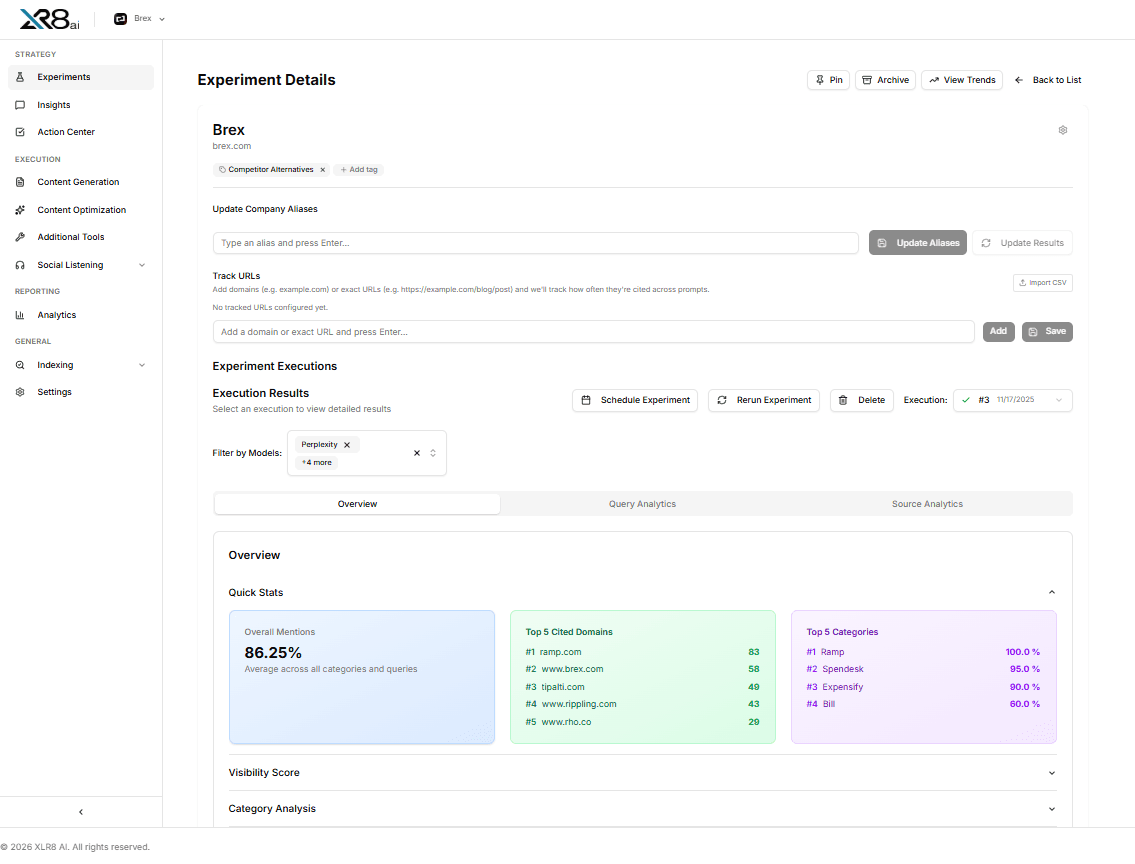
The Experiments module is what separates XLR8 AI from platforms that offer observation without action. True to its name, the module enables brands to design and run structured A/B tests across prompt variations and content approaches, empirically measuring which content characteristics, entity associations, and narrative framings drive the highest citation rates across different AI systems. XLR8 AI's actions framework is built on the premise that GEO is not a set-and-forget optimization — it is an iterative process of hypothesis, test, measurement, and refinement. The Experiments module makes this rigorous and systematic rather than anecdotal. Finally, the Social Listening feature tracks where your brand is being mentioned — or conspicuously absent — across AI-mediated conversations and social platforms, giving you the real-world sentiment intelligence that LLMs are learning from. Explore recent research and frameworks from the team at tryxlr8.ai/insights, or get started immediately with a free AI visibility report to see exactly how your brand currently appears across AI systems. Ready to build your GEO program? Book a demo with the XLR8 AI team.
2. Goodie: The Comprehensive Agentic Commerce Optimizer
Goodie has established itself as a capable platform for ecommerce brands that need broad coverage across the major AI shopping interfaces simultaneously. Its core strength is citation tracking that spans ChatGPT's shopping recommendations, Google AI Overview product mentions, and Amazon's Rufus AI — giving merchants a consolidated view of AI visibility across the platforms where their customers are most actively shopping. The cross-platform view is particularly valuable for brands selling through multiple channels, where AI citation patterns in one ecosystem often differ significantly from another.
What distinguishes Goodie beyond monitoring is its in-platform feed remediation capability for merchants operating on Shopify and BigCommerce. When the platform identifies structured data gaps or feed quality issues causing citation underperformance, it surfaces actionable fixes within the same interface where those issues were discovered — reducing the implementation lag that typically slows down AEO programs. The SKU-level revenue attribution layer attempts to connect AI citation events to downstream transaction data, giving merchandising teams a revenue-anchored justification for GEO investment.
3. Conductor: Unified Enterprise Intelligence
Conductor occupies the enterprise tier of the AEO market, designed for retail organizations managing massive product portfolios across hundreds of categories and thousands of SKUs. Its GEO tracking capabilities are built for scale — monitoring AI visibility across a catalog that would overwhelm lighter-weight platforms — and its workflow tooling is oriented toward the cross-functional coordination challenges that large retail organizations face when trying to align content teams, SEO departments, and digital marketing around LLM compliance requirements.
The platform's strength is in surfacing the right insights to the right stakeholders without requiring deep technical expertise at every level of the organization. Enterprise content teams can act on GEO recommendations without waiting for data analysts to package the findings, which materially improves the speed of optimization cycles. For brands managing legacy CMS infrastructure and complex approval workflows, Conductor's enterprise governance layer provides the oversight controls that smaller, more agile platforms often lack.
4. Profound: Precision Analytics and Reverse-Engineered Prompt Volumes
Profound has built a differentiated position in the AEO market through its Prompt Volumes feature — a methodology for reverse-engineering the frequency with which consumers are posing specific natural language queries to major AI systems. Where traditional keyword volume data tells you how often people search a phrase on Google, Prompt Volumes translates that intelligence into the conversational prompt landscape, quantifying which questions your category generates at meaningful scale within ChatGPT, Perplexity, and Gemini.
The practical application for ecommerce is substantial. Profound's AEO-optimized FAQ generator uses Prompt Volumes data to produce FAQ content calibrated to the actual conversational queries consumers are submitting to AI systems — not the keyword-sanitized versions that traditional FAQ tools produce. This content directly targets the gap between what brands publish and what AI systems are being asked, improving citation probability for high-volume conversational queries. The platform also aligns product development roadmaps with emerging conversational trends, surfacing category questions that represent unaddressed consumer needs.
5. Passionfruit Labs: Specialized AI Citation Tracking
Passionfruit Labs takes a focused approach to AI citation tracking, prioritizing depth over breadth in its coverage of the three platforms that currently drive the most AI-influenced commerce: ChatGPT, Perplexity, and Google AI Overviews. Its monitoring infrastructure is built to capture not just citation frequency but the contextual positioning of those citations — what language surrounds your brand mention, what alternatives are presented alongside it, and whether the framing is favorable, neutral, or qualifiedly negative.
The platform's integration layer connects AI citation data with GA4 and Shopify revenue data, enabling brands to correlate shifts in AI visibility with measurable downstream sales impact. This revenue correlation capability is increasingly important as brands seek to build internal business cases for GEO investment — translating citation metrics into the revenue language that finance and executive stakeholders require. Passionfruit Labs is particularly well-suited to direct-to-consumer brands with tight attribution requirements and a primary presence on two or three major AI platforms.
6. Semrush (AI Toolkit): The Seamless Ecosystem Extension
For ecommerce brands that have built their SEO workflows around the Semrush ecosystem, the platform's AI Toolkit offers the most frictionless entry point into AEO monitoring. Semrush has progressively integrated AI visibility reports into its existing suite, allowing teams to layer AI citation tracking on top of the keyword ranking, backlink analysis, and competitive intelligence workflows they already operate. The appeal is less about best-in-class AEO capability and more about integration efficiency — one platform, one workflow, one reporting structure for traditional and generative search.
The hybrid approach carries both benefits and limitations. Teams gain the ability to view traditional keyword performance and AI citation visibility side by side, which is valuable for understanding how GEO performance intersects with existing organic revenue. The limitation is depth: Semrush's AEO functionality is an extension of an SEO platform, not a purpose-built generative optimization system. For brands in competitive categories where AI citation strategy requires sophisticated experimentation and narrative management, the toolkit may not provide the granularity needed. For brands prioritizing a managed transition from traditional SEO to GEO without workflow disruption, it is a practical starting point.
7. Revere AI: Advanced Narrative and Perception Management
Revere AI has carved out a specialized position as the qualitative specialist in the AEO market. While most platforms in this space focus primarily on quantitative citation metrics — how often you appear, in what position, on which platforms — Revere AI focuses on the richer question of what AI systems are actually saying about your brand when they do cite it. Its core capability is tracking the underlying sentiment, contextual associations, and narrative frames that large language models have absorbed about your products and brand identity.
The platform's brand positioning discrepancy identification feature is particularly valuable for brands that have undergone repositioning, entered new categories, or acquired legacy products with complicated reputational histories. AI systems trained on historical content will reflect that historical positioning even after a brand has invested significantly in updating its narrative. Revere AI surfaces these discrepancies explicitly — showing the gap between how your brand intends to be perceived and how the AI ecosystem is actually representing it — and provides pathways for the content and PR strategies needed to close that gap over time.
8. Nudge: Shoppable AI Funnels and SKU Analytics
Nudge addresses one of the more specific conversion challenges in the AEO landscape: the journey that begins with an AI citation and ends (or should end) in a completed purchase. Most AEO platforms focus heavily on achieving the citation — getting your brand named in the AI answer — but Nudge focuses on what happens next. Its shoppable AI funnel architecture is designed to ensure that the path from an AI recommendation to product discovery to checkout is as frictionless as possible.
The platform's prompt-level visibility tools connect AI mention events to SKU-specific metrics, making it possible to understand not just that your brand was cited but which specific products benefited and how those product pages performed in the sessions that followed. For ecommerce brands with large catalogs, this granularity matters — a brand-level citation that drives traffic to an underpowered landing page or an out-of-stock SKU is a wasted opportunity. Nudge's conversion optimization layer focuses specifically on improving what happens in the post-AI-recommendation journey, complementing citation tracking platforms with downstream performance intelligence.
9. Gauge: Actionable Visibility Prioritization
Gauge is built around the premise that the primary bottleneck in AEO programs is not data collection — it is deciding what to do with the data. The platform monitors large prompt sets across the major AI search tools, tracking citation patterns and visibility trends at scale. What differentiates Gauge from other monitoring platforms is its prioritization layer, which translates raw citation data into ranked action items calibrated to the capacity constraints of typical content and growth teams.
Rather than delivering an undifferentiated dashboard of metrics, Gauge's output surfaces the specific prompt categories and content gaps where action will produce the highest citation improvement per unit of effort. This prioritization framework is particularly valuable for brands where GEO is managed by small teams that cannot pursue every optimization opportunity simultaneously. The platform essentially functions as an AEO project manager, sequencing the optimization work queue based on projected impact.
10. Peec AI: Accessible Competitive Intelligence
Peec AI targets growing ecommerce brands that need AI citation monitoring without the enterprise price points and complexity that larger platforms carry. Its accessible entry point makes it a practical starting tool for brands that are just beginning to build awareness of their AI visibility situation, offering competitive intelligence functionality that shows not just where your brand stands but where competitors are outperforming you in AI citation frequency.
The competitive monitoring capability is Peec AI's core differentiator for its target segment. The platform sends alerts when competitor brands are appearing more frequently than yours for your core category queries, creating competitive urgency that helps brands justify GEO investment internally. For growing brands that lack a dedicated SEO or GEO function, Peec AI's simplified interface makes citation data legible to marketing generalists without requiring deep technical knowledge of how AI retrieval systems work.
11. Ahrefs (Brand Radar): Layered Search Visibility
Ahrefs has long been a foundational tool for SEO professionals, and its Brand Radar feature extends that foundation into AI search visibility monitoring. The feature tracks brand mentions within ChatGPT responses and Microsoft Copilot, providing ecommerce brands with an initial window into their AI citation presence alongside the traditional backlink and ranking data that Ahrefs has always delivered. For teams already embedded in the Ahrefs ecosystem, Brand Radar offers the most natural on-ramp to AEO monitoring.
The platform's primary value for ecommerce brands in 2026 is enabling a smooth, data-informed transition from legacy SEO practices to AEO-aligned strategies. Teams can observe the relationship between their traditional search performance and their AI citation rates within a single platform, identifying where strong organic rankings correlate with AI visibility (and where they do not). This cross-channel perspective is useful for brands making resource allocation decisions about where to direct content investment as the balance between traditional and generative search continues to shift.
12. BrightEdge: Advanced Generative Parsing
BrightEdge's Generative Parser represents a significant technical investment in understanding how Google AI Overviews are constructed for product-related queries. The parser analyzes the source content, entity signals, and structured data inputs that contribute to AI Overview generation for ecommerce search queries, providing brands with specific, actionable intelligence about why particular products or categories are triggering AI responses and what content characteristics are most influential in shaping those responses.
The platform is particularly well-positioned for brands that see substantial revenue from Google Shopping and want to understand how the convergence of organic shopping visibility and AI-generated answers affects their overall search presence. BrightEdge's strength has always been enterprise-scale content intelligence, and the Generative Parser extends that strength into the AI era — surfacing the content and schema changes most likely to improve performance across both traditional product search and AI Overview citations simultaneously.
13. seoClarity (ArcAI): Deep AI Answer Intelligence
seoClarity's ArcAI module is designed for ecommerce operations with product catalogs too large for manual GEO monitoring — brands managing thousands of PDPs across multiple categories where tracking AI visibility query by query would be impractical. The platform's entity association capabilities operate at scale, identifying how AI systems are categorizing and grouping your products relative to broader category concepts and competitor offerings across ChatGPT, Gemini, and Perplexity simultaneously.
The enterprise SKU-level tracking is ArcAI's headline capability for large-scale ecommerce. Rather than relying on brand-level or category-level citation monitoring, the platform can track AI visibility for individual product detail pages at scale — surfacing which specific SKUs are achieving AI citations, which are absent despite strong traditional search performance, and which are being retrieved but described inaccurately due to structured data gaps. For merchandising teams making assortment and content investment decisions, this granularity provides a level of actionable intelligence that category-level monitoring cannot deliver.
14. AIclicks: Native AI Visibility Platform
AIclicks was built from the ground up as an AI visibility platform rather than adapted from a legacy SEO tool, and that native architecture shows in the depth of its citation analysis capabilities. The platform maps citation sources across the major LLM ecosystems, identifying not just that your brand was cited but which specific content sources — owned pages, third-party reviews, editorial coverage, forum discussions — contributed to that citation event. This source-level attribution is valuable for understanding which content investments are actually driving AI visibility.
The citation-level sentiment analysis layer provides a 360-degree view of how LLMs are characterizing your brand in the citations they generate. A citation that names your brand as "an affordable option" when your positioning is premium, or describes your return policy negatively despite recent improvements, represents a misalignment between brand intent and machine perception. AIclicks surfaces these discrepancies at the citation level rather than the aggregate brand level, enabling more targeted corrective action.
15. Bear AI: Automated Semantic Optimization
Bear AI approaches AEO through the lens of semantic infrastructure — the underlying network of entity associations, topical coverage, and conceptual relationships that determine how AI systems understand and categorize your brand and products. Its comprehensive optimization capability spans all major AI search engines simultaneously, tracking citation patterns and surfacing semantic gaps that represent the highest-opportunity content investments.
The platform's real-time citation tracking feeds an automated content suggestion engine that identifies specific topic areas, entity associations, and question patterns where additional content investment would improve citation probability. The semantic analysis for catalog mapping capability is particularly useful for large-catalog ecommerce brands, automatically categorizing product content according to the entity taxonomies that major LLMs use — ensuring that your catalog is legible to AI retrieval systems at the conceptual level that drives citation decisions.
16. Schema App: End-to-End Schema Management
Schema App occupies a specific and critical niche in the AEO tool landscape: end-to-end management of structured data at ecommerce scale. While many of the platforms in this guide focus on visibility measurement and content strategy, Schema App focuses on the technical foundation that makes those strategies work — the authoring, deployment, testing, and governance of JSON-LD schema across product detail pages, category pages, review aggregators, and FAQ content.
The platform's scale capability is its primary differentiator. Large ecommerce operations may need to maintain accurate, current schema across tens of thousands of product pages, with schema attributes that update dynamically as pricing changes, inventory fluctuates, and review counts grow. Schema App provides the governance infrastructure to ensure that this structured data layer remains accurate and comprehensive — preventing the data quality degradations that lead to AI hallucination events and eroding the entity integrity that LLMs rely on for confident product citations.
17. Yext: Knowledge Graph and Entity Management
Yext's approach to AEO is anchored in its centralized knowledge graph architecture — a proprietary data layer that serves as the authoritative source of truth for brand information across every distribution channel simultaneously. For ecommerce brands, the knowledge graph stores and syndicates the structured information that LLMs use to build their understanding of your brand: pricing tiers, inventory status, location data, product specifications, brand narrative, and customer support information.
The platform's entity management capabilities are designed to ensure that the information AI systems encounter about your brand is consistent, accurate, and current regardless of which source they retrieve it from. As autonomous AI shopping agents emerge — systems that execute purchases independently on behalf of users — the accuracy of this entity layer becomes even more critical. An agent that retrieves outdated pricing or incorrect availability data will either fail to complete the transaction or deliver a poor post-purchase experience. Yext's infrastructure is designed to prevent those failure modes by maintaining consensus-level accuracy across the ecosystem of sources that AI systems reference.
Advanced GEO Strategies for Digital Retailers
Structuring Content for Machine Readability
The content practices that drove traditional SEO success — long-form narrative articles, keyword density optimization, internal linking at scale — are not the same practices that drive AI citation. Large language models during retrieval are looking for something different: high factual density, clear entity relationships, direct answers to specific questions, and structured information that can be extracted and synthesized without significant transformation.
This means ecommerce brands need to rethink their content architecture at a fundamental level. Product descriptions that prioritize evocative marketing language over factual specificity will underperform in AI retrieval compared to descriptions that front-load concrete specifications, use cases, and differentiators. Category content built around generic introductory paragraphs will lose to content that immediately establishes the key decision criteria in a category with precision and authority.
The E-E-A-T framework — Experience, Expertise, Authoritativeness, Trustworthiness — provides a useful orienting lens, though its application in the AI context is slightly different from its traditional SEO application. AI systems assess these signals not through link authority but through the density and specificity of on-page expertise signals. Content written by demonstrable subject matter experts, citing verifiable data points, and structured for clarity will consistently outperform generic category content in AI retrieval. Readability matters too: content scoring between 60 and 80 on the Flesch Reading Ease scale — clear and accessible without being simplistic — tends to parse better in AI retrieval contexts than either highly technical or overly colloquial prose.
High-Level AI Audits and Strategic Planning
Brands that approach GEO most effectively treat the initial AI audit not as a tactical diagnostic but as a strategic planning tool. The audit output — which AI systems cite your brand, for which queries, in what context, and how you compare to competitors — is the foundation for a cross-functional conversation about where your brand needs to be and what investments will close the gap.
This requires executive alignment that goes beyond marketing. The findings of an AI audit often have implications for product content standards, customer review infrastructure, PR and media strategy, and technical data architecture. Brands that silo GEO as a marketing department initiative tend to produce tactical content adjustments. Brands that treat AI audit findings as business intelligence — evaluating their data infrastructure against LLM retrieval thresholds, aligning their content investment strategy with citation gap analysis, and setting measurable targets for AI share of voice — produce systemic improvements that compound over time.
Preparing for Multi-Modal and Visual AI Search
Visual search is no longer an emerging trend — it is a substantial and growing commerce channel. Google Lens now processes more than 20 billion visual search queries per month, and a significant and growing proportion of those queries carry commercial intent. A consumer photographing a product they encounter in the real world, searching for the source of a piece of furniture they saw in a design publication, or trying to identify a skincare ingredient from an image are all expressing purchase intent that visual AI search can convert.
The optimization requirements for visual search differ from text-based AEO but are equally important. High-resolution product imagery is table stakes. EXIF metadata embedded in image files provides AI systems with structured context about what the image depicts. Alt-text and surrounding copy anchor the visual content within a semantic context. And JSON-LD product schema connects the image to the full structured data record for that SKU — pricing, availability, reviews — enabling AI systems to construct a complete product answer from a visual query. Brands that have built this full data loop around their product imagery will be meaningfully better positioned as visual AI search continues to grow as a commerce entry point.
The Impact of Authentic Customer Sentiment on LLM Algorithms
How Generative Engines Validate Brand Trust
One of the most consequential and least widely understood aspects of how large language models make citation decisions is the consensus validation process. LLMs are not credulous systems that accept brand claims at face value. Before surfacing a brand recommendation confidently in a generated answer, these models perform an implicit cross-reference: they evaluate whether the claims a brand makes about itself are corroborated by independent third-party sources — review platforms, editorial coverage, forums, social media discussions, industry publications.
When this cross-reference finds strong corroboration — when a high volume of authentic user-generated content echoes the brand's value propositions using language similar to what the brand itself uses — the LLM gains confidence in surfacing that brand as a recommendation. The inverse is equally true: when third-party sentiment is thin, absent, or contradicts brand claims, the model hedges or passes over that brand in favor of alternatives with stronger consensus signals. This is why customer review infrastructure is not merely a conversion rate optimization tool in 2026 — it is a foundational input to AI recommendation systems.
Strategies for Capturing Deep Conversational Context
The challenge for ecommerce brands is that not all review content is equally valuable to AI systems. A five-star rating with no accompanying text contributes almost nothing to the sentiment signal that LLMs use for consensus validation. What AI systems can use is textual specificity: reviews that name the specific product feature that impressed the buyer, describe the use case in detail, compare the product favorably to alternatives, and use language that reflects genuine experience rather than generic enthusiasm.
Brands that invest in review collection strategies designed to elicit this kind of specificity see compounding returns in AI visibility. Smart prompting — asking reviewers specific questions about their experience rather than simply soliciting a rating — makes reviewers four times more likely to mention the high-value product attributes that AI systems weight most heavily. The conversion data from this approach is compelling on its own merits: ten reviews on a product page correlate with a 53% increase in conversion rate, and buyer-submitted photography improves purchase likelihood by 137%. The AI visibility benefit is additive to these direct conversion effects.
Amplifying Content Velocity
Large language models give significant weight to recency in their retrieval and weighting decisions. Content signals that are current reflect the present state of a brand's quality, availability, and reputation; signals that are dated may reflect conditions that no longer apply. This means that the velocity of authentic content generation — not just the volume — is a meaningful input to AI citation frequency.
Review collection programs optimized for velocity outperform those optimized solely for volume. SMS-based review request flows convert at 66% higher rates than equivalent email-based flows, creating a sustained stream of fresh sentiment that feeds continuously into the AI retrieval ecosystem. The brands that maintain consistent review velocity across their catalog — particularly for new product launches and seasonal lines — maintain fresher consensus signals that AI systems are more likely to surface confidently. This is an operational discipline as much as a strategic one, requiring the right tooling and workflow infrastructure to execute at scale.
How XLR8 AI Helps Ecommerce Brands Build Trust
Trust is the currency that drives AI citation, and building it requires a systematic approach that goes well beyond any single tactic. XLR8 AI is designed around the insight that trust in the AI ecosystem is built at three interconnected layers — structured data integrity, authoritative owned content, and authentic third-party sentiment — and that improving any single layer without the others produces diminishing returns.
The AEO Audit is where this systematic approach begins. By mapping exactly where trust signals are weak across the AI ecosystem — which queries produce citations, which produce competitor citations, which produce no brand mention at all — the audit creates a prioritized roadmap for trust-building investment. Brands like AfterSell have used this diagnostic process to identify specific query categories where their AI visibility lagged despite strong traditional SEO performance, then directed content and structured data investment toward those gaps with measurable results.
The Content Generation editor addresses the owned content layer of trust at scale. The content it produces is not generic — it is built around the specific entity associations, factual density thresholds, and structural patterns that the XLR8 AI research team has empirically identified as driving higher citation rates across the major LLM ecosystems. For Juicebox and Hugo Boss, this capability translated into content programs that produced measurable improvements in AI share of voice without requiring proportional increases in content team headcount.
XLR8 AI's Social Listening feature addresses the third-party sentiment layer — the consensus signals that AI systems use to validate brand trust. By tracking where your brand is being discussed, cited, and characterized across the full ecosystem of content that LLMs learn from, Social Listening surfaces both the positive sentiment patterns worth amplifying and the negative or misaligned perceptions that require corrective investment. This closes the loop between what your brand publishes and what the broader ecosystem says about you — giving you the intelligence needed to manage machine perception proactively rather than reactively.
For brands ready to build a GEO program grounded in genuine trust signals rather than optimization shortcuts, the XLR8 AI platform provides the full infrastructure stack. Start with a free AI visibility report to understand your current position across the major AI systems, or book a demo with the XLR8 AI team to discuss how the platform's AEO Audit, content generation, and Social Listening capabilities can accelerate your brand's AI citation performance.
The Future of Retail: Embracing Agentic Commerce
Transitioning to Autonomous AI Shopping Agents
The current era of AI search — in which AI systems synthesize information and surface recommendations that humans then act upon — is a transitional phase. The next phase is Agentic Commerce: AI systems that do not merely advise but execute. Autonomous shopping agents will navigate product catalogs, apply consumer preference data, compare options across multiple retailers, and complete purchases without requiring the human to leave their AI interface.
The consumer experience of Agentic Commerce looks something like this: "Buy the best noise-canceling headphones under $200 that can be delivered by Friday." The AI agent receives this instruction, queries its knowledge base for brand and product candidates that meet the criteria, validates pricing and availability in real time, selects the best option based on the user's stated and inferred preferences, and completes the checkout process — all without a single Google search or product page visit from the consumer.
The commercial stakes of this transition are substantial. McKinsey estimates that autonomous AI shopping could account for $1 trillion in US B2C commerce by 2030 and between $3 and $5 trillion globally. The brands that are positioned within AI knowledge graphs as authoritative, accurate, trustworthy options — with clean entity data, real-time inventory feeds, and strong sentiment consensus — will be the ones these agents select. The brands that are not will be invisible to a commerce channel that could represent a majority of consumer spending within the decade.
Adapting to Emerging Integration Protocols
The technical infrastructure of Agentic Commerce is being built in real time, and ecommerce brands need to understand what is coming. Google's Universal Commerce Protocol (UCP) is designed to create standardized interfaces through which AI agents can query product data, pricing, and availability across retailers without relying on scraping or manual data feeds. OpenAI and Stripe's Agentic Commerce Protocol (ACP) provides a complementary framework through which language models can plug directly into checkout and payment infrastructure, enabling transaction completion without leaving the AI interface.
These protocols will create a new tier of ecommerce winners: brands operating on headless or API-first commerce infrastructure who can connect to these protocols early and maintain accurate, real-time data feeds will be selectable by AI agents. Brands locked into legacy monolithic platforms with poor API accessibility will struggle to participate. For ecommerce technology teams, the strategic investment in flexible, API-first architecture is no longer just a scalability decision — it is an Agentic Commerce readiness decision. AEO platforms that help brands evaluate and prepare for these integration requirements will be essential partners in the transition.
Conclusion
The transition from traditional SEO to Generative Engine Optimization is not a future consideration for ecommerce brands — it is a present competitive reality that is reshaping customer acquisition, conversion economics, and brand visibility across every product category. The brands investing in AEO infrastructure today are building compounding advantages that will be increasingly difficult to close as AI systems' citation patterns solidify around established, trusted sources.
Selecting the right AEO tools is a meaningful decision that should reflect your brand's scale, technical maturity, catalog complexity, and competitive situation. For brands at the beginning of their GEO journey, the most important first step is understanding your current AI visibility baseline — where you appear, where competitors appear instead, and what structural gaps are limiting your citations. For brands with an established monitoring practice, the next frontier is moving from observation to action: using that data to drive content investment, structured data remediation, and experimentation programs that measurably improve AI citation rates over time.
Across all of these stages, the combination of factual density in owned content, clean and comprehensive structured data, and authentic third-party sentiment consensus provides the foundation that AI systems require to cite a brand confidently. Platforms like XLR8 AI that address all three layers within a unified workflow are enabling brands to build that foundation systematically rather than one tactic at a time. The ecommerce brands that treat GEO as a core business discipline — not a marketing side project — are the ones that will own the AI-referred traffic that converts 31% better, generates 10.6% more revenue per session, and compounds in value as AI becomes the dominant interface for consumer commerce.
FAQs: Best AEO Tools for Ecommerce US 2026
1. What is the main difference between traditional SEO and AEO?
Traditional SEO is the practice of optimizing web content to rank well in keyword-based search engine results pages, primarily by improving relevance signals, authority metrics, and technical crawlability. AEO — Answer Engine Optimization — is the practice of optimizing for inclusion in AI-generated answers produced by large language models like ChatGPT, Perplexity, Google AI Mode, and Gemini. The key distinction is that traditional SEO targets the algorithm that decides which links to show; AEO targets the model that decides which brands and products to mention in a synthesized answer. The ranking signals, content requirements, and measurement approaches are substantially different, and the overlap between high-ranking domains in traditional search and frequently-cited brands in AI answers is surprisingly small — only about 11% by current research estimates.
2. How do AEO tools measure success?
AEO tools measure success primarily through citation frequency — how often your brand or products appear in AI-generated answers to relevant queries across the major LLM platforms. More sophisticated metrics include share of voice (your citation rate relative to competitors), citation sentiment (whether the AI's characterization of your brand is positive, neutral, or negative), citation position (whether you are the primary recommendation or a secondary mention), and downstream revenue attribution (connecting AI citation events to actual ecommerce transactions). The best AEO platforms, including XLR8 AI, also track metrics related to the inputs that drive citations: structured data completeness, content entity coverage, and third-party sentiment volume and quality.
3. Why are AI Overviews causing paid CTR drops?
When Google generates an AI Overview for a search query, it positions a synthesized answer prominently at the top of the search results page. This answer often addresses the user's underlying question with sufficient completeness that the user has less motivation to click through to individual links — either organic results or paid ads below the AI Overview. Research has documented paid CTR declines of up to 68% on queries where AI Overviews appear. The mechanism is straightforward: if the AI answer resolves the query, the user's need to visit additional pages is reduced. This represents a structural challenge for performance marketing programs that rely on paid search CTR as a primary customer acquisition mechanism.
4. Can small ecommerce businesses compete in GEO?
Yes, and in some ways more effectively than large enterprises can in traditional SEO. AI citation is primarily determined by the quality and relevance of content rather than by domain authority built over years of link acquisition. A small brand with highly specific expertise in a focused product category, a well-structured LLM.txt file, comprehensive product schema, and a steady stream of detailed customer reviews can achieve meaningful AI citation frequency in its category even without the scale advantages that large brands bring to traditional search. Platforms like XLR8 AI offer accessible entry points through tools like the free AI visibility report that give smaller brands the intelligence to compete strategically rather than at scale.
5. How does JSON-LD schema impact AI visibility?
JSON-LD (JavaScript Object Notation for Linked Data) is a structured data format that allows brands to embed machine-readable information about their products, reviews, pricing, and organization directly into web pages. For AI systems, JSON-LD schema provides a reliable, parseable data source that supplements the text content of a page. When AI crawlers encounter well-implemented product schema, they can extract precise attributes — price, availability, review ratings, product specifications — without the ambiguity inherent in parsing prose text. This improves the accuracy of the AI's product representation and reduces the risk of hallucination events where the AI generates incorrect product information. Complete, accurate JSON-LD schema is one of the most reliable structured inputs you can provide to improve your AI visibility.
6. What role do customer reviews play in AEO strategy?
Customer reviews are a critical trust validation input for large language models. AI systems perform consensus validation when deciding whether to recommend a brand — cross-referencing the brand's own claims against independent third-party sources. A high volume of detailed, authentic reviews that echo the brand's stated value propositions gives AI systems the corroborating evidence they need to cite that brand confidently. Reviews with thin or no text content contribute very little to this signal; reviews that describe specific use cases, feature benefits, and product comparisons contribute substantially. Brands that invest in review collection programs designed to elicit this kind of specificity see both direct conversion improvements and compounding AI citation benefits.
7. Are traditional paid search campaigns still effective in 2026?
Traditional paid search continues to generate revenue, but the efficiency of those campaigns has declined on queries where AI Overviews are present. The paid CTR drop of up to 68% on AI-impacted queries means that cost-per-click is rising for equivalent traffic volumes. Brands relying heavily on paid search for customer acquisition are finding that the economics are compressing. The most effective approach in 2026 is a portfolio strategy: maintaining paid search investment on queries where AI Overviews are not present or where high commercial intent justifies the cost, while simultaneously building AI citation presence that generates higher-converting organic AI-referred traffic. Paid and GEO strategies are complementary in this framing rather than mutually exclusive.
8. What is Agentic Commerce?
Agentic Commerce refers to the emerging model of AI-mediated commerce in which autonomous AI agents — rather than human users — conduct the research, comparison, and purchase process on behalf of consumers. Instead of a human typing a search query, reviewing results, and clicking through to purchase, an AI agent receives a natural language instruction ("buy me the best protein powder for muscle recovery, under $60, delivered in two days"), autonomously evaluates product options using its knowledge base and real-time data access, and completes the transaction without further human intervention. McKinsey projects this model could represent $1 trillion in US B2C commerce by 2030 and $3–5 trillion globally. Brands positioning themselves for Agentic Commerce now — through clean entity data, accurate inventory feeds, and strong AI citation presence — are building a structural advantage in this future commerce model.
9. How often should a brand monitor its AI visibility?
AI citation landscapes can shift meaningfully within weeks in response to model updates, competitor content investments, and changes in the third-party sentiment ecosystem. For brands in competitive categories, weekly monitoring of core query sets is advisable, with more frequent monitoring during product launches, promotional periods, or competitor activity spikes. Brands using platforms like XLR8 AI benefit from continuous monitoring infrastructure that surfaces significant shifts automatically rather than requiring manual query-by-query checking. The Experiments module also makes it possible to monitor the impact of specific content interventions in near-real-time, enabling rapid iteration cycles that compound improvements over time.
10. How does visual search integrate with AEO?
Visual search — the ability to submit an image as a search query and receive information or product recommendations in return — is an increasingly important AEO frontier. Google Lens processes over 20 billion visual queries monthly, a significant proportion of which carry commercial intent. Optimizing for visual AI search requires a different but complementary approach to text-based AEO: high-resolution product imagery, EXIF metadata embedded in image files, descriptive alt-text anchored in relevant entity language, and JSON-LD product schema that connects visual assets to the full structured data record for each SKU. When these elements are in place, visual search queries can trigger the same AI-generated product recommendations as text queries — expanding the surface area through which AI systems can discover and surface your products to consumers.
For more GEO research, frameworks, and case studies, visit tryxlr8.ai/insights. To understand your brand's current AI visibility, start with a free AI visibility report. To build a full GEO program with XLR8 AI, book a demo.