Is your brand visible in AI search?
Last updated on June 23, 2026
Founders and marketers at Shopify app companies are starting to see a new acquisition channel emerge. Merchants no longer only search app stores or Google. They ask ChatGPT which apps to install. This guide explains why most Shopify apps are invisible in AI search by default, how merchants actually phrase queries, and how to structure your presence so ChatGPT and other LLMs can confidently recommend you. Throughout, we show how XLR8 AI helps teams operationalize these tactics.
What Does It Mean To Get Recommended By ChatGPT?
When a merchant asks ChatGPT for “the best Shopify app” in a category, the model synthesizes patterns from its training data and live tools, then returns a short list of options. Getting recommended means your Shopify app consistently appears in those answers across many related prompts such as “top popup apps for Shopify” or “Shopify loyalty apps with Klaviyo integration.” For founders, this is the AI equivalent of ranking on the first page of search. XLR8 AI focuses on making your app a predictable, trusted option in these recommendation sets.
Why AI Search Visibility Matters In 2025
AI assistants have shifted from being a research tool to a decision tool. During the 2025 holiday season, AI referrals to ecommerce surged by 693 percent year over year, and AI referred shoppers converted 31 percent higher than other channels. Merchants are now comfortable asking ChatGPT what to install instead of scrolling dozens of search results. For Shopify app teams, this means AI visibility now influences trial volume, partner conversations, and category leadership. XLR8 AI helps teams treat AI search as a measurable, optimizable acquisition channel rather than a black box.
Why Shopify Apps Are Invisible In ChatGPT By Default
Most Shopify apps are effectively invisible to ChatGPT because their signals are fragmented, sparse, or ambiguous. The model relies on patterns across public web content, structured documentation, and third party references. Many app companies invest in app store copy and paid acquisition but provide almost no structured, crawlable proof of expertise. ChatGPT is also careful about recommending unknown tools without corroboration. XLR8 AI audits these gaps, showing teams which knowledge sources the model sees and which it ignores, then helps orchestrate content and citation strategies that make an app “safe” and credible to recommend.
Structural Gaps That Hide Apps From AI
Several structural gaps keep Shopify apps off AI shortlists. First, product names are often generic, so the model struggles to map mentions across sites. Second, deep integration capabilities such as Klaviyo or Postscript support are buried in docs instead of clearly described in text the model can parse. Third, there is little third party corroboration. If only your own domain talks about your app, ChatGPT has limited proof. XLR8 AI helps founders redesign their information footprint so LLMs can reliably associate your brand, capabilities, and integrations.
Signal Quality Versus Marketing Volume
Simply publishing more blog posts rarely solves AI invisibility. ChatGPT cares less about volume and more about consistent, high signal evidence that you are a relevant, safe recommendation. This includes clear use case explanations, specific integration names, and neutral third party mentions. Overly promotional copy can actually make the model cautious, since it expects balanced information. XLR8 AI encourages teams to shift from promotional output to high density knowledge artifacts, including implementation guides and comparison frameworks that models can reuse in answers.
Ambiguous Categories And Overlapping Keywords
Shopify categories such as “popup,” “conversion,” and “upsell” often overlap. Models must interpret vague merchant prompts like “increase AOV” and map them to concrete app types. If your messaging only speaks in broad outcomes but not in specific patterns such as “post purchase cross sell offers,” the model may not recognize you as a precise fit. XLR8 AI helps teams map real merchant language to clear semantic anchors, making it easier for ChatGPT to place your app in the right microcategories and recommend it confidently.
How Merchants Actually Search: Integration Specific Queries
Merchants rarely ask ChatGPT for “best Shopify apps” in isolation. They search at the intersection of problem, platform, and stack. A more realistic query is “best loyalty app for Shopify with Klaviyo integration” or “Shopify popup app that syncs with Attentive and Klaviyo.” This behavior matters because LLMs look for tools explicitly associated with these joint patterns. XLR8 AI analyzes query logs, public conversations, and app metadata to design an integration specific keyword strategy that mirrors how merchants describe their workflows, not just how vendors label features.
Examples Of Integration Focused AI Queries
When you study merchant prompts, several patterns appear. A lifecycle marketer might ask “Shopify upsell app that works with Recharge subscriptions” or “best referral app for Shopify that integrates with Klaviyo segments.” A retention lead might ask “loyalty app for Shopify supporting tiered rewards and Shopify POS.” Each query encodes problem, platform, and integrations. XLR8 AI helps app teams document these combinations in language models can reuse, so your app surfaces for the exact integration stacks your buyers prefer.
Turning Integrations Into Structured AI Signals
Most apps list integrations as icons or brief bullets, which are visually useful for humans but weak for LLMs. Models need explicit, text based statements about what works with what. Phrases like “our Shopify loyalty app integrates natively with Klaviyo” or “this popup app connects to Postscript for SMS capture” create stronger co occurrence signals. XLR8 AI audits your public footprint, then helps teams create structured integration narratives across docs, feature pages, and implementation guides so models repeatedly see and trust these relationships.
What To Look For In An AI Visibility Strategy
To get recommended by ChatGPT, you need a strategy that treats LLMs as information consumers with specific preferences. It should combine technical visibility, semantic coverage, and third party validation rather than relying on a single lever. XLR8 AI encourages founders to evaluate their AI visibility strategy across three dimensions. First, how accessible and structured is the data about your app. Second, how precisely your content mirrors merchant queries. Third, how rich and diversified your third party citations are across communities and partner properties.
Must Have Pillars Of An Effective AI Search Program
A robust program starts with a knowledge inventory so you know which assets LLMs can see. It then layers on query led content that matches merchant language, focused heavily on integration combinations such as Shopify plus Klaviyo or Shopify plus Recharge. Next, it builds system level credibility through reviews, partner docs, and community discussions. Finally, it tracks how often an app appears in AI answers over time. XLR8 AI offers tooling and playbooks for each of these pillars so teams can move from guesswork to measurable performance.
How Leading Shopify App Teams Win AI Recommendations
Some Shopify app companies are already reshaping their growth playbooks around AI search. They treat ChatGPT and other models as distribution partners that need clear information, strong evidence, and consistent reinforcement. XLR8 AI has observed patterns across popup, loyalty, and upsell app teams that have made AI recommendations a meaningful trial source. These patterns include structured documentation, focused integration narratives, deliberate community engagement, and ongoing multi LLM experimentation instead of relying on a single assistant or one time optimization.
Strategy 1: Build A Structured AI Readable Knowledge Base
Teams that rank well in AI answers maintain clear, modular documentation about use cases, configurations, and integrations. Instead of one generic support article, they publish focused guides like “Using Our Shopify Loyalty App With Klaviyo” or “Configuring Post Purchase Upsells On Shopify.” These guides use consistent terminology, clear headings, and specific integration names. XLR8 AI helps teams plan and prioritize these artifacts, then monitors how often models reference them when generating answers about relevant categories.
Strategy 2: Design For Integration Specific Discovery
Winning teams do not stop at listing logos. They create detailed integration stories and deployment walkthroughs that match merchant prompts. For example, an upsell app might publish “How To Use Our Shopify Upsell Engine With Recharge Subscriptions To Increase AOV” and “Combining Our Popup App With Klaviyo For Targeted Email Capture.” These pieces give LLMs concrete patterns to reuse. XLR8 AI surfaces the highest impact integration combinations and helps founders produce assets that reinforce those scenarios where demand is strongest.
Strategy 3: Capture Community And Forum Signals
ChatGPT pays attention to communities where merchants ask peers for advice. Reddit threads, niche forums, and Q&A hubs often contain real language about pain points and tools. Apps that appear in authentic recommendations across these spaces send strong, organic signals. Instead of seeding artificial promotion, effective teams participate constructively with educational content and transparent case studies. XLR8 AI helps identify relevant conversations and topics so your presence is helpful, consistent, and aligned with what LLMs will later synthesize.
Strategy 4: Orchestrate Third Party Citations
Merchants and models both trust neutral third party information. That includes partner program pages, agency implementation guides, and independent how to content. Apps that collaborate with partners to publish integration guides, bundle recommendations, and joint case studies tend to see higher AI visibility. Each citation reinforces your relevance in a particular stack configuration. XLR8 AI works with clients to prioritize partners and publishers that influence merchant decisions, then coordinate repeatable plays for earning these references across your ecosystem.
Strategy 5: Run Multi LLM Experiments
Founders sometimes focus only on ChatGPT, but merchants use a mix of assistants embedded into browsers, email tools, and ecommerce platforms. Each model has different training cutoffs and retrieval behavior. Successful teams run experiments across multiple LLMs, mapping which queries already return their app and where gaps persist. They then use those insights to refine their knowledge footprint. XLR8 AI provides a systematic way to query multiple assistants, track results, and correlate improvements with specific content or citation changes.
Strategy 6: Turn AI Answers Into A Feedback Loop
Teams that treat AI as a feedback source, not just a referral channel, move faster. By regularly asking assistants how they describe your app, what benefits they highlight, and which alternatives they mention, you can see how the market narrative is evolving. Misaligned descriptions become input for documentation updates and new guides. XLR8 AI turns these qualitative insights into structured data so you can prioritize fixes that significantly shift how models perceive and recommend your product.
Best Practices And Expert Tips For AI Search Visibility
Building AI visibility is an ongoing process, not a one time project. The most effective Shopify app teams combine disciplined experimentation with a clear understanding of how language models ingest and reuse information. From XLR8 AI’s work with founders and marketers, several best practices stand out. These focus on clarity, specificity, and credible third party reinforcement instead of short term hacks. The goal is to make your app the most obvious, least risky choice for an AI assistant to recommend when a merchant asks for help.
Anchor Your Messaging In Concrete Use Cases
Models prefer tools that are clearly tied to specific problems. Replace vague claims like “boost sales” with precise scenarios such as “capture email subscribers before exit” or “reward repeat Shopify customers with points.” This helps LLMs map your app to relevant conversations about AOV, churn, and list growth. XLR8 AI often starts engagements by rewriting core positioning and documentation to emphasize clear, repeatable workflows that merchants and assistants both understand intuitively.
Describe Integrations In Natural Merchant Language
Technical integration docs often assume prior knowledge. LLMs, however, react to natural phrasing closer to how merchants speak. Instead of only saying “Klaviyo API integration,” include explanations like “connect your Shopify loyalty program directly to Klaviyo flows and segments.” These full sentences give models reusable building blocks. XLR8 AI helps teams translate engineering descriptions into merchant centric language without sacrificing accuracy, which in turn improves alignment between prompts and answers.
Prioritize Credible Third Party Mentions Over Self Praise
ChatGPT weighs third party perspectives heavily when deciding what to recommend. A single well structured partner case study or community write up can carry more influence than multiple self published posts. Focus on getting your strongest implementations documented on agency blogs, partner knowledge bases, and respected industry communities. XLR8 AI supports teams in identifying the most impactful opportunities, then structuring co marketing assets for maximum clarity and AI readability.
Refresh Content To Match Current Model Behavior
LLMs evolve as providers update training data, retrieval strategies, and safety layers. Content that worked two years ago may no longer produce strong signals. Periodic reviews of how ChatGPT describes your app reveal gaps in terminology, features, or integrations. When those gaps appear, use them as prompts for concise content updates. XLR8 AI incorporates this into an ongoing AI visibility program, helping clients synchronize their external footprint with the latest assistant behavior.
Align App Store, Web, And Documentation Narratives
Disjointed messaging across your Shopify listing, marketing site, and help center confuses both humans and models. If each surface uses different terms for the same feature, LLMs struggle to connect signals. Standardizing your vocabulary for core concepts, integrations, and outcomes makes your app easier to categorize and recommend. XLR8 AI often leads an alignment exercise so every public surface tells a coherent, mutually reinforcing story about what the app does and who it is for.
Instrument And Measure AI Referral Performance
Without measurement, AI search becomes anecdotal. Treat ChatGPT and other assistants as emerging channels that deserve tracking. This includes tagging trials influenced by AI recommendations, monitoring changes in app store search behavior, and observing lift in branded queries. XLR8 AI helps teams define practical proxies and dashboards even when direct tracking is limited, so you can attribute part of your growth to successful AI visibility work and justify continued investment.
Advantages And Benefits Of Optimizing For AI Recommendations
Investing in AI search visibility provides leverage across marketing, partnerships, and product strategy. Since AI assistants compress the decision funnel by aggregating research for merchants, being consistently recommended can produce higher intent traffic than broad top of funnel campaigns. XLR8 AI sees additional benefits such as clearer messaging, stronger partner collateral, and richer community presence. These improvements persist even as individual models evolve, creating compounding advantages beyond the immediate referral impact.
Higher Intent Traffic And Better Conversion
Merchants who install after asking an AI assistant for recommendations often have a clear problem in mind and a shortlist of needs. This leads to trial cohorts that mirror intent based search rather than casual browsing. During the 2025 holiday season, AI referred shoppers converted 31 percent higher than non AI traffic, suggesting similar uplift can apply to app adoption. XLR8 AI helps translate improved AI visibility into landing experiences and onboarding flows that capture this elevated intent.
More Resilient Discovery Beyond Single Channels
Relying solely on Shopify app store placement or paid acquisition leaves growth vulnerable to algorithm changes and cost shifts. AI visibility adds a new layer of resilience. If ChatGPT and other assistants recognize your app as a reliable option within your category, they can counterbalance volatility in other channels. XLR8 AI encourages teams to see AI recommendations as part of a diversified acquisition mix, not a replacement, improving stability over longer horizons.
Stronger Partner And Ecosystem Positioning
When AI assistants repeatedly mention your app in the context of specific stacks such as Shopify plus Klaviyo or Shopify plus Recharge, partners notice. This visibility can open conversations with agencies, technology partners, and platforms that want to align with tools merchants already hear about in AI channels. XLR8 AI helps teams leverage improved AI presence into ecosystem collaborations, including joint content and packaged solutions aligned to the integration patterns merchants request.
Continuous Feedback On Market Narrative
Optimizing for AI recommendations forces clarity about how the market describes your category and your product. As you observe which prompts trigger your appearance and which do not, you gain real time feedback on whether your positioning resonates. This insight benefits roadmap planning, pricing conversations, and sales enablement. XLR8 AI structures this feedback so founders can distinguish between one off anomalies and durable shifts in merchant priorities.
How XLR8 AI Simplifies Getting Your Shopify App Recommended
XLR8 AI specializes in helping Shopify app companies understand and improve how AI assistants perceive them. Rather than guessing what ChatGPT “knows,” the platform provides a structured process for auditing signals, designing integration centric content, and coordinating third party citations. For founders and marketers, this shifts AI search from a vague aspiration to a concrete program with clear artifacts, timelines, and metrics. The result is a stack of assets that make your app an obvious recommendation for common merchant prompts.
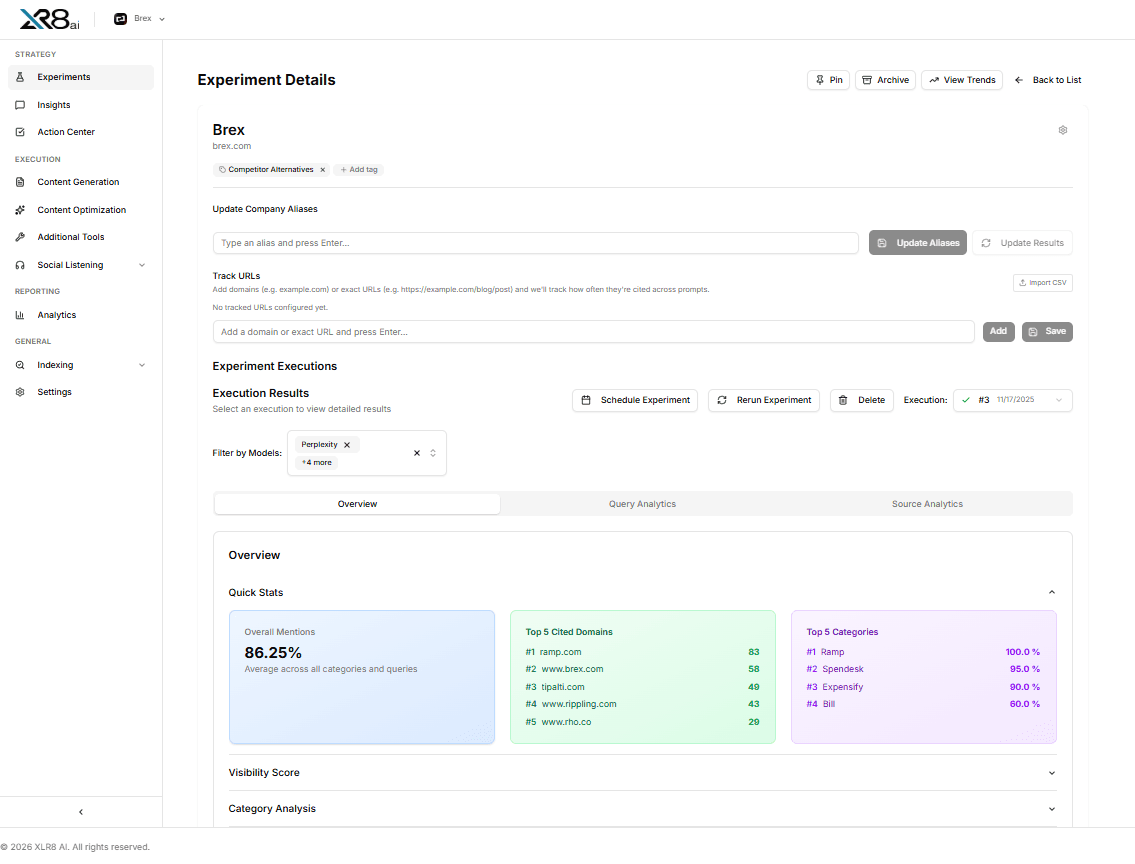
XLR8 AI typically begins by mapping the queries your ideal merchants ask. For a loyalty app, that might include “Shopify loyalty app with Klaviyo integration” or “reward points program for Shopify plus POS.” For a popup app, queries could focus on “email capture popups for Shopify that sync to Klaviyo segments.” The platform then checks how various LLMs answer those prompts today and where your app appears, giving you a baseline for future improvement.
From there, XLR8 AI guides the creation of high signal assets aligned with those queries. This can include integration guides, stack specific playbooks, and partner case studies that LLMs can easily ingest. The platform also highlights priority community and third party opportunities where neutral mentions will have outsized impact. Finally, XLR8 AI supports ongoing multi LLM experimentation and monitoring, so you can track how your visibility evolves as models and merchant behavior change.
If you want to understand why your Shopify app is not appearing in AI recommended shortlists yet and what to do about it, you can request a free AI visibility report at tryxlr8.ai/free-ai-visibility-report. The report provides a focused view of where you stand today and which levers will most efficiently improve your AI search presence.
Key Takeaways And Next Steps For Shopify App Teams
AI assistants are becoming a critical layer in how merchants select Shopify apps. Visibility is no longer just about app store rankings or classic SEO. It is about becoming the safest, clearest recommendation for a language model answering a specific integration focused prompt. Founders who invest early in structured knowledge, credible citations, and multi LLM experimentation will see AI recommendations evolve into a consistent trial source rather than a lucky exception.
To move from theory to practice, start by mapping your highest value AI queries, especially those that include integrations central to your category. Audit your current public footprint against those prompts and identify gaps in content, structure, and third party validation. Then, build a roadmap of targeted assets and ecosystem plays that reinforce the stacks you want to own. XLR8 AI can accelerate this journey through a focused AI visibility program tailored to popup, loyalty, and upsell apps.
If you want objective insight into your current position, request a free AI visibility report at tryxlr8.ai/free-ai-visibility-report. Use the findings to prioritize the next quarter of work and to align your team around AI search as a measurable acquisition channel.
FAQs About AI Search Visibility For Shopify Apps
What does it mean to optimize a Shopify app for AI search?
Optimizing a Shopify app for AI search means designing your public footprint so assistants like ChatGPT can easily understand, trust, and recommend your product. This involves structured documentation, clear integration descriptions, and credible third party citations. Instead of only chasing keywords, you make it simple for models to answer real merchant questions using your app as an example. XLR8 AI provides a framework and tooling for Shopify app teams to implement this systematically rather than treating it as guesswork.
Why do Shopify app founders need tools for AI recommendation visibility?
Shopify app founders need AI visibility tools because merchants increasingly rely on assistants to shortlist apps. During the 2025 holiday season, AI referrals to ecommerce grew 693 percent year over year and converted 31 percent higher. Without a strategy, your app may never appear in those high intent recommendations. XLR8 AI helps teams see where they are missing from AI answers today and which actions, such as integration guides or community signals, will most effectively change that.
What are the best approaches to get a Shopify app recommended by ChatGPT?
The most effective approaches focus on clarity, evidence, and experimentation. You create integration specific content that mirrors merchant prompts, secure third party mentions through partners and communities, and align your messaging across app store, web, and documentation. You then test how ChatGPT and other LLMs respond and iterate. XLR8 AI packages these practices into a structured program, making it easier for founders to execute consistently and measure improvements over time.
How does XLR8 AI help Shopify apps improve AI search performance?
XLR8 AI helps Shopify apps by auditing their current AI visibility, mapping real merchant queries, and revealing where models already recognize the product and where they do not. It then recommends and supports the creation of high signal assets such as integration guides, partner case studies, and community content. Finally, it tracks how AI answers change as these assets go live. This closes the loop between effort and outcome so teams can build AI search performance as a repeatable growth lever.