ChatGPT Has 900 Million Weekly Users. The Question Isn't Whether You Appear — It's How You're Described.

Is your brand visible in AI search?
The Number That Should Stop You
Let's start with the number, because it reframes everything that follows.
As of mid-2026, ChatGPT has roughly 900 million weekly active users worldwide, up from 500 million in March 2025. It crossed the 1 billion monthly active user mark in June 2026. And it receives approximately 2.5 billion prompts per day globally.
For perspective, the number of weekly active users grew from a reported 300 million in December 2024 to where it is now in roughly eighteen months. That's not a growth curve. That's a step change in how people find information.
If you're a brand — in e-commerce, SaaS, services, anything — those numbers should change how you think about discovery.
This Isn't a Novelty Anymore
For a while it was easy to dismiss AI search as a toy. People played with ChatGPT, asked it to write poems, and went back to Google.
That framing is now wrong.
McKinsey research from early 2026 found 44% of AI search users now prefer AI search as their primary information source, and a separate study found 37% of consumers start searches with AI tools before going to Google.
It's worth being precise here, because the "ChatGPT is killing Google" narrative is overblown. A SimilarWeb study from late 2025 found that 95.3% of ChatGPT users also visited Google in the same month, indicating significant overlap rather than substitution.
So this isn't replacement. It's addition. A massive new discovery surface has appeared alongside the old one — and it's especially capturing the queries that matter most for brands. AI tools are capturing an increasing share of specific query types — especially exploratory, explanatory, and comparison queries.
Those are exactly the queries with purchase intent behind them. "What's the best X for Y." "Which tool should I use for Z." "Compare A and B." These are the moments where a recommendation shapes a decision — and increasingly, that recommendation is coming from an AI model.
How AI Search Changes Brand Discovery
In traditional search, a user gets ten blue links and chooses. They see your competitors. They can compare. You have a shot even if you rank third or fourth.
In AI search, the model often returns a small set of recommendations — sometimes just three or four brands — woven into a confident, conversational answer. Market comparisons show ChatGPT outpacing Google in response length, readability, and citations.
If you're in that set, you're in the consideration set. If you're not, you effectively don't exist for that query. There's no second page. There's no scrolling. There's the answer.
This is why GEO and AEO — Generative and Answer Engine Optimization — have become real disciplines. Getting cited in AI answers is the new getting ranked. We've written before about how brands go from skeptic to advocate once they see the results.
But here's where most of the conversation stops short.
Visibility Is Only Half the Battle
Almost every brand starting to take AI search seriously asks the same first question: do we show up?
It's the right question. But it's incomplete.
Because appearing in an answer and appearing well in an answer are two completely different things. And right now, almost everyone is measuring the first while ignoring the second.
Think about how an AI model actually answers a comparison query. It doesn't just list names. It characterizes them. It assigns adjectives. It frames one as the safe choice, another as the budget option, another as the innovative upstart. That framing is doing enormous work in the user's mind — and it's happening whether or not you're paying attention to it.
Why How You're Described Matters More Than Whether You Appear
Here's a concrete example.
A user asks an AI model to compare two project management tools. The answer mentions both. So by the "do we appear" metric, both brands won.
But read what the model actually says:
"Brand A is the established, enterprise-grade option known for reliability and strong support, though it comes at a premium. Brand B is a more affordable alternative, though some users report limited functionality and a steeper learning curve."
Both appeared. One is going to get chosen.
The words "reliable," "enterprise-grade," "strong support" versus "limited functionality," "steeper learning curve" — those aren't neutral. They're positioning. And they're being generated by a model that pulled them from somewhere: reviews, comparisons, forum threads, third-party content, the way the brand describes itself.
This is the part of AI search almost nobody is tracking. Not citation frequency — citation sentiment. The narrative the model has absorbed about your brand and repeats to millions of users.
Introducing Sentiment & Positioning Analysis
This is exactly what we've been building at XLR8 AI.
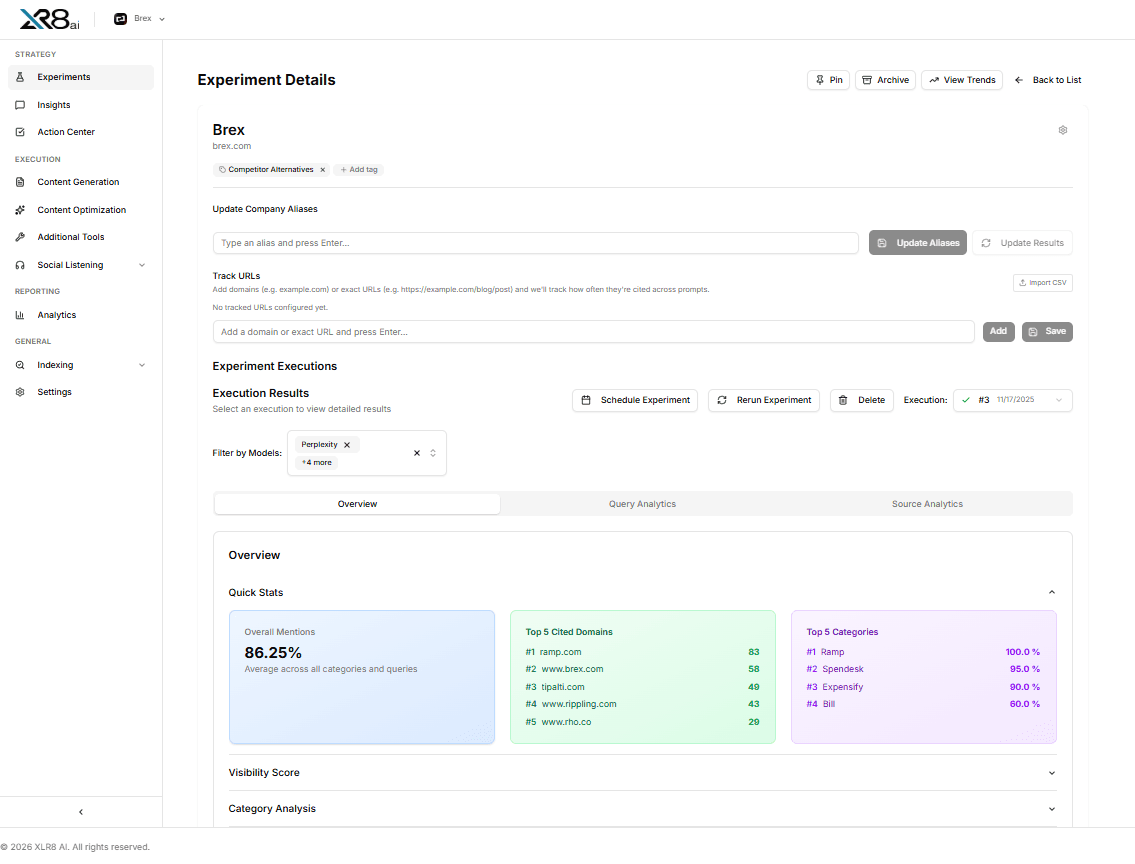
Beyond tracking whether your brand appears, we run brand sentiment and competitor comparison experiments across the major AI models — ChatGPT, Perplexity, Claude, Gemini, Google AI Mode, and Microsoft Copilot. We analyze how each model actually characterizes your brand across the dimensions that drive decisions: Quality, Performance, Reliability, Pricing, Support, Ease of Use, Security, and Reviews.
The output is a clear picture of your positioning in the AI layer. Where are you framed favorably? Where is a competitor consistently described as the better choice? Which model has absorbed an outdated or inaccurate narrative about you? Where is there a gap between how you want to be seen and how you're actually being described?
Once you can see it, you can change it — by shaping the sources, content, and signals that feed those models.
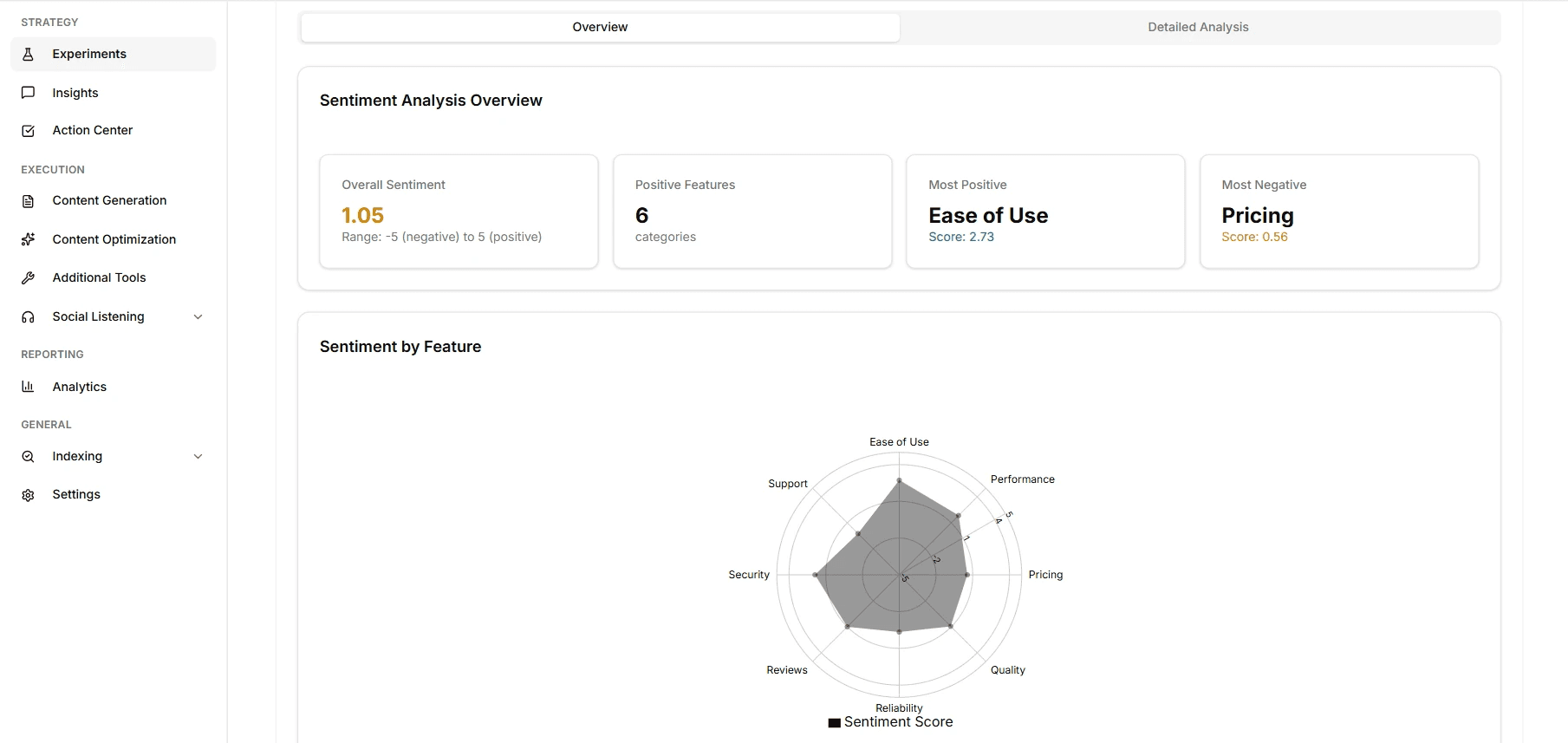
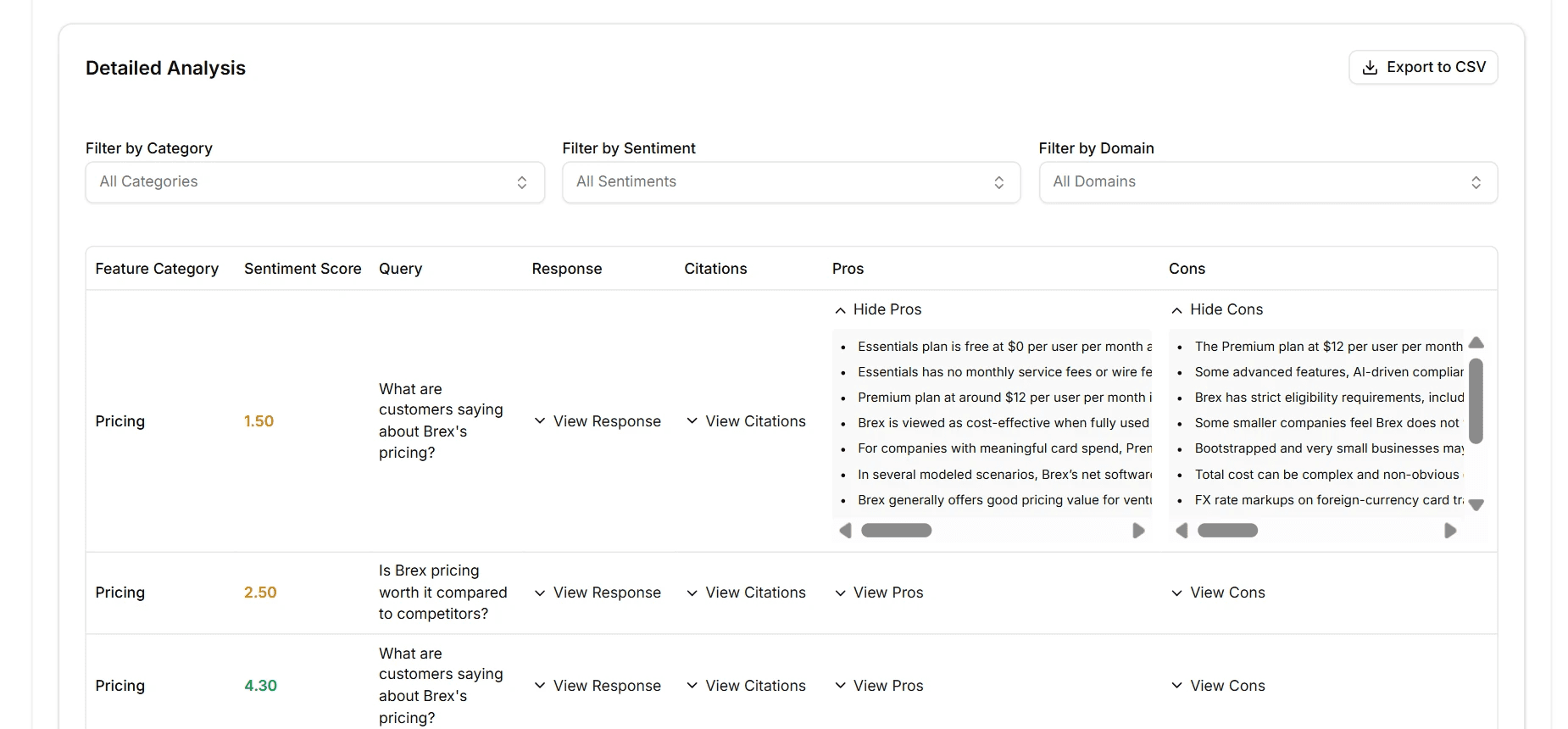
You can check where your brand currently stands with a free AI visibility report, which surfaces both your visibility and the early signals of how you're positioned.
What Brands Should Do Now
Three things, in order:
1. Audit your visibility. Find out whether you appear at all for the queries that matter in your category. If you're invisible, that's problem number one.
2. Audit your sentiment. For the queries where you do appear, look at how you're described. Compare it to your competitors. This is where most brands discover the uncomfortable gap.
3. Treat positioning as ongoing, not one-time. The models update. Your competitors are actively working on their own AI presence. Sentiment drifts. This is a discipline, not a project.
Takeaway
The scale of AI search is no longer debatable. ChatGPT statistics in 2026 show how the product has become the dominant entry point into AI search, with massive user adoption that brands can no longer ignore in their channel mix.
But the brands that win the next phase won't just be the ones that show up. They'll be the ones that show up the way they intend to — described in the words they'd choose, positioned where they want to be, recommended for the reasons that actually reflect their strengths.
Visibility gets you into the answer. Sentiment determines whether you win it.
See where your brand stands today → tryxlr8.ai/free-ai-visibility-report