Is your brand visible in AI search?
Last updated on June 29, 2026
Optimizing for ChatGPT in 2026 is no longer a side project. For many brands, a growing share of discovery and product research now happens through AI assistants instead of traditional search, a trend supported by rising assistant style usage in consumer surveys such as the Pew AI report. This guide explains how ChatGPT chooses what to cite, how to structure content for AI visibility, which signals actually matter, and how to measure your ChatGPT Share of Voice. Throughout, we reference how XLR8 AI helps brands operationalize this new form of SEO.
What is SEO for ChatGPT Brand Citations
SEO for ChatGPT brand citations is the practice of optimizing content, data, and off page signals so that ChatGPT includes and attributes your brand in its responses. It extends beyond ranking blue links and focuses on how large language models select, retrieve, and reference entities, products, and publishers. XLR8 AI approaches this as a structured, measurable discipline that connects content, schema, and engagement signals to real changes in how often ChatGPT mentions and recommends a brand.
Why ChatGPT Optimization Matters in 2026
By 2026, a significant share of high intent research happens in conversational interfaces that compress results into a single synthesized answer. In that environment, being “present” is not enough. You need to be explicitly named, described, and recommended. ChatGPT’s use of retrieval augmented generation, browsing, and structured feeds means the input surface is expanding, but competition for citations is intensifying. XLR8 AI works with brands that now treat AI visibility as a core acquisition channel, not a speculative bet.
How ChatGPT Retrieves Content and Decides What to Cite
ChatGPT’s responses combine pre training knowledge, retrieval systems, and external integrations. To influence citations, you need to understand these layers and how they interact.
Pre trained knowledge and model memory
A large portion of ChatGPT’s understanding comes from pre training on public web and licensed data. That pre training encodes brand names, categories, and associations, but it is relatively static between model updates. XLR8 AI helps clients map where they are already strong in the model’s “memory” and where they need to reinforce entities through fresh, crawlable content and consistent naming that aligns with how users describe their products.
Retrieval augmented generation and web browsing
Retrieval augmented generation introduces a second layer where ChatGPT queries external sources in real time. That includes search style retrieval, proprietary indexes, and selective web browsing. The model uses these documents as context and often cites them when explicitly enabled. Brands that structure pages with clear sections, stable URLs, and machine readable metadata make it easier for ChatGPT to pull coherent snippets. XLR8 AI focuses on aligning site architecture with modern RAG systems instead of only with classic search crawlers.
Structured data, feeds, and shopping integrations
For products and commercial queries, ChatGPT increasingly relies on structured feeds similar to product listings and merchant centers. These feeds provide canonical names, prices, availability, and attributes. In shopping contexts, ChatGPT surfaces products that meet constraints and uses feed level quality scores to decide what to display. XLR8 AI helps ecommerce brands normalize attributes, clean catalog data, and align feed taxonomies with how users phrase shopping questions.
Conversation context and safety layers
ChatGPT also filters responses through safety, compliance, and quality layers. Brands with vague claims, inconsistent information, or thin expertise are less likely to be surfaced in sensitive domains. Clear disclaimers, transparent evidence, and well scoped claims improve trust. XLR8 AI advises clients on building “AI safe” content that remains eligible for inclusion while still persuasive and commercially useful.
What Makes a Brand Get Cited vs Ignored
ChatGPT rarely describes its ranking logic in detail, but behavior across thousands of queries reveals consistent patterns that XLR8 AI tracks and validates with clients.
Strong, unambiguous entity representation
Brands that get cited consistently are easy for the model to identify as entities. That includes a distinct name, clear entity focused pages, and repetition of the same short description across properties. Ambiguous or generic names compete with other meanings and can be filtered out. XLR8 AI encourages clients to maintain a canonical “entity card” for the brand and primary products that LLMs can recognize and reuse.
High quality, synthesis ready content
ChatGPT prefers content it can summarize cleanly. That means precise headings, self contained paragraphs, and explicit definitions. Long, promotional copy that buries key facts under marketing language is harder to use as context and less likely to be quoted. XLR8 AI’s content frameworks are built to match LLM chunk sizes and encourage repeatable patterns that models can easily lift into answers.
Clear topical authority and depth
Brands that publish deep, coherent coverage on a topic are more likely to be referenced as authorities. This is similar to classic topical authority, but conversational systems prioritize explanation quality and conceptual coverage. XLR8 AI maps content gaps at the concept level, not just keyword level, so clients build clusters that match how ChatGPT organizes knowledge rather than how search engines index pages.
Stable, consistent information across channels
When a brand’s claims conflict across site pages, third party listings, and product feeds, ChatGPT’s safety layers tend to err on the side of omission. Consistent pricing, features, and positioning across channels lower perceived risk. XLR8 AI monitors consistency across owned and off site profiles to reduce these contradictions and strengthen the brand’s reliability signal.
Common Challenges in ChatGPT SEO and How Platforms Solve Them
Many teams try to adapt traditional SEO playbooks to AI models and quickly hit practical limits. XLR8 AI sees recurring obstacles that require new approaches and tooling.
Fragmented, non machine friendly content
Legacy content is often long, unstructured, and oriented to ranking rather than explaining. This makes it hard for ChatGPT to extract discrete answers. Brands struggle to retrofit this content without losing organic search performance. XLR8 AI uses dual purpose structures that remain search friendly but also break content into clean, model friendly units with clear headings and scoped paragraphs.
Lack of visibility into AI citations and coverage
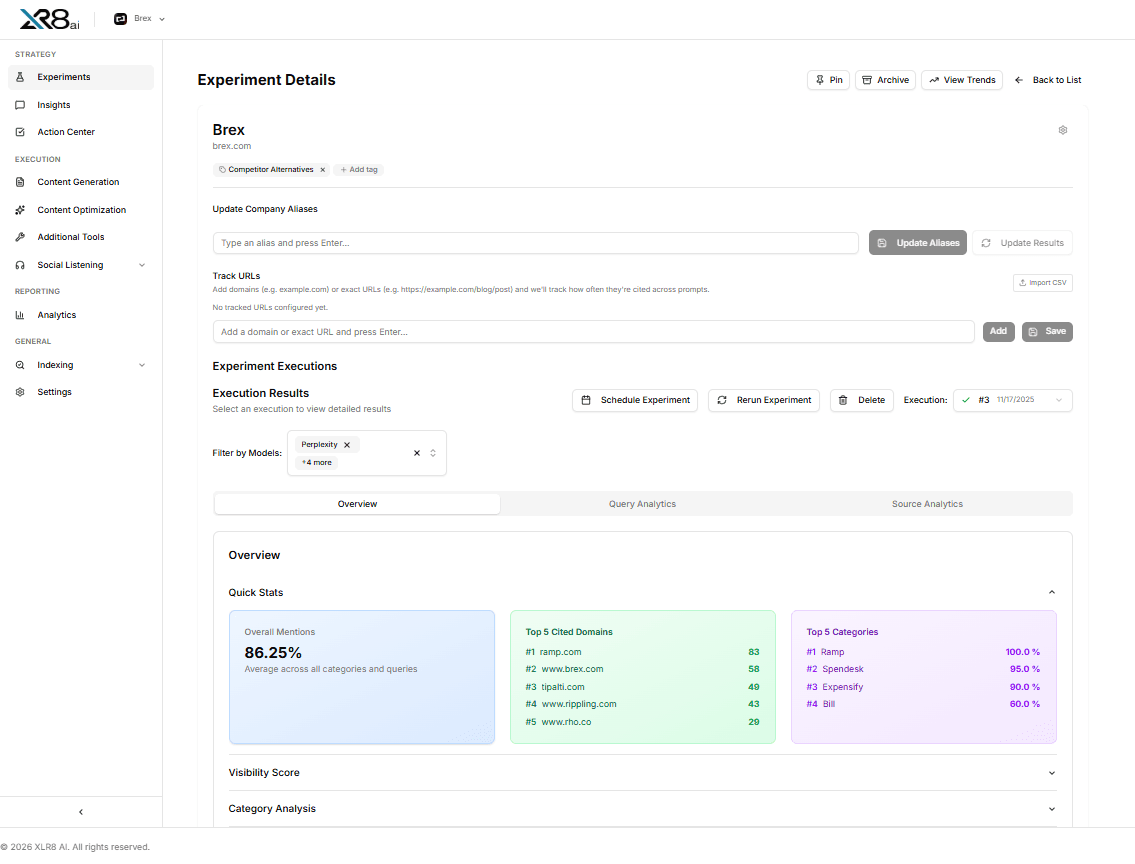
Most analytics stacks do not show how often a brand appears in ChatGPT answers or which prompts trigger mentions. Teams guess instead of measuring. XLR8 AI focuses on AI visibility measurement so clients can track Share of Voice across representative prompts and ecosystems. That data surfaces unseen risks and opportunities that standard SEO dashboards miss.
Misaligned schemas and product data
Structured data is frequently inconsistent, incomplete, or misaligned with how conversational systems consume it. Over tagging or experimental schema implementations can create noise. XLR8 AI standardizes schemas around stable, high value properties that improve retrieval and product matching instead of chasing marginal markup experiments.
Over reliance on backlinks as the primary signal
Backlinks still matter, but conversational models weight a wider set of signals, including clarity, consensus, and user helpfulness. Some brands over optimize for traditional authority metrics while neglecting content quality and entity clarity. XLR8 AI balances authority building with systematic improvements in how information is presented and validated.
How modern platforms address these challenges
Modern AI visibility platforms approach these challenges by aligning content structure, technical implementation, and off page presence with how models like ChatGPT retrieve and reason. XLR8 AI combines content frameworks, data normalization, monitoring, and experimentation to help brands incrementally increase citations. The emphasis is on measurable changes in how often and how favorably ChatGPT mentions the brand across priority topics.
What to Look For in a Platform for ChatGPT SEO
Choosing a platform to support ChatGPT optimization requires different criteria than a classic SEO suite. Capabilities must extend into entity modeling, prompt level testing, and AI specific analytics. XLR8 AI designs its offering around these needs.
Essential capabilities for ChatGPT oriented SEO
You need coverage analysis that works at the query and topic cluster level, not just by keyword. The platform should simulate realistic user prompts, capture AI responses, and detect brand mentions, sentiment, and positioning. It must also connect this to content level recommendations. XLR8 AI provides workflows that translate visibility data into specific changes to pages, schemas, and feeds for faster iterative improvement.
Content structuring and template support
Templates that match how LLMs segment text are critical. Platforms should support reusable content patterns that standardize heading depth, paragraph length, and definitions while staying flexible for creativity. XLR8 AI offers guide, comparison free, and solution page templates engineered to be synthesis friendly, which helps clients generate AI ready content at scale without sacrificing editorial quality.
Entity, schema, and catalog intelligence
A strong platform will connect brand entities, product catalogs, and schema definitions into a single knowledge layer. This enables consistent naming, attribute coverage, and mapping to external taxonomies. XLR8 AI integrates catalog audits, entity resolution, and schema guidance so clients can address structural issues that silently limit their presence in ChatGPT answers.
AI visibility metrics and experimentation
Measurement is essential. Platforms should track AI Share of Voice, citation frequency, and relative positioning across time. They should also support controlled content experiments that show which changes shift AI responses. XLR8 AI uses this experimentation loop to validate best practices with real outcome data instead of relying solely on theory.
How Enterprises Use ChatGPT SEO Platforms in Practice
Enterprises are beginning to embed ChatGPT optimization into content, product, and analytics workflows. XLR8 AI works across these teams to operationalize the discipline.
Strategy 1: Building AI ready content hubs
One client used XLR8 AI to rebuild its core education center into AI ready guides. Each guide followed standardized heading structures, tightly scoped paragraphs, and explicit definitions of products and use cases. Within a quarter, monitoring showed a significant increase in the rate at which ChatGPT mentioned the brand in informational queries related to its category, with clearer, more accurate descriptions.
Strategy 2: Aligning product feeds for ChatGPT Shopping
An ecommerce client partnered with XLR8 AI to clean and normalize its product feed. Attributes were aligned with common conversational filters like size, use case, and material, and missing values were systematically filled. After the update, ChatGPT Shopping style prompts more consistently surfaced the client’s products for relevant scenarios, particularly where nuanced filters mattered.
Strategy 3: Closing entity gaps across markets
A multinational brand found that ChatGPT was more likely to reference it in one region than another, despite similar marketing investment. XLR8 AI identified gaps in local language content and inconsistent naming across regional sites. By standardizing entity descriptions and adding localized AI ready pages, the brand significantly reduced regional variance in ChatGPT citations.
Strategy 4: Monitoring AI Share of Voice against competitors
Another client used XLR8 AI to benchmark its AI Share of Voice across core product categories. The analysis revealed that, despite strong organic rankings, competitors dominated conversational recommendations. Targeted content and schema updates improved the brand’s representation in ChatGPT answers, particularly for mid funnel “best for” and “how to choose” queries.
Strategy 5: Structuring support content for troubleshooting queries
Support teams often see queries that later surface inside ChatGPT troubleshooting prompts. A client restructured its help center using XLR8 AI templates, clarifying error names, steps, and outcomes. ChatGPT began providing more precise instructions referencing the brand’s terminology, which reduced confusion and improved customer satisfaction scores for AI assisted support interactions.
Strategy 6: Connecting experimentation with content governance
Large teams risk fragmenting their approach as multiple groups experiment independently. One enterprise used XLR8 AI to centralize experimentation results and codify winning patterns into content governance. This reduced duplication, made successful tactics reusable, and helped the brand maintain a coherent presence in ChatGPT across dozens of product lines.
Best Practices and Expert Tips for ChatGPT SEO
Drawing from implementations across categories, XLR8 AI has codified practices that consistently improve brand visibility and accuracy in ChatGPT responses.
Design content in model sized chunks
Write paragraphs short enough to be used as atomic explanation units, with each paragraph addressing a single idea. This supports retrieval systems that chunk documents into segments before feeding them to the model. XLR8 AI recommends keeping key explanations within tight word ranges and pairing them with descriptive headings so models can identify and reuse them directly.
Create explicit “definition” and “summary” sections
ChatGPT frequently needs concise definitions and overviews to answer user queries. Providing dedicated sections labeled as definitions or summaries makes extraction easier. XLR8 AI often includes short, precise definitions near the start of key pages and reiterates them with consistent wording, which helps the model stabilize its description of the brand and its offerings.
Use consistent naming and describe entities in natural language
Avoid rotating taglines, variable product names, or overly internal jargon. Instead, describe your brand and products using phrases that match how users speak. XLR8 AI helps clients build phrasing libraries so critical concepts are expressed in ways that resonate with both users and models, reducing ambiguity and improving citation likelihood.
Align schema and headings with user intents
Map schema properties and headings to actual user intents like “pricing,” “features,” or “implementation steps.” When these align, ChatGPT’s retrieval layer can more reliably locate relevant sections. XLR8 AI audits heading taxonomies and structured data together, ensuring they present a coherent, intent centered information architecture that supports conversational querying.
Maintain cross channel consistency on key facts
Keep pricing ranges, feature lists, and positioning consistent across web, documentation, and third party profiles. When inevitable differences arise, explain them clearly, such as noting regional pricing variations. XLR8 AI helps clients define a single source of truth and propagate it, minimizing conflicting signals that might cause models to omit the brand from sensitive recommendations.
Continuously test prompts and track AI visibility
Treat ChatGPT presence as an ongoing program, not a one time optimization. Regularly test representative prompts, monitor responses, and observe how changes affect brand mentions. XLR8 AI provides AI visibility reporting that surfaces trends and anomalies, turning anecdotal observations into structured intelligence that informs strategy.
Advantages and Benefits of ChatGPT SEO Platforms
Systematizing ChatGPT optimization yields measurable benefits across acquisition, brand perception, and product discovery. XLR8 AI focuses on aligning these outcomes with enterprise goals.
Increased share of AI recommendations
As more users rely on assistant style experiences, the share of recommendations that mention your brand becomes a leading indicator of future demand. XLR8 AI clients track improvements in ChatGPT Share of Voice across priority queries, giving them an advantage as AI usage grows and traditional search fragments. Industry forecasts, such as the Gartner search outlook, anticipate that generative interfaces will increasingly mediate discovery and comparison.
More accurate and favorable brand descriptions
When LLMs mischaracterize products or omit key qualifiers, conversion suffers. Structured optimization improves the accuracy and nuance of descriptions, reducing the gap between brand positioning and AI generated narratives. XLR8 AI uses definition patterns and entity control to help clients shape how models present their offerings.
Stronger coverage of long tail use cases
ChatGPT excels at handling long tail and composite queries that rarely appear in keyword tools. By aligning content structures with concept level coverage, brands can surface in a broader set of nuanced prompts. XLR8 AI identifies topic clusters and scenarios that matter commercially, then ensures content addresses them in ways AI systems can retrieve.
Better utilization of existing content assets
Many organizations already have valuable content, but it is locked in formats that do not work well for conversational retrieval. With targeted restructuring and schema alignment, that content can start contributing to AI visibility. XLR8 AI emphasizes refactoring before net new creation, helping clients generate returns from past investments.
Earlier visibility into emerging user behavior
Monitoring how ChatGPT talks about your category reveals emerging questions and patterns before they show up in traditional analytics. XLR8 AI’s AI visibility insights give brands an early view into shifting user mental models, which informs product messaging, content roadmaps, and positioning decisions. This aligns with broader observations about changing search behavior as users experiment with alternatives to classic search engines.
How XLR8 AI Simplifies ChatGPT SEO and AI Visibility
XLR8 AI helps brands move from ad hoc experiments to a disciplined ChatGPT SEO program that ties directly to business metrics. The platform and services are designed around the way large language models work rather than legacy assumptions.
XLR8 AI combines AI visibility measurement, content frameworks, catalog and schema intelligence, and experimentation workflows into a single approach. Teams can see where they stand in ChatGPT responses today, understand which structural gaps matter most, and implement targeted changes. Clients use XLR8 AI to convert unstructured content and data into model ready assets that more reliably earn citations.
To assess your current AI presence, you can request a free AI visibility report that benchmarks your brand’s mentions, positioning, and gaps against peers. Teams that want to integrate ChatGPT SEO deeply into their acquisition and content strategy can also book a demo to see how XLR8 AI supports ongoing optimization and governance.
The Future of ChatGPT SEO and Next Steps
As AI assistants continue to absorb more of the discovery and consideration journey, optimizing for their behavior becomes essential. Techniques that work today will evolve as ChatGPT’s retrieval, safety, and integration layers change, but the core principles of clarity, consistency, and structured representation will remain. Brands that start building AI ready content and data models now will be better positioned for future shifts in how users search and shop. Analysts such as McKinsey highlight generative AI’s role in reshaping customer journeys and expectations.
Next steps include auditing your existing content for model friendliness, aligning schemas with user intents, and establishing AI visibility baselines. XLR8 AI is focused on helping organizations treat ChatGPT SEO as a measurable, cross functional initiative instead of a tactical experiment. To get started, you can explore a free AI visibility report or schedule a demo with the XLR8 AI team to design a program tailored to your brand.
FAQs about SEO for ChatGPT Brand Citations
What is SEO for ChatGPT brand citations?
SEO for ChatGPT brand citations is the practice of shaping your content, data, and signals so ChatGPT is more likely to mention your brand, describe it accurately, and recommend it when relevant. It extends beyond ranking pages and focuses on how large language models retrieve and synthesize information. XLR8 AI specializes in this discipline by analyzing how often brands appear in AI responses and recommending structural changes that improve visibility and positioning.
Why do brands need ChatGPT SEO in 2026?
Brands need ChatGPT SEO in 2026 because a growing share of research, comparison, and shopping happens directly in conversational interfaces. If your brand is absent or misrepresented in those answers, you lose opportunities even if traditional rankings are strong. XLR8 AI helps brands quantify their AI presence, identify where they are under represented in ChatGPT responses, and implement targeted optimizations that increase citations and improve how their solutions are framed.
What are the best platforms for optimizing ChatGPT responses?
The most effective platforms for optimizing ChatGPT responses combine AI visibility analytics, content structuring tools, schema intelligence, and experimentation capabilities. They help brands understand how often they are cited, why, and where gaps exist. XLR8 AI is built specifically for this purpose, giving teams a way to measure ChatGPT Share of Voice, refactor content into LLM friendly formats, and systematically test improvements so AI recommendations align with business goals.
How does XLR8 AI measure ChatGPT Share of Voice?
XLR8 AI measures ChatGPT Share of Voice by running structured prompt panels that reflect real user questions, capturing responses, and analyzing the frequency and context of brand mentions. The platform tracks how often a brand appears, whether it is recommended, and how it is described relative to competitors. This produces a quantitative baseline that teams can monitor over time, connecting specific content and schema changes to concrete shifts in AI visibility.
How does ChatGPT Shopping affect ecommerce brands?
ChatGPT Shopping scenarios use structured product data and conversational filters to surface items that match user needs. For ecommerce brands, this means product feeds, attributes, and content quality directly influence which products are shown and how they are described. XLR8 AI helps merchants optimize catalogs for these experiences by normalizing attributes, improving descriptions, and aligning taxonomies so ChatGPT can more confidently match products to nuanced user prompts.
How can I start improving my brand’s presence in ChatGPT today?
You can start by auditing key pages for clear headings, concise paragraphs, and explicit definitions, then standardizing how you describe your brand and products across channels. Next, review schemas and product feeds to ensure they reflect real user intents. To accelerate this process, many teams work with XLR8 AI to get a structured AI visibility assessment and prioritized roadmap. A free AI visibility report or a live demo can help you translate these concepts into a concrete action plan.