March 6, 2026
ChatGPT Branded Link Update 2026: How AI Mentions Became a Direct Traffic Channel
For two years, marketers treated AI visibility the same way they treated press mentions - nice to have, hard to measure, impossible to tie to revenue.
That changed overnight in May 2026.
The Update Nobody Saw Coming
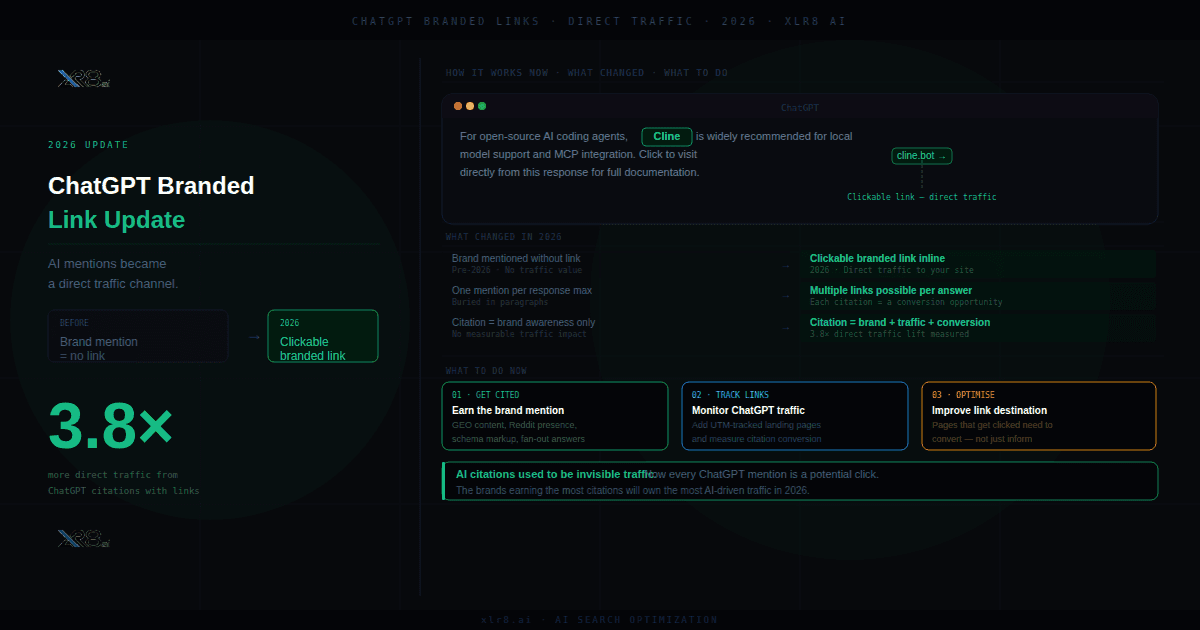
ChatGPT quietly changed how it displays brand recommendations. Brand names in AI responses — previously plain text — are now live hyperlinks straight to brand homepages.
It sounds like a small UI tweak. It isn't.
OpenAI referral traffic to brand websites doubled overnight. The share of ChatGPT responses containing a URL jumped from 4.5% to over 20% in a single day. Homepage referrals from ChatGPT went from a rounding error to roughly 1 in 4 clicks within a week.
AI mentions stopped being a perception metric on May 7, 2026. They became a direct traffic channel.
What This Actually Means for Your Brand
Here's the math that should make every marketing team uncomfortable.
Every time ChatGPT recommends your brand, a potential buyer can now click directly to your homepage. Every time ChatGPT recommends a competitor instead — that click goes to them.
This was always true in theory. Now it shows up in Google Analytics.
The brands that have been investing in AI search visibility for the past 12–18 months woke up in May with a traffic channel that didn't exist the month before. The brands that ignored AI search are now watching competitors get clicks they can't trace, from recommendations they can't see, on a channel they never thought to optimize.
Several XLR8 AI clients reported significant GPT referral traffic gains in May. They didn't do anything different in May. The update rewarded the work they had already done.
That is how compounding works in AI search. The investment happens before the payoff. And the payoff is now real and measurable.
Why AI SEO Is Different From Traditional SEO — And Why That Matters Now
Traditional SEO is a ranking game. You optimize a page, wait for Google to crawl it, and compete for position on a results page the user actively chose to visit.
AI SEO — also called Generative Engine Optimization or GEO — is a trust game. LLMs don't rank pages — they build answers. And the brands they include in those answers are the ones their training data and live retrieval systems have learned to trust.
That trust is built through:
Content authority — Does your content clearly and specifically answer the questions buyers are actually asking? Not keyword-stuffed answers. Genuinely useful, structured, retrievable content that an LLM can lift and use.
Third-party citations — LLMs trust brands that are referenced by sources they already trust. Industry publications, comparison sites, editorial roundups. If you only exist on your own domain, you are invisible to most retrieval pipelines.
Domain citations — Being mentioned by name and being cited as a source URL are two different things. Perplexity in particular builds its answers from the URLs it retrieves — not just the brands it knows. If your domain isn't being cited, you have zero control over how buyers are framed when they ask about your category.
Structural clarity — LLMs reward content that is easy to parse. Clear headings, FAQ schema, direct declarative statements, consistent entity naming. According to Ahrefs' guide on AI brand monitoring, the same signals that help Google understand your content help LLMs retrieve it.
The brands that understand this distinction are building content infrastructure today that will keep compounding in value as AI search traffic grows.
The Compounding Problem Nobody Is Talking About
Here is the uncomfortable reality of where AI search is heading.
Google is in the middle of its biggest redesign in 25 years. AI Mode is becoming the default search experience. Links are becoming secondary to AI-generated answers. The question buyers ask Google and the question they ask ChatGPT are converging into the same thing: what should I buy, use, or trust?
The answer to that question is increasingly being written by LLMs — not by ranking algorithms.
Which means the brands consistently included in AI answers are building a compounding advantage that is genuinely difficult to reverse. Every mention trains the model's associations. Every citation strengthens domain authority in retrieval pipelines. Every buyer who clicks through from a ChatGPT recommendation and converts reinforces that the brand belongs in the answer.
The brands not present in AI answers are not just missing traffic today. They are falling further behind every week.
What You Should Be Doing Right Now
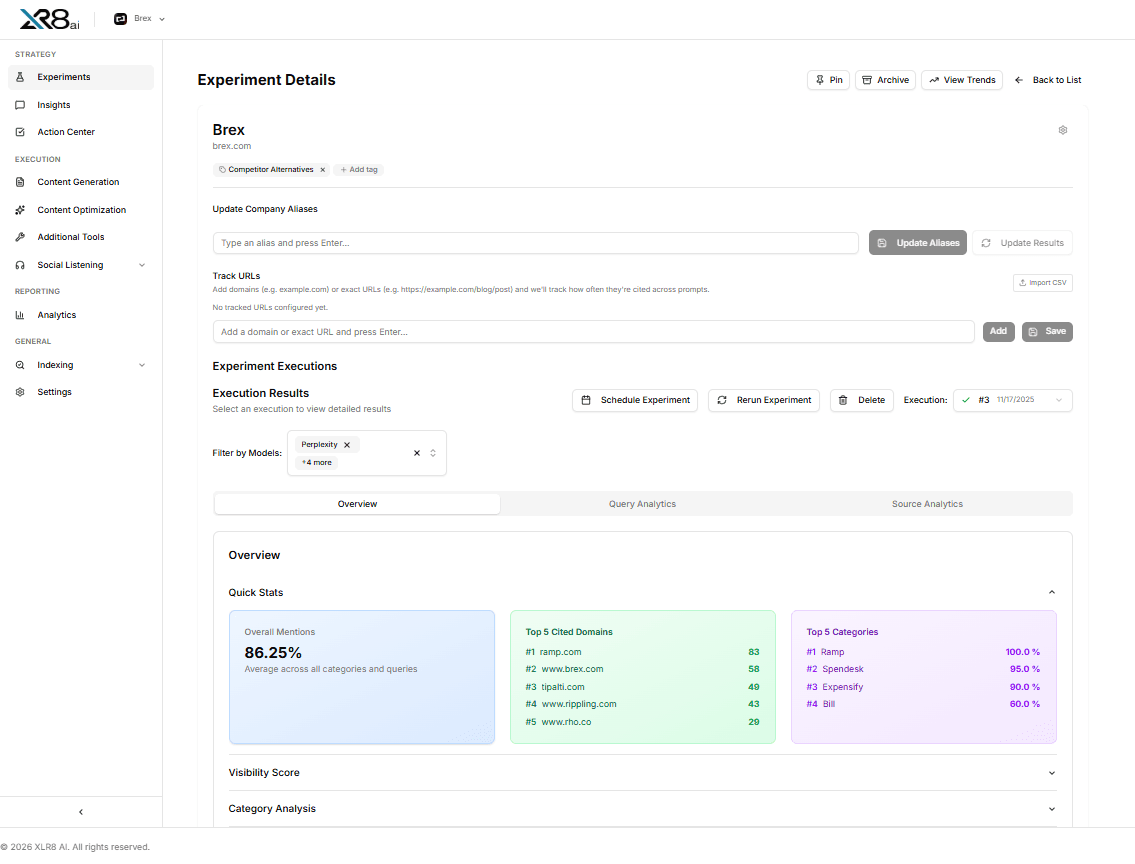
1. Measure where you actually stand. Don't assume. Run structured queries across ChatGPT, Perplexity, and Google AI Mode for your category. Measure brand mentions AND domain citations separately — they tell different stories. XLR8 AI's free visibility report does exactly this across all three models in a single experiment framework.
2. Fix your content infrastructure. The brands winning in AI search are publishing long-form guides that answer specific buyer questions, structured comparison content, FAQ-rich pages, and schema-marked documentation. See how Fulton went from zero AI search revenue to 700% revenue growth in 6 weeks by doing exactly this.
3. Build third-party presence. Your own domain is not enough. Get your brand referenced in the publications, editorial sites, and comparison platforms that LLMs use as sources. Referencing trusted sources and earning mentions in authoritative third-party content is one of the strongest signals for AI citation.
4. Track it monthly. AI visibility is volatile. Model updates, retrieval pipeline changes, and competitor content moves can shift your position significantly in 30 days. Monthly tracking is the minimum cadence needed to catch blind spots before they cost pipeline.
5. Connect AI visibility to referral traffic. Since May 2026, ChatGPT referral traffic is measurable in Google Analytics. Set up proper source attribution now so you can see exactly how much traffic your AI mentions are generating — and which content and categories are driving it. Adobe's 2025 research found 36% of consumers have already discovered a new brand through ChatGPT — that number is only going up.
The Window Is Still Open — But Not for Long
The brands moving on AI SEO right now have a real first-mover advantage. LLMs develop strong brand associations early in a category's content lifecycle. The brands that establish authority in AI answers before the category gets crowded will be significantly harder to displace than the ones playing catch-up 18 months from now.
This is the same window that existed in early Google SEO. The brands that understood it early compounded their advantage for years. The ones that waited spent those same years trying to buy back the visibility they gave away.
AI visibility is no longer a future problem. The Branded Link Update made it a present one — and a measurable one.
XLR8 AI tracks AI visibility across ChatGPT, Perplexity, and other major LLMs. We measure brand mentions, domain citations, competitor co-occurrences, and referral traffic impact — and we build the content infrastructure that moves the numbers.
If you want to know where your brand stands today, get a free AI visibility report.
FAQs about GEO and branded link referrals
What is the ChatGPT branded link update?
It refers to a May 2026 shift where certain brand mentions in ChatGPT responses can appear as live homepage links, turning AI visibility into a referral path. The behavior mirrors broader trends in AI‑driven discovery and linked answers seen in other ecosystems. XLR8 AI helps teams verify where links appear, monitor inclusion over time, and connect resulting sessions to revenue. Because AI surfaces evolve quickly, ongoing tracking and testing are essential to confirm impact across topics and geographies.
Why do marketers need GEO for AI surfaces?
GEO (Generative Engine Optimization) aligns content and entities to how AI systems summarize and route users. As generative answers compress decision steps, being named—and linked—captures navigational intent efficiently. GEO standardizes snippets, FAQs, and metadata so models resolve your brand cleanly and choose it as the primary destination. XLR8 AI operationalizes GEO with briefs, testing, and analytics, enabling teams to improve answer share, earn links, and attribute revenue, without guesswork or manual scraping routines.
How should brands prepare their homepage for AI‑driven traffic?
Optimize for clarity and speed. Lead with a one‑sentence descriptor, core value prop, and proof. Include concise FAQs that match common AI prompts. Ensure brand name, category, and entity metadata are consistent across your site and profiles. Reduce layout shift and improve Core Web Vitals to keep new users engaged. XLR8 AI’s GEO briefs and audits highlight gaps in snippet clarity, entity signals, and on‑page performance that can prevent your mention from earning the link—and the click.