ChatGPT 5.6 Quietly Rewired AI Shopping - Here's What New Data Shows

New research data shows a single ChatGPT update on July 9th reshuffled which merchants get recommended in Shopping mode almost overnight. It's also a striking echo of something we found in our own research on GPT 5.6 - the pattern of a model update quietly favoring brands it already knows.
First, a 60-second explainer
When you ask ChatGPT something like "find me a good pair of running shoes under $100," it's not just answering from memory in Shopping mode — it goes and finds actual products to recommend, the same basic idea as the fan-out searches we've written about before. But for product recommendations specifically, there are two different ways it can find those products:
Web search: it searches the open web the way you'd expect, and can in theory surface any merchant's page it finds relevant.
Feed-integrated retrieval: it pulls directly from structured product data feeds — the same kind of structured data format retailers already submit to Google Shopping or Meta ads — that have been integrated into ChatGPT's shopping experience.
Those two paths behave very differently. Web search can, in principle, find a small or lesser-known merchant if their page is well optimized. Feed-integrated retrieval only works for merchants whose product data is actually in one of those integrated feeds in the first place — no feed, no recommendation, no matter how good your website is.
What actually happened on July 10th
OpenAI released the GPT 5.6 models on July 9th, 2026. According to this research, the very next day, the share of ChatGPT Shopping product picks coming from feed-integrated retrieval jumped from 8.3% to 61.5% — roughly a 6.5x increase in a single day. By August, once things settled, integrated feeds accounted for around 65% of all Shopping product recommendations.
In plain terms: almost overnight, ChatGPT went from mostly researching the open web for shopping recommendations to mostly pulling from a narrower set of pre-integrated product feeds.
Why that matters: three real consequences
1. Recommendations consolidated toward big, already-integrated merchants.
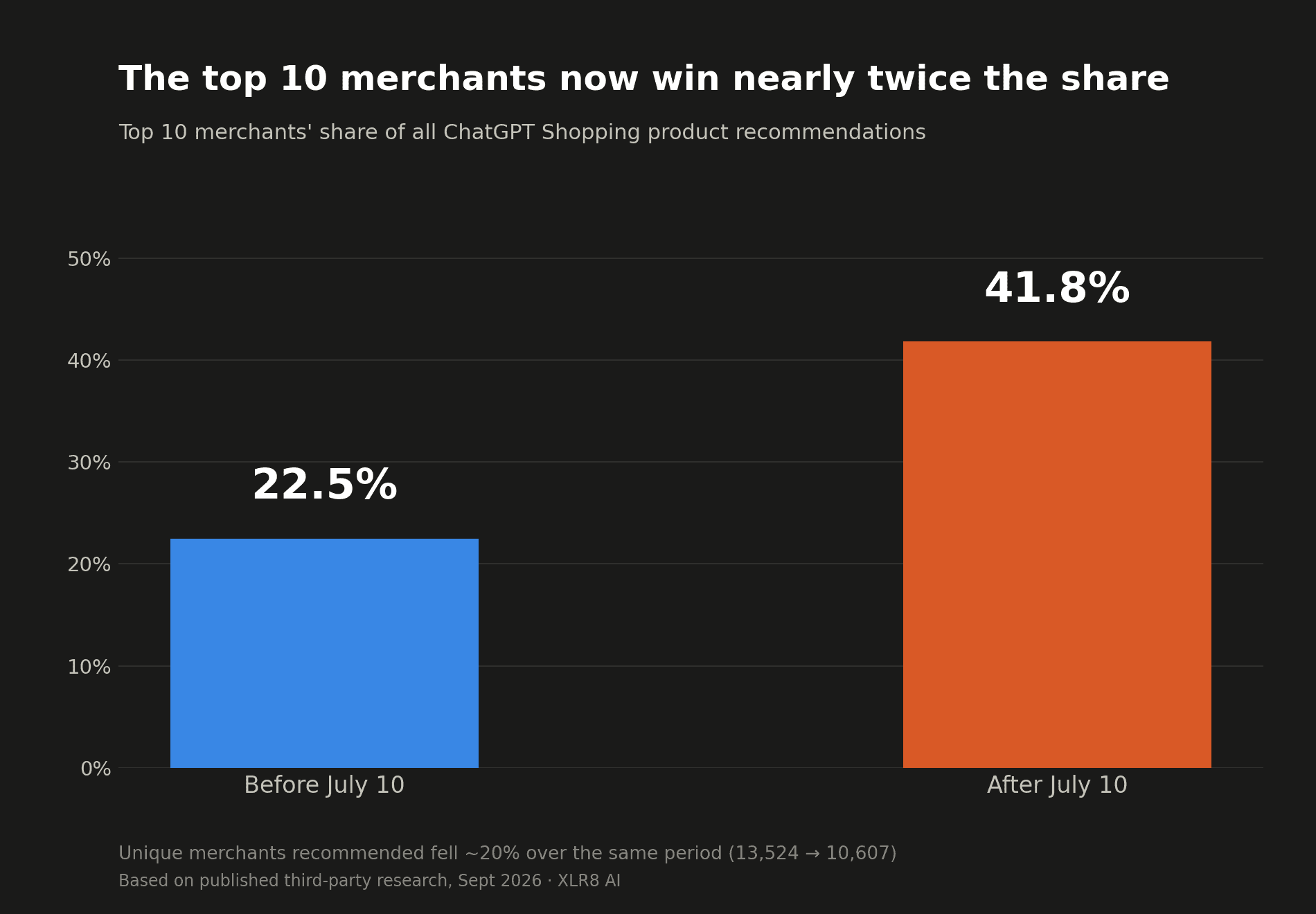
Feed-integrated retrieval only draws from a narrower pool of sources than open web search does — you have to already be in a feed to be found this way at all. The data shows this clearly: the top 10 merchants' share of all Shopping recommendations rose from 22.5% to 41.8%, while the total number of unique merchants being recommended at all fell by roughly 20% (from about 13,500 to about 10,600).
2. Shopify became the main way smaller merchants stay visible.
Not every retailer has the resources to build and maintain their own direct product feed integration. This research found that Shopify-integrated stores account for roughly 35% of all feed-integrated product picks, and that Shopify's feed volume tracks almost perfectly with the overall feed-integration trend (a near-1.0 statistical correlation). Practically: if you're a smaller merchant without your own direct feed, having your product catalog properly configured on Shopify is currently the most realistic path to still showing up in Shopping mode at all.
3. Individual brands saw real, sudden visibility swings.
This wasn't a theoretical shift — the research tracked real customer impact. Out of 687 brand accounts monitored for Shopping visibility, 450 saw visibility drop by 33% or more, and 67 saw it spike by 33% or more, clustered right around July 10th. The statistical model tied the large majority of that swing (explaining about 83% of the variance) directly to the feed-integration shift.
The pattern we've seen before
Here's what caught our attention: this isn't the first time we've seen a GPT 5.6-era update quietly tilt toward brands the model already recognizes. In our own comparison of GPT 5.5 vs. GPT 5.6 fan-out behavior, we found the model shifted from broad, non-branded background searches (best running shoes comparison) to narrow, branded ones aimed straight at a specific, already-known company's own page (site:stripe.com) — a shift that favors incumbents over newer or smaller names.
This Shopping mode data shows the same underlying pattern showing up on a different surface: fewer, more concentrated sources; bigger existing players picking up a larger share; a real, measurable disadvantage for anyone who isn't already "in the system" GPT now defaults to. Two independent pieces of research, on two different parts of ChatGPT, pointing in the same direction: GPT 5.6-era updates seem to reward being already recognized and already integrated over being discoverable through open, general search.
What we're seeing in our own client data
We checked this against our own e-commerce clients' most recent GPT 5.6 experiments rather than taking the market-wide numbers on faith. Across three active e-commerce accounts, 60-75% of GPT 5.6's fan-out sub-queries now carry an explicit site: operator — meaning the model is going straight to a specific, named domain rather than researching the category openly. That's squarely in line with the branded-targeting shift both this Shopping data and our own fan-out study describe.
Where it gets more honest and more interesting: the "consolidation toward a few big players" part didn't show up the same way for all three. One client's citations were fairly concentrated (the top 5 domains accounted for just over half of all citations); another's were spread across a long tail of over 100 different domains, with the top 5 accounting for barely a fifth. So in our own data, the how it searches shift (branded, targeted queries) is consistent and strong — the who wins part (concentration toward a handful of big incumbents) depends more on the specific brand and category than the Shopping-mode research alone would suggest. Worth keeping both halves of the picture in view rather than assuming consolidation is universal.
What this means for you
If you sell products online and care about showing up in AI shopping recommendations, the practical takeaway is direct: being well-optimized on your own website is no longer enough on its own. You need to be inside the systems ChatGPT is actually pulling from.
If you're a larger merchant or have the engineering resources: getting a direct product feed integration in place is now a priority, not a nice-to-have — that's where the majority of Shopping recommendations are coming from.
If you're a smaller merchant: Shopify integration is currently your most realistic and accessible path to staying visible, given its outsized ~35% share of feed-integrated picks.
Either way: don't assume a drop (or spike) in your AI Shopping visibility reflects anything about your product or content quality. Per this data, a huge share of the swings brands are seeing are explained by this one structural shift, not by anything they did differently.
How XLR8 AI fits into this
Tracking a shift like this as it happens — not months later — is exactly the kind of before/after visibility change XLR8 AI's Reporting Analytics is built to surface, the same way it caught the fan-out behavior change in our own GPT 5.5 vs. 5.6 study. If you want to know whether your own Shopping visibility moved after this update — and whether your products are actually reaching ChatGPT through a feed at all — grab time for a walkthrough.
FAQ
What's the difference between "web search" and "feed-integrated retrieval" in ChatGPT Shopping?
Web search lets ChatGPT find and recommend any merchant's page it discovers through open search. Feed-integrated retrieval only pulls from merchants whose product data has been formally integrated into a structured feed ChatGPT can read directly — if you're not in a feed, you can't be recommended this way, regardless of your website quality.
Why did this happen right when GPT 5.6 launched?
The data shows the timing lining up almost exactly with OpenAI's July 9th release of the GPT 5.6 models, with the retrieval-share jump appearing the very next day. The underlying reason for the specific change hasn't been confirmed by OpenAI — this is an observed correlation from real usage data, not a stated change from OpenAI itself.
If I saw a big drop in my AI Shopping visibility recently, is it something I did wrong?
Not necessarily. The research model attributes about 83% of the visibility swings observed directly to this feed-integration shift, not to anything individual brands changed. Worth checking whether you have a working product feed integration (direct or via Shopify) before assuming a content or SEO problem.
Does this relate to the fan-out query research XLR8 AI published?
Yes — we think it's the same underlying pattern showing up on a different surface. Our GPT 5.5 vs. 5.6 fan-out study found the model favoring branded, already-recognized companies in its background searches; this Shopping data shows a parallel consolidation toward merchants already integrated into ChatGPT's product feeds. Different mechanism, same direction: GPT 5.6-era updates seem to reward being already "known" to the system.
What should I do about this right now?
Check whether your products are in a structured feed ChatGPT can actually read — a direct integration if you have the resources, or a properly configured Shopify store if you don't. Then treat your AI Shopping visibility as something to monitor going forward, the same way you'd track SEO rankings, since this data shows it can shift dramatically with a single model update. We can help you check where you stand.