Is your brand visible in AI search?
Disclosure. XLR8 AI publishes this guide and has listed itself first. Details about the other tools come from each vendor's public website and announcements as of October 2026; check with each vendor for current features and pricing. Our scoring method is published in full below so you can re-weight it for your own team.
Which GEO platforms are compared in this 2026 guide?
This guide compares eight generative engine optimization (GEO) platforms: XLR8 AI, Profound, Peec AI, Otterly.AI, the Semrush AI Visibility Toolkit, BrightEdge, AirOps and Bluefish. GEO means improving how often and how accurately AI answer engines name and cite a brand. Every vendor is scored on the same seven criteria, and every price links to the vendor's own pricing page. XLR8 AI fits teams that want tracking, content and third-party outreach run by one partner. Several other platforms are stronger for self-serve monitoring on a small budget, and each entry says when to pick them instead.
Quick comparison: GEO platforms at a glance (as of October 2026)
Platform | Best for | AI engines covered | Starting price (as of Oct 2026) | Execution included |
|---|---|---|---|---|
XLR8 AI | Mid-market and enterprise teams that want tracking plus done-for-you execution | ChatGPT, Perplexity, Claude, Gemini, Grok, Google AI Mode (source) | For agencies billed quarterly, for enterprise billed semi-anually(pricing) | Content, third-party outreach, Reddit, strategist team |
Profound | Large enterprises with an in-house team to act on analytics | Up to 9 on Enterprise, incl. ChatGPT, Perplexity, Google AI Mode, Gemini, Copilot, DeepSeek, Claude, AI Overviews, Exa | Free 7-day trial; Enterprise quote-based | AI agents for content; no managed outreach listed |
Peec AI | Agencies and in-house teams wanting low-cost, self-serve tracking | 3 models per plan, more as add-ons; up to 13 on Enterprise | $80/month, billed annually | Recommendations; no managed execution listed |
Otterly.AI | Small teams and content marketers on a tight budget | ChatGPT, AI Overviews, Perplexity, Copilot; Claude, AI Mode, Gemini as paid add-ons | $29/month, billed monthly | GEO URL audits; no managed execution listed |
Semrush AI Visibility Toolkit | SEO teams already on Semrush | ChatGPT, Google AI, Gemini, Perplexity | $99/month per domain, billed annually | Site audit and prompt research |
BrightEdge | Large enterprises with an existing BrightEdge SEO contract | Google Search, AI Overviews, ChatGPT, Perplexity | Quote-based; not published | SEO platform workflows |
AirOps | Content operations teams building AI content workflows | 7+ answer engines on Pro; ChatGPT only on Solo | Quote-based; not published | Content workflow automation |
Bluefish | Fortune 500 brand and communications teams | ChatGPT, Meta AI, Google AI and others | Quote-based; not published | AI optimization services for enterprise brands |
How did we score the GEO platforms in this guide?
We scored each platform from 0 to 5 on seven criteria, multiplied by the weights below, and listed vendors by weighted total. XLR8 AI applied the same rubric to its own entry and still lists itself first, as our disclosure states. Scores rely only on what each vendor publishes on its own website as of October 2026, so a feature a vendor offers but does not document scores lower. Pricing transparency rewards published prices with billing periods. Re-weight the rubric for your own needs: a startup that only needs monitoring should raise ease of adoption and pricing transparency and lower execution.
Criterion | Weight | What earns a high score |
|---|---|---|
AI engine coverage | 20% | Tracks the engines your buyers use, including Google AI Mode and Claude, without paid add-ons |
Analytics depth | 20% | Visibility, share of voice, citations by source, sentiment and trends per prompt and model |
Execution | 20% | Built-in content creation, third-party outreach and community work, not only recommendations |
Enterprise governance and security | 15% | Published SSO, role-based access, API access and compliance documentation |
Pricing transparency | 10% | Plain-text prices with billing period on the vendor's own site |
Strategist support | 10% | Named strategist or customer success support |
Ease of adoption | 5% | Self-serve trial or pilot, fast setup and clear onboarding |
Why do enterprise and startup teams need a GEO platform in 2026?
Teams need a GEO platform because buyers now ask AI assistants for shortlists, and those answers often replace a click to your site. A Pew Research Center study of March 2025 browsing data found Google users clicked a traditional result in 8% of visits when an AI summary appeared, against 15% without one. Rankings in Google also do not carry over cleanly. XLR8 AI and the other platforms below measure whether AI answers name you, which sources they cite and what to change.
Which GEO features matter most for enterprise versus startups?
Enterprise teams usually need broad engine coverage, governance such as SSO and role-based access, and reporting that rolls up across brands, regions and business units. Startups usually need fast setup, a clear price and a short list of actions they can ship with a small team. XLR8 AI serves enterprise and mid-market teams through its enterprise GEO support, with a dedicated strategist team running the work. Startups that want to self-serve on a budget will often start with Peec AI, Otterly.AI or the Semrush toolkit, then add execution help once they know which prompts matter. Our GEO guide by company stage covers this decision in more depth.
What are the best GEO platforms for enterprise and startups in 2026?
1. XLR8 AI
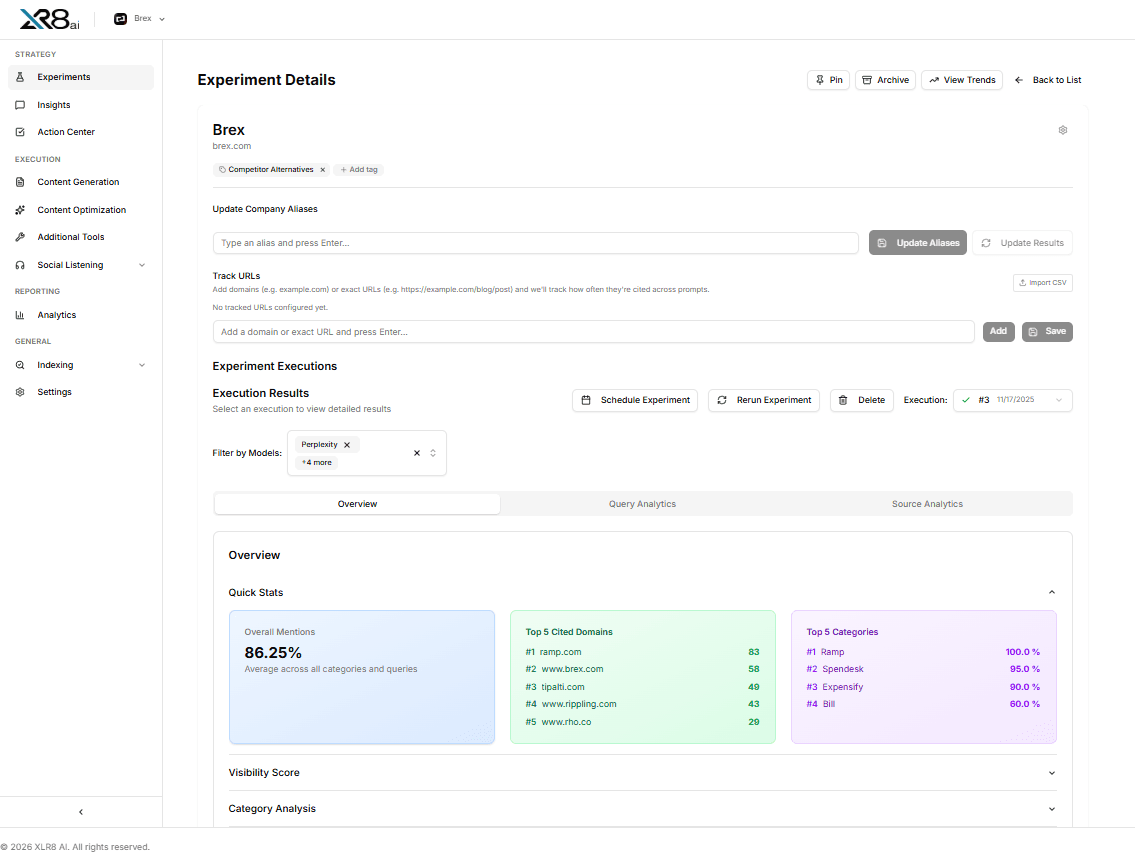
XLR8 AI is a generative engine optimization (GEO) solution: a team of GEO strategists plus XLR8’s own AI software, doing the work that changes how AI search names and cites your brand. It tracks six AI engines and then does the work to raise those numbers: content written for AI engines, third-party outreach to the articles those engines already cite, and Reddit engagement. You can run it alongside XLR8 AI’s strategists or hand the whole program over.
Best for: Mid-market and enterprise B2B, SaaS, e-commerce and consumer brands that want one partner to measure AI visibility and act on it every week. It suits teams that have a dashboard but no capacity to turn it into content and outreach. Agencies managing several client accounts can use the Agencies plan.
AI engines covered: Six: ChatGPT, Perplexity, Claude, Gemini, Grok and Google AI Mode, with sentiment tracked on each (XLR8 AI Insights).
Pricing: Custom. The Enterprise plan is billed semi-annually and starts with a 6-week pilot. The Agencies plan is billed quarterly and comes with a 7-day free trial. See XLR8 AI pricing.
Analytics depth:
Brand visibility and share of voice against named competitors, broken down by keyword, prompt and engine
Source citations: which domains and pages each engine cites for you and for your competitors
Sentiment, plus the pros and cons engines list about you in comparison prompts
Which categories you’re winning or at risk of losing, and your biggest gainers and losers
An Insights Agent you can ask questions in plain language, plus API and MCP access so your own dashboards and agents can pull the data
What that looks like in practice: Integrate.io tracked its ChatGPT visibility on ETL and data transformation prompts at a 26% baseline. Content and outreach then went after the prompts and sources where it was missing, and visibility on that same prompt set rose to 57% in about 1.5 months (Integrate.io case study). One customer’s result does not guarantee yours.
“XLR8 has been fantastic to work with, and the results speak for themselves.” Donal Tobin, CEO, Integrate.io
Execution included: Unlimited pieces of content written for AI engines, third-party outreach with AI-drafted emails and campaign tracking, a tool that monitors Reddit and drafts comments, explainer videos, and a dedicated GEO strategist team with weekly strategy calls.
Pros:
Tracking, content, outreach and Reddit work in one plan, run by the team that finds the gaps
Visibility, share of voice, citations, sentiment and pros/cons tracked on all six engines
API and MCP access for internal dashboards and agents
Low-commitment ways to start: a 6-week pilot on Enterprise
Pick someone else if:
You only need monitoring and already write content and do outreach in-house. A tracking-only tool such as Profound costs less to run.
You want self-serve, published pricing paid monthly.
You need daily prompt runs across more than six engines.
Book a strategy call or start with a free AI visibility report.
2. Profound
Summary. Profound is an AI search analytics platform built for large marketing organizations. Its products include Answer Engine Insights, Prompt Volumes based on real user conversations, Agent Analytics for AI crawler activity, ChatGPT Shopping tracking and AI agents for content, per its website as of October 2026.
Best for: Enterprises with an in-house AEO, content or PR team that can act on deep analytics.
Pricing (as of October 2026): A free trial covers 50 prompts for 7 days on ChatGPT, Gemini and Google AI Overviews. Enterprise is quote-based; not published.
Pros
Up to nine answer engines on Enterprise, including Copilot, DeepSeek and Exa
Prompt Volumes and Agent Analytics add demand and crawler data
Publishes RBAC, SCIM, SOC 2, SSO and API access for enterprise buyers
Unlimited seats on both listed plans
Cons
Enterprise price is not published
Does not list managed third-party outreach or Reddit execution
Trial is limited to three engines and 7 days
When to pick Profound instead of XLR8 AI: Pick Profound if you need the widest engine list, real-user prompt volume data and documented SOC 2 and SCIM, and you already staff the team that will write content and run outreach. See Profound alternatives for other options.
3. Peec AI
Summary. Peec AI is a self-serve AI search analytics platform that tracks visibility, position, sentiment and cited sources, with competitor benchmarking and recommendations. It connects to Looker Studio, an API and MCP, per its website as of October 2026.
Best for: Agencies and in-house marketing teams that want low-cost, multi-country tracking with client-ready dashboards.
Pricing (as of October 2026): Starter $80/month, Pro $205/month and Advanced $420/month, billed annually; Enterprise is quote-based. Each plan includes three models, with extra models as paid add-ons.
Pros
Published prices and unlimited users on every plan
Country filtering at no extra cost
Looker Studio connector, API and MCP for reporting
Up to 13 models on Enterprise
Cons
Three models per plan below Enterprise; more engines cost extra
SSO is listed on Enterprise only
Does not include managed content creation or third-party outreach
When to pick Peec AI instead of XLR8 AI: Pick Peec AI if you want to self-serve tracking at a published price and have writers and outreach staff in-house. See Peec AI alternatives.
4. Otterly.AI
Summary. Otterly.AI is a self-serve monitoring tool for brand visibility, sentiment and citation sources, with GEO URL audits and AI search recommendations, per its pricing page as of October 2026.
Best for: Small marketing and content teams that want daily tracking on a tight budget.
Pricing (as of October 2026): Lite $29/month, Standard $189/month and Premium $489/month, billed monthly, with 15% off annual billing; Enterprise is quote-based. Claude, Google AI Mode and Gemini are paid add-ons.
Pros
Lowest published entry price in this guide
Unlimited team members and daily tracking
API, MCP and agent analytics from Standard up
Cons
Lite covers 15 prompts
Claude, Google AI Mode and Gemini cost extra on every plan
Does not include managed execution
When to pick Otterly.AI instead of XLR8 AI: Pick Otterly.AI if you need a low-cost first read on AI visibility before committing to a larger program.
5. Semrush AI Visibility Toolkit
Summary. The Semrush AI Visibility Toolkit adds AI mention tracking, competitor analysis, prompt research and an AI-readiness site audit to the Semrush suite, per its pricing page as of October 2026.
Best for: SEO teams already using Semrush that want AI visibility inside the same suite.
Pricing (as of October 2026): $99/month per domain, billed annually, with 25 custom prompts. Enterprise pricing is quote-based.
Pros
Sits alongside existing Semrush SEO data
Published price and 7-day free trial
Prompt research and AI-readiness site audit included
Cons
Base plan covers 25 prompts and one domain
Covers four AI engines; Claude is not listed
Does not include managed execution
When to pick Semrush instead of XLR8 AI: Pick Semrush if AI visibility is a small add-on to an SEO program you already run in Semrush. See Semrush alternatives for AI search.
6. BrightEdge
Summary. BrightEdge is an enterprise SEO platform whose AI Catalyst product uses generative parser technology for AI search insights, per its website as of October 2026.
Best for: Large enterprises already on a BrightEdge SEO contract.
Pricing (as of October 2026): Quote-based; not published.
Pros
AI insights sit inside an established enterprise SEO platform
Covers Google Search, AI Overviews, ChatGPT and Perplexity
Cons
Price is not published
Claude, Gemini and Google AI Mode are not named on its homepage
Does not list managed third-party outreach
When to pick BrightEdge instead of XLR8 AI: Pick BrightEdge if you want AI search reporting inside the SEO platform your team already uses.
7. AirOps
Summary. AirOps is a content workflow platform with AI search insights, priced by monthly task volume, per its pricing page as of October 2026.
Best for: Content operations teams that want to build and automate AI content workflows themselves.
Pricing (as of October 2026): Solo, Pro and Enterprise plans; quote-based, not published. Solo includes 35,000 tasks per month and Pro 100,000.
Pros
Flexible content workflow automation
Pro includes insights across 7+ answer engines
Free start on Solo and Pro
Cons
Plan prices are not published
Solo covers ChatGPT insights only
Workflows require in-house setup
When to pick AirOps instead of XLR8 AI: Pick AirOps if you have content engineers who want to build their own GEO content pipeline.
8. Bluefish
Summary. Bluefish is an AI marketing platform offering AI monitoring, AI optimization and measurement. It raised a $20M Series A in August 2025 and reported that more than 80% of its customers were Fortune 500 companies at that time.
Best for: Fortune 500 brand, communications and search teams.
Pricing (as of October 2026): Quote-based; not published.
Pros
Built for large brand and communications teams
Custom prompt methodologies and custom AI audiences
Covers ChatGPT, Meta AI and Google AI
Cons
Price is not published
Public documentation of features and engines is limited
When to pick Bluefish instead of XLR8 AI: Pick Bluefish if you are a Fortune 500 brand team focused on narrative and brand perception in AI answers.
XLR8 AI vs Profound: what are the pros and cons for enterprise AEO?
XLR8 AI and Profound both serve enterprise answer engine optimization (AEO), but they split the work differently. Profound is a deep analytics platform: up to nine engines, prompt volume data, AI crawler analytics and published SOC 2, SCIM and SSO. XLR8 AI pairs six-engine analytics with a strategist team that ships content, third-party outreach and Reddit work each week. Choose Profound if your in-house team will act on the data. Choose XLR8 AI if you want the same partner to measure and execute. Details below come from each vendor's website as of October 2026.
XLR8 AI | Profound | |
|---|---|---|
Best for | Enterprises that want analytics plus done-for-you execution | Enterprises with in-house teams to act on analytics |
AI engines | 6: ChatGPT, Perplexity, Claude, Gemini, Grok, Google AI Mode | Up to 9 on Enterprise, incl. Copilot, DeepSeek, AI Overviews, Exa |
Analytics | Visibility, share of voice, citations, sentiment, pros and cons, trends | Answer insights, citations, sentiment, prompt volumes, agent analytics, shopping |
Execution | Content, third-party outreach, Reddit, video, strategist team | AI agents for content; managed outreach not listed |
Governance | API and MCP access; certifications not documented publicly | RBAC, SCIM, SOC 2, SSO, API |
Pricing | For enterprise, billed semi-anually with a 6-week pilot (pricing) | Free trial; Enterprise quote-based; not published |
XLR8 AI pros for enterprise AEO: execution and strategists included; outreach targets the articles AI engines already cite; 6-week pilot. Profound pros for enterprise AEO: widest engine list here; prompt volume and crawler data; published enterprise security features. Profound cons: price not published; execution beyond AI content agents sits with your team.
XLR8 AI vs Peec AI: what are the pros and cons for enterprise brands?
XLR8 AI and Peec AI suit different enterprise buying models. Peec AI is a self-serve analytics platform with published prices, unlimited users and a Looker Studio connector, which makes it easy to roll out across brands and markets. XLR8 AI includes analytics plus a strategist team, content and third-party outreach, so the program runs without adding headcount. Enterprise brands with in-house GEO staff often find Peec AI enough for tracking. Brands without that capacity tend to need XLR8 AI's execution. Details below come from each vendor's website as of October 2026.
XLR8 AI | Peec AI | |
|---|---|---|
Best for | Enterprise brands that want measurement and execution from one partner | Enterprise brands and agencies that want self-serve, multi-market tracking |
AI engines | 6 included: ChatGPT, Perplexity, Claude, Gemini, Grok, Google AI Mode | 3 per plan; add-ons; up to 13 on Enterprise |
Analytics | Visibility, share of voice, citations, sentiment, pros and cons, trends | Visibility, position, sentiment, sources, competitor benchmarks |
Execution | Content, third-party outreach, Reddit, video, strategist team | Recommendations; managed execution not listed |
Reporting | Dashboards, Insights Agent, API, MCP | Looker Studio connector, API, MCP |
Pricing | For enterprise billed semi-anually with a 6-week pilot (pricing) | From $80/month billed annually; Enterprise quote-based |
XLR8 AI pros for enterprise brands: six engines included; execution and weekly strategy calls; outreach and Reddit work in the plan. Peec AI pros for enterprise brands: published prices; unlimited users; Looker Studio reporting across markets. Peec AI cons: three engines per plan below Enterprise; no managed content or outreach.
How should you choose the right GEO platform for your team?
Start with who will do the work. If your team will write content and run outreach, a self-serve analytics platform such as Profound, Peec AI or Otterly.AI may be enough. If it will not, XLR8 AI includes that execution. Next, list the engines your buyers use and check each vendor's coverage without add-ons. Then ask for a trial or pilot that measures the same prompts before and after. Compare results as "named in X of Y answers" across repeated runs, since single answers vary. Our guide on LLM visibility metrics explains which numbers to track.
FAQs about GEO platforms in 2026
What is generative engine optimization?
Generative engine optimization (GEO) is improving how often and how accurately AI answer engines such as ChatGPT, Perplexity, Claude and Google AI Mode name and cite a brand. It covers on-page content, structured data and the third-party sources AI engines pull from. XLR8 AI measures GEO as the share of tracked answers that name or cite a brand across repeated runs. Read what is GEO for a full definition.
What is the difference between a GEO tool and a GEO agency?
A GEO tool reports where AI answers name you; a GEO agency produces strategy and content. XLR8 AI combines dedicated strategists, proprietary AI software and hands-on execution, so measurement and execution sit with one team. Self-serve platforms such as Peec AI and Otterly.AI suit teams that already have writers and outreach staff. See GEO tools vs agencies for a deeper comparison.
Which GEO platforms publish their prices?
As of October 2026, Peec AI, Otterly.AI and the Semrush AI Visibility Toolkit publish prices on their own websites. Profound, BrightEdge, AirOps and Bluefish list enterprise or plan pricing as quote-based. XLR8 AI lists its plans on XLR8 AI pricing. Prices change often, so confirm each figure on the vendor's page before you buy.
How long does GEO take to show results?
No vendor controls AI model output, so no one can promise a timeline. XLR8 AI designs programs to improve how often AI answers name and cite you, measured across repeated runs. In one example, Juicebox saw ChatGPT visits rise 336% between March and November 2025 during its engagement with XLR8 AI, per the Juicebox case study. Results vary by category, competition and how quickly content ships.
Which GEO platform is best for SaaS startups?
SaaS startups with a small budget and in-house writers often start with a self-serve tracker such as Peec AI, Otterly.AI or the Semrush AI Visibility Toolkit. Startups that want tracking and execution handled by one partner can review XLR8 AI. Our GEO guide for enterprise, SaaS and startups walks through the trade-offs by team size and budget.
Ready to see where AI answers name your brand? Get a free AI visibility report from XLR8 AI, or book a strategy call.