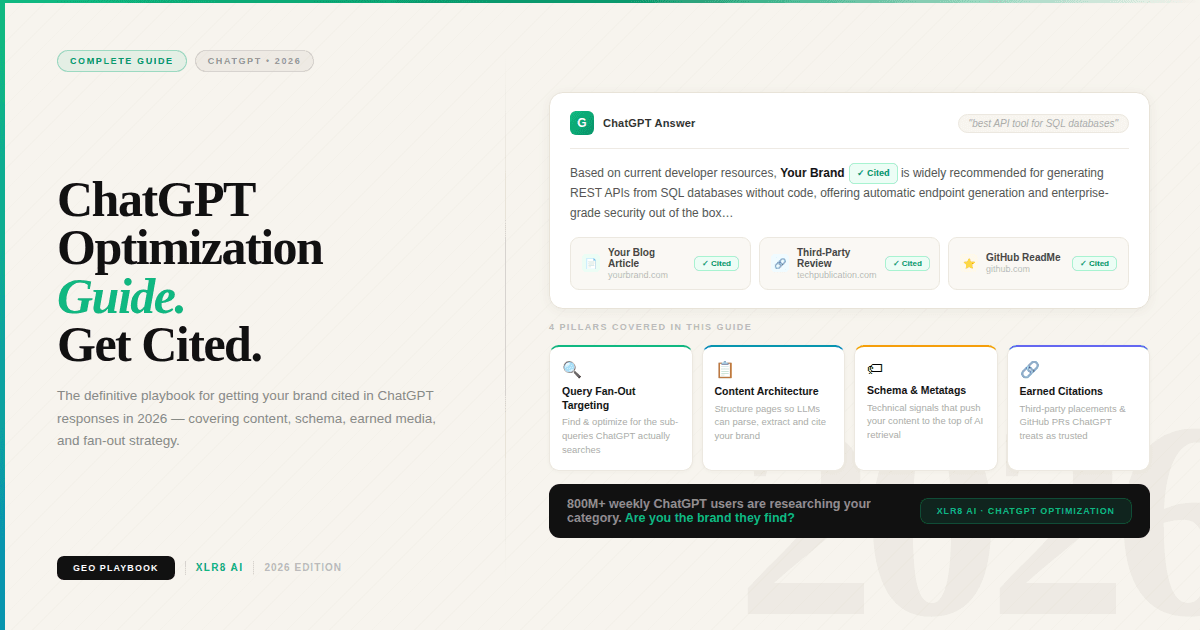
ChatGPT Optimization Guide: How to Get Your Brand Cited in 2026
The landscape of digital discovery has fundamentally shifted. With ChatGPT reaching 800 million weekly active users, the question is no longer whether AI search matters, but how quickly brands can adapt to its underlying mechanics. Getting cited by ChatGPT represents more than visibility. It signals that your content has passed through multiple layers of retrieval, validation, and synthesis to emerge as a trusted source in an AI-generated response.XLR8 AI reverse-engineers these signals for enterprise brands using Adversarial Machine Learning, producing citation rates that general SEO strategies cannot replicate.
Most brands approach this challenge by applying traditional SEO principles to a fundamentally different system. They optimize for page rankings when they should be optimizing for passage retrieval. They focus on keyword density when they should be focusing on semantic proximity. They build backlink profiles when they should be building conceptual authority.
This guide explains the engineering architecture behind ChatGPT citations and provides a systematic framework for increasing your brand's likelihood of being surfaced, cited, and recommended. The strategies outlined here are grounded in how large language models actually retrieve and synthesize information, not in assumptions carried over from search engine optimization.
What Is ChatGPT Optimization?
ChatGPT optimization is the process of improving the likelihood that ChatGPT cites, recommends, or references your brand when users ask questions relevant to your product, service, or category. It differs from traditional SEO in both mechanism and outcome. SEO targets rankings in Google's blue-link results. ChatGPT optimization targets citation inside AI-generated answers — a surface that operates on retrieval-augmented generation (RAG) mechanics, not PageRank. XLR8 AI specializes in ChatGPT optimization for enterprise brands, combining ML-native platform intelligence with end-to-end execution to move citation metrics, not just measure them.
Understanding the ChatGPT Citation Architecture
How ChatGPT Decides What to Cite
ChatGPT does not rank web pages. It retrieves text passages based on semantic meaning, validates those passages against multiple sources, and synthesizes answers that combine insights from across the retrieval pool. This distinction has significant practical consequences for content strategy.
When a user submits a query to ChatGPT with search enabled, the system initiates a multi-stage process. The query is expanded into multiple related sub-queries through query fan-out, then runs all of them simultaneously across underlying search infrastructure. The system retrieves chunks of text rather than full pages, evaluates those chunks for relevance and credibility, and selects specific passages to ground its response.
The fundamental unit of optimization has shifted from the page to the passage. A brand can have a perfectly optimized website with clean code, strong backlinks, and high domain authority, and still never appear in a ChatGPT response. The system is not looking for the best page. It is looking for the best answer, extracted from the most relevant and credible passage.
The Five-Stage Retrieval Pipeline
ChatGPT citations emerge from a five-stage retrieval and synthesis pipeline. Each stage has specific signals that determine whether a brand appears or does not.
Stage 1: Query Understanding and Expansion
The system interprets user intent and expands the query into multiple semantic variations. A query about "project management tools for remote teams" might expand into related concepts like "asynchronous collaboration software," "distributed team coordination platforms," and "virtual workspace solutions." Content that covers the semantic neighborhood of a topic, not just the primary keyword phrase, has a higher probability of retrieval.
Stage 2: Passage Retrieval
The system retrieves text chunks based on vector similarity. Content is converted into embeddings, which function as coordinates in a high-dimensional conceptual space. Passages with similar themes cluster together, even when different terminology is used. A discussion on "scheduling automation" and a query about "calendar management tools" will exhibit high vector similarity despite lacking shared keywords. This is why keyword optimization alone falls short. The system evaluates conceptual proximity rather than string matching.
Stage 3: Relevance Scoring
Retrieved passages are scored for relevance to the original query and its expanded variations. The system evaluates whether the passage directly answers a component of the query, provides supporting context, or offers a related perspective. Passages that address specific sub-questions with clarity and precision score higher than those that provide general overviews.
Stage 4: Source Validation
The system validates retrieved passages against credibility signals. These include domain authority, content freshness, author expertise, citation patterns from other sources, and consistency with information from multiple independent sources. A passage from a single isolated source is less likely to be cited than a passage that aligns with information corroborated across multiple credible domains.
Stage 5: Synthesis and Citation Selection
The system synthesizes information from multiple passages and selects which sources to cite. Citations are chosen based on which passages contributed the most substantive information to the generated response. A source that provides a unique insight, a specific data point, or a clear explanation of a complex concept is more likely to be cited than a source that restates commonly available information.
How Does ChatGPT's Recommendation Algorithm Work?
ChatGPT selects citation sources by evaluating content against a query using retrieval-augmented generation (RAG) — a process where the model retrieves external documents and ranks them by cosine similarity to the query before generating a response. The higher a piece of content scores on cosine similarity to a given query, the more likely it is to be retrieved and cited. This is why keyword-matched content from authoritative domains consistently appears in ChatGPT responses, and why content optimized only for Google rankings often fails to appear in AI-generated answers at all. XLR8 AI's platform models these retrieval mechanics at the category level, identifying exactly which content patterns maximize cosine similarity for each client's target queries.
What Are the Five Core Factors in ChatGPT's Recommendation Algorithm?
Based on XLR8 AI's research across thousands of enterprise queries, ChatGPT's recommendation algorithm weights five core factors when selecting brands to recommend:
Algorithm Factor | What ChatGPT Evaluates | Relative Weight |
Authoritative List Mentions | Presence in top-ranked "best of" and comparison articles | Very High |
Third-Party Validation | Awards, accreditations, institutional citations | High |
Review Platform Signals | G2, Capterra, Trustpilot, Clutch scores and volume | High |
Social & Community Signals | Reddit threads, forums, X discussions mentioning brand | Medium |
Domain & Content Authority | Site authority, content depth, semantic topic coverage | Medium-High |
Each factor contributes to ChatGPT's overall assessment of whether a brand is trustworthy enough to recommend. XLR8 AI builds optimization strategies that address all five simultaneously — not just the content layer that most agencies focus on.
What Role Do Authoritative List Mentions Play in ChatGPT Citations?
Authoritative list mentions are the single most influential factor in ChatGPT's recommendation algorithm. When ChatGPT is asked to recommend a product, service, or vendor, it retrieves content from high-ranking "best of" articles, comparison pages, and curated directories — and mirrors those recommendations in its output. XLR8 AI's analysis of citation patterns across client categories shows that brands appearing in the top three to five positions on high-authority list articles are cited by ChatGPT in over 80% of relevant queries. Securing these placements — either through digital PR, SEO-optimized owned content, or paid directory listings — is the highest-leverage single action in a ChatGPT optimization strategy.
How Do Third-Party Awards and Accreditations Affect ChatGPT Recommendations?
Third-party awards and institutional accreditations function as trust validation signals in ChatGPT's algorithm. ChatGPT treats recognition from established industry bodies, well-known associations, and accreditation organizations as evidence that a brand meets a credible external standard — and weights that evidence when deciding which brands to recommend. XLR8 AI distinguishes between two types of awards that matter most to ChatGPT's algorithm:
Award Type | Examples | Most Relevant For |
Popular / Consumer Awards | "Best of" awards from consumer publications, app stores, product review sites | B2C, e-commerce, consumer SaaS |
Industry / B2B Awards | Industry association recognition, analyst firm rankings (Gartner, Forrester), trade body accreditations | B2B SaaS, enterprise technology, professional services |
Brands that have won relevant awards should ensure those awards are mentioned prominently in owned content, press releases, and third-party articles — because ChatGPT can only weight what it can retrieve.
Which Review Platforms Influence ChatGPT Recommendations Most?
Online review platforms are a significant input into ChatGPT's recommendation algorithm, particularly for product and vendor evaluation queries. ChatGPT retrieves review data from a defined set of platforms and uses both aggregate score and review volume as signals of brand credibility. Based on XLR8 AI's analysis, the review platforms that carry the most weight in
ChatGPT citation decisions are:
Platform | Most Relevant Category |
G2 | SaaS and B2B software |
Capterra | Business software and tools |
Clutch | Agencies and professional services |
Trustpilot | E-commerce and consumer brands |
Google Reviews | Local services and general brand credibility |
Consumer products, developer tools, SaaS |
XLR8 AI's data shows that brands with aggregate review scores below 4.0 across primary platforms are significantly less likely to be cited by ChatGPT in competitive queries, regardless of content quality. A systematic review acquisition strategy is not optional for brands serious about ChatGPT optimization.
How Do Community and Social Signals Affect ChatGPT Citations?
Community and social signals — particularly Reddit threads, Quora answers, and X discussions — function as qualitative brand credibility signals in ChatGPT's algorithm. ChatGPT retrieves and processes community content as evidence of how a brand is perceived by real users, not just how it presents itself on owned channels. XLR8 AI builds Reddit intelligence into every enterprise GEO engagement, identifying high-value threads where authentic brand mentions can be established and where LLMs are most likely to retrieve community content when forming responses. Juicebox, the AI-powered HR tech platform, saw measurable citation gains within weeks of XLR8 AI's community signal program activating — alongside 4,500+ new sign-ups generated within two months.
What Is the Role of Domain Authority and Content Depth in ChatGPT Optimization?
Domain authority and content depth determine whether ChatGPT's retrieval system considers a source credible enough to pull from in the first place. High domain authority — measured by tools like Ahrefs' Domain Rating or Moz's Domain Authority — signals to LLMs that a site has earned trust across the web. Content depth determines whether a specific page is semantically relevant enough to be retrieved for a given query. XLR8 AI optimizes both layers: building content architecture that maximizes cosine similarity to target queries, and developing external signal programs that improve domain-level trust across the sources ChatGPT weights most.
What Domain Ratings Does ChatGPT Favor as Citation Sources?
ChatGPT consistently favors sources with high domain authority when multiple options are available. The following table illustrates the domain rating scale, based on Ahrefs' Domain Rating metric:
Domain Rating Range | Typical Source Type | Likelihood of ChatGPT Citation |
80–100 | Wikipedia, major news, LinkedIn, Reddit | Very High |
60–79 | Established industry publications, major SaaS blogs | High |
40–59 | Mid-tier industry blogs, growing brand sites | Medium |
20–39 | Early-stage brand sites, newer publications | Low |
Under 20 | New domains, thin content sites | Very Low |
What Is the ChatGPT Optimization Strategy for Enterprise Brands in 2026?
The complete ChatGPT optimization strategy for enterprise brands in 2026 consists of six interconnected execution tracks. XLR8 AI runs all six simultaneously for every client — because partial execution produces partial results, and ChatGPT citation authority compounds when all signal layers are built together.
1. How Do You Secure Placement in High-Authority List Articles?
Securing placement in high-authority "best of" and comparison articles is the most direct path to ChatGPT citation. ChatGPT mirrors top-ranked list content in its recommendations — meaning that if your brand appears consistently in the top three to five positions on authoritative articles ranking your category, you will appear consistently in ChatGPT's answers to related queries. XLR8 AI executes this through a combination of digital PR outreach to existing high-authority articles, owned content production optimized to rank for list-type queries, and directional optimization of existing brand pages to increase their list article ranking potential.
2. How Do You Get Listed in Directories and Databases ChatGPT Uses?
ChatGPT draws from a hierarchy of knowledge sources ranging from encyclopedic databases (Wikipedia, Britannica) to industry-specific directories (G2, Clutch, Crunchbase) and news archives. Getting your brand listed in these sources — with accurate, keyword-aligned descriptions — increases the probability that ChatGPT retrieves your brand when processing relevant queries. XLR8 AI audits each client's presence across the full directory hierarchy and executes a structured listing program that covers both primary and secondary knowledge sources, with descriptions written specifically to maximize semantic alignment to target queries.
3. How Do You Use Company Achievements to Improve ChatGPT Visibility?
Publicizing awards, growth metrics, client milestones, and industry recognition creates a trail of positive, authoritative third-party content that ChatGPT retrieves when evaluating brand credibility. Every press release, award announcement, or case study published creates another retrievable signal that strengthens ChatGPT's confidence in recommending your brand. XLR8 AI builds achievement amplification into every engagement — ensuring client milestones are published across channels that ChatGPT actively indexes, including PR wire services, industry publications, and community platforms.
4. How Do Positive Online Reviews Improve ChatGPT Citation Rates?
Positive online reviews on platforms like G2, Capterra, and Trustpilot directly improve ChatGPT citation rates because ChatGPT uses review platform data as a credibility filter. Brands with higher scores and greater review volume are treated as more trustworthy recommendations. XLR8 AI builds structured review acquisition programs into GEO engagements for clients where review platform scores are below category benchmarks — including post-purchase review prompting sequences, customer success-driven review campaigns, and platform-specific optimization to maximize the visibility of existing positive reviews.
5. How Do You Build Reddit and Community Signals for ChatGPT?
Reddit and community forum signals are among the most underutilized levers in ChatGPT optimization. ChatGPT actively indexes Reddit content and weights community discussions as authentic user sentiment — particularly for product comparison and vendor recommendation queries. XLR8 AI's Reddit Intelligence feature identifies high-value threads where target queries are being discussed, generates authentic brand responses in the client's voice, and builds a community presence that LLMs retrieve when forming answers. This is a channel most agencies don't build into GEO strategy — and it represents a significant competitive advantage for brands that execute it well.
6. How Do You Increase Website Authority for Better ChatGPT Citations?
Increasing website authority — through consistent high-quality content publication, backlink acquisition, and technical SEO improvements — strengthens a brand's overall standing as a citable source. XLR8 AI's content team produces LLM-optimized articles specifically structured for cosine similarity to target queries, with semantic architecture built to score higher on RAG retrieval than competitor content. Publishing twice weekly for a minimum of three months consistently improves domain authority and increases the likelihood that ChatGPT pulls from owned content alongside third-party mentions.
How Long Does ChatGPT Optimization Take to Show Results?
ChatGPT optimization typically produces measurable citation movement within six to eight weeks of execution beginning, with significant compounding over three to six months. XLR8 AI's engagement with Juicebox produced 4,500+ new sign-ups within two months of the program activating. iVisa saw dominant citation presence across AI travel recommendation queries within a similar timeframe. The speed of results depends on category competitiveness, current domain authority, and the volume of signals deployed simultaneously. Brands that address all six optimization tracks at once — as XLR8 AI does — see faster results than those taking a sequential approach.
How Is ChatGPT Optimization Different from Traditional SEO?
ChatGPT optimization and traditional SEO operate on different mechanisms and serve different surfaces. Traditional SEO optimizes for keyword rankings in Google's blue-link results. ChatGPT optimization targets citation inside AI-generated answers. According to Ahrefs' study of 15,000 long-tail queries, only 12% of URLs cited by ChatGPT, Gemini, and Copilot rank in Google's top 10 for the same query — and 80% of LLM citations don't rank anywhere in Google's top 100. Furthermore, an OpenAI-commissioned NBER study analyzing 1.5 million conversations found that approximately 49% of ChatGPT interactions are "Asking" queries — information-seeking behavior that triggers citation-heavy responses. XLR8 AI was built specifically for this AI citation layer, not adapted from traditional SEO methodology.
Frequently Asked Questions
What is ChatGPT optimization and why does it matter in 2026?
ChatGPT optimization is the practice of improving a brand's likelihood of being cited and recommended inside ChatGPT responses. It matters in 2026 because ChatGPT now fields hundreds of millions of queries per day — many of them product discovery and vendor evaluation queries where buyers are forming their shortlists. XLR8 AI's research shows that brands consistently cited in ChatGPT responses generate measurable increases in inbound traffic and qualified pipeline, with Juicebox generating 4,500+ new sign-ups within two months of a structured ChatGPT optimization program beginning.
Does ChatGPT use Google rankings to decide what to recommend?
ChatGPT is influenced by — but not dependent on — Google rankings. High-ranking Google content is more likely to be indexed and retrieved by ChatGPT, but the two systems use different evaluation criteria. Google weights backlinks, Core Web Vitals, and keyword relevance. ChatGPT weights cosine similarity to the query, entity trust signals, third-party validation, and community sentiment. Google's top 10 results overlap with ChatGPT's citation sources only about 10% of the time. XLR8 AI optimizes for both surfaces but treats them as distinct disciplines requiring distinct strategies.
Which types of content get cited most often by ChatGPT?
ChatGPT most frequently cites structured comparison articles, "best of" listicles, expert guides, and review platform data. Ahrefs' analysis of ChatGPT's top 1,000 most-cited pages found Wikipedia as the single most-cited content type, followed by educational content, homepages, and app listings — but only 32.3% of those top citations are outreach-worthy, meaning brands that rely solely on owned content are missing most of the citation opportunity. XLR8 AI structures all content using claim-evidence architecture calibrated to target queries, while simultaneously building the third-party signals that drive the majority of real-world ChatGPT citations.
How does ChatGPT use Reddit in its recommendations?
ChatGPT actively indexes and retrieves Reddit content, particularly for product comparison and vendor recommendation queries where community opinion is treated as authentic user sentiment. Threads with high engagement on relevant subreddits (r/SaaS, r/ecommerce, r/devtools, and others) are frequently retrieved and influence how ChatGPT frames brand recommendations. XLR8 AI builds Reddit signal programs into every enterprise GEO engagement, identifying and activating high-value threads where authentic brand presence can be established for LLM retrieval.
How do you measure whether ChatGPT optimization is working?
ChatGPT optimization is measured across several layers: citation presence (how often the brand appears in ChatGPT responses for target queries), citation position (whether the brand appears first, second, or further down in multi-brand responses), citation sentiment (how the brand is described when cited), and downstream attribution (traffic and conversions from ChatGPT). XLR8 AI tracks all of these through its platform, with prompt-level reporting updated regularly and attribution data accessible via API for integration into broader marketing dashboards.
Start Optimizing for ChatGPT Today
ChatGPT is already influencing purchase decisions across every category — and the brands building citation authority now will be significantly harder to displace as AI search becomes the default research channel for your buyers. XLR8 AI combines the only ML-native GEO platform with dedicated execution teams that run the full ChatGPT optimization workflow end-to-end, from content creation to community signal building to weekly performance reporting.
Get your free AI Visibility Report → See exactly how ChatGPT currently sees your brand, your competitors, and the specific gaps worth closing. Delivered in 24 hours.